Facebook
 Google
 GitHub
 Linkedin

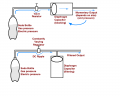
I would only note that the current is rightly explained as a " fictitious displacement current ID "flows" in the vacuum equal to the "real" current in the wires
Hi,
After i posted my last reply i *knew* someone was going to drag this into the discussion

That's ok, but i must warn that the physical viewpoint is a separate argument from the purely electrical circuit analysis view and that it will lead to confusion. We see this kind of contradiction once in a while though.
The two views are:
1. The displacement current view is based on an internal view of the capacitor and how ti behaves as near to physical reality as possible, with measurements made from inside the capacitor body.
2. The circuit analysis view, which is an external view based on how it behaves in a purely electronic way, with measurements made from outside of the body of the cap.
Because the two different views are based on different premises, they usually can not be used to exactly explain anything outside of the view on which they were based. In other words, we cant use displacement current to explain how an AC coupling capacitor works in the electronic view because in the electronic view we view current as actually passing through the capacitor with no field effects. And when we try to explain the displacement current using the external electronic view it makes it look like the displacement current is an actual electron flow of current.
For these reasons i suggest that we always keep each view within it's intended reach and not try to mix the two.
In circuit analysis, it is acceptable that electron current flows though the cap and that charge accumulates. In the purely internal physical analysis neither of those two are acceptable because charge accumulates on one plate and diminishes on the other plate and electron current does not pass through the cap.
It is very interesting that we see such a difference, but that's how some things are. That's the state of physical science even in the current year. It sometimes separates ideas in order to form workable conclusions even if all the facts are not yet considered, and sometimes still has trouble finding a unifying theorem that really does include all the known facts.
I'm sure we could talk more about this and probably will, but in the interest of circuit analysis alone we should stick to the circuit analysis view.
Here's one immediate problem we run into with the electronic view if we try to analyze with the internal physical view:
"An AC coupling capacitor blocks DC current and passes AC current".
and in the physical view we have:
"Electron current does not pass through the capacitor".
So one argues that some types of current can pass through, while the other says that neither can.
That's what happens when we try to mix paradigms