Why not stick multimeter across wall plug?

Thread Starter

Yaşar Arabacı

Joined Nov 11, 2014
49
Hi,

A book I am reading warns me that I shouldn't stick a multimeter across a wall-plug to measure it's current. I am wondering why not? For example, if I have a multimeter that can measure up until 1kV and I am trying to measure 220V AC wall-plug, I would imagine that multimeter can handle it. Am I missing something here?
 

Brevor

Joined Apr 9, 2011
297
Voltage and current are 2 different things, Your wall plug is 220 VOLTS you can measure that with your multimeter set to volts. Dont try to measure current from a wall plug you will destroy your meter.
 
Last edited:

Brownout

Joined Jan 10, 2012
2,390
Agree with Brevor in post #2. You should be able to measure volts with no problem. Use extreme caution! Make sure you're on AC Volts and set the range to higher than the voltage you expect to see. NEVER try to measure current across the outlet. The current function on your meter has ZERO resistance, and so you'll have 220V directly across a dead short. Your meter's death, and possibly yours, will be immediate and spectacular!
 

WBahn

Joined Mar 31, 2012
32,823
Hi,

A book I am reading warns me that I shouldn't stick a multimeter across a wall-plug to measure it's current. I am wondering why not? For example, if I have a multimeter that can measure up until 1kV and I am trying to measure 220V AC wall-plug, I would imagine that multimeter can handle it. Am I missing something here?
The fact that it can measure a lot of camels (a thousand volts) is irrelevant when you are trying to measure goats (current).
 

wayneh

Joined Sep 9, 2010
18,104
[responding to #1, not WBahn's goats]
Why not? Many meters do not have a fuse the ammeter's high-current input, and so the meter itself becomes the fuse, just like sticking a pair of tweezers into the outlet (something I have direct experience with!).

At best, there is a fuse in the meter that will protect you and your meter. Next up is the circuit breaker in your house for the outlet you are "testing"; it will likely trip at 15A if your meter hasn't already exploded. If the breaker fails to trip, it's a toss-up between the shunt inside your meter and your house wiring as to which will go poof first. I'd bet on the meter in your hand lighting up like a light bulb.

Point is, your attempt to measure the amperage capacity of your outlet will result in destruction of the weakest link. You won't have time to see any useful measurement on your display.
 

snav

Joined Aug 1, 2011
115
[responding to #1, not WBahn's goats]
Why not? Many meters do not have a fuse the ammeter's high-current input, and so the meter itself becomes the fuse, just like sticking a pair of tweezers into the outlet (something I have direct experience with!).

At best, there is a fuse in the meter that will protect you and your meter. Next up is the circuit breaker in your house for the outlet you are "testing"; it will likely trip at 15A if your meter hasn't already exploded. If the breaker fails to trip, it's a toss-up between the shunt inside your meter and your house wiring as to which will go poof first. I'd bet on the meter in your hand lighting up like a light bulb.

Point is, your attempt to measure the amperage capacity of your outlet will result in destruction of the weakest link. You won't have time to see any useful measurement on your display.
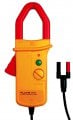
Mains supplied current should always be measured with non contact metering IMHO. When I first got my fluke 117 I discovered a DMM-11 was $32! More than the battery that I blew it on. You learn to check leads often when measuring DC current. I would use clamp accessory if it weren't that I spend most of my time in the MA range.
 

Lundwall_Paul

Joined Oct 18, 2011
236
When measuring current in series with a DMM you should be clear about the meters current range and have an idea what the load current should be. A red flag for reading current is series would be the gauge of the circuits wires. Like connecting a 10 amp DMM in series with a circuit 6 gauge wire. Clamp on meters are a very good choice.
 

ian field

Joined Oct 27, 2012
6,536
[responding to #1, not WBahn's goats]
Why not? Many meters do not have a fuse the ammeter's high-current input, and so the meter itself becomes the fuse, just like sticking a pair of tweezers into the outlet (something I have direct experience with!).

.
IME; the fuse in a multimeter serves only one putpose - as an indicator that tells you the meter is Napoleon blownaparte.
 
Top