ferrite rod / loop stick antenna

Thread Starter

arduinolego611

Joined Jan 23, 2022
75
I am attempting to pick up a radio signal from a ferrite rod/loop stick antenna, which is very different than a "loop antenna". The only thing I cant find online is a formula for number of turns specific to this type of antenna, because its so different from other types of antennae.

I have been searching for a formula for number of coil windings. I know length of rod (47 mm), radius of ferrite rod (4 mm). I can measure wire thickness with calipers, it's 26 awg, so the internet says 0.4572 mm

I know I want to pick up any frequency at all (after all its just an experiment), but I am focusing on AM frequencies of 540 - 1700 kHz just to give myself some direction.

I started with a 365 pico farad cap (or close to it) and I can figure out required inductance (although online I've found that around 280 micro henries might be good for this frequency range). After some calculations I found another set of values - both 400 micro henries and 400 micro farads. I can probably figure this part out myself...

What I cant figure out is how many windings of my 26 awg copper wire. Is there a formula that I just cant find online? Anybody have any insight?
 
Last edited:

sparky 1

Joined Nov 3, 2018
1,218
4MHz reception uses standard adjustable 280pF capacitor and ferrite rod inductor wound to 82 microhenries 82uH.
The 7.5" rod has been popular in some countries because several sections can be wound switch select different bands.
The Z or impedance is important. You showed you are working with common impedance values that work.

On a separate note regarding air coils.
Interesting that you gravitate toward being a coil winder. AWG #26 makes very good air coil.
Air coils have good Q, A calculator for air coils use 2nd calculator on the page below, the diameter of plastic pluming pipe.
or cardboard paper towel tube. Shellac is made from natural yellow flakes Wellermart 4oz and kingston BBQ lighter fluid.
Outlawed in California, removed from the paint departments, Dielectric properties are ok for this application.
https://www.translatorscafe.com/unit-converter/en-US/calculator/coil-inductance/
Crystal Radio Design Page (scitoys.com)

Peter Vis using AWG #26 is for long waves the AM modified crystal radio experimenters use a fine litz wire.
26 should work but below some radio guys like litz. Again we come to impedance of the resonant circuit.
https://www.petervis.com/Radios/making-a-crystal-radio/crystal-radio-coil-winding.html

Also SW receiver using ALD110800A quad mosfet in parallel and a grounding diode in figure 5 high sensitivity receiver.

for AM using Amidon R61-050-750, 61 material, 7.5 inches long and 0.5 inch diameter. Use 15/44 litz wire 70 Turns in the center
of the rod to cover about 3 inches. AL=580?

He thanks Wes Hayward for his input at the end,
culter.indd (arrl.org)
 
Last edited:

MisterBill2

Joined Jan 23, 2018
27,159
The electrical advantage of using a low-loss ferrite core in a coil is that the same inductance can be had with mny fewer turns, thus allowing lower losses and better selectivity.
 

LowQCab

Joined Nov 6, 2012
5,101
A Ferrite "Loop-Stick" Adjustable-Tuning-Inductor
doesn't really make all that great of an Antenna all by it's self, ( although it "might" work ).

For a more reasonable amount of sensitivity,
You will still want an out-door "Long-Wire" Antenna,
made as long as possible,
and placed as high in the Air as possible,
and a good Earth-Ground.

A good Antenna, as described, will pull-in AM/SW Transmissions from around the Globe.
.
.
.
 

MisterBill2

Joined Jan 23, 2018
27,159
Quite an interesting document, with all of the references to the original topic removed.
I had not considered that there could be a down-side of resonant loop antennas. But every cheap transistor pocket radio used a resonant ferrite loop antenna for a whole lot of years. So they must have been OK for AM broadcast reception.

And a "not great" antenna that is not as good as a "much better"antenna may still be adequate for useful results. Understand that "Perfect" is only one point at the very top of the graph, and some other points may be adequately close.
 
Last edited:

BobTPH

Joined Jun 5, 2013
11,463
What I cant figure out is how many windings of my 26 awg copper wire. Is there a formula that I just cant find online? Anybody have any insight?
This depends too much on the material properties and geometry. There is no simple formula. It is best determined experimentally.

Wind some number of turns and measure the inductance. Then it will scale proportional roughly to the square of the number of turns, though not exactly as the length of the coil changes as well.

Say you wound 100 turns and got an inductance of 400uH. Then you have:

100^2 / 400 = n^2 / 280

n^2 = 10000 * 280 / 400 = 7000

n = sqrt(7000) = 83.66 turns

You nay need one more iteration to get the exact answer. That is, wind 84 turns and apply the formula again.
 

Externet

Joined Nov 29, 2005
2,624
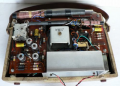
Several decades old AM radios rescued from the spiders have ferrite rod antenna and can be altered to your reception needs.

1726067047291.png
 

MrChips

Joined Oct 2, 2009
34,626
Radio signals are transmitted via electromagnetic radiation which consists of an electric field and a magnetic field.
The ferrite rod antenna picks up the magnetic field and works well at low frequencies. They are very useful for locating the direction of the transmitter, i.e. it is a direction finder antenna.
 

MisterBill2

Joined Jan 23, 2018
27,159
The formula that I have seen, and the tables and graphic schemes, work adequately for air core coils because the magnetic properties of air are consistent. Ferrite and powdered iron cores are less consistent and so the specific material properties will need to be known.
 

nsaspook

Joined Aug 27, 2009
16,249
Radio signals are transmitted via electromagnetic radiation which consists of an electric field and a magnetic field.
The ferrite rod antenna picks up the magnetic field and works well at low frequencies. They are very useful for locating the direction of the transmitter, i.e. it is a direction finder antenna.
+1
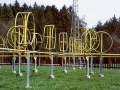
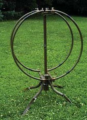
We used magnetic antenna loops across the HF band at various shore receiver sites.
1726111480752.png
https://maps.app.goo.gl/EJ7iqX4p7QAVNinRA

1726110853869.png1726110750687.png
https://ia902707.us.archive.org/24/items/hermeselectronic00unse/hermeselectronic00unse.pdf
1726110581838.png
 
Last edited:

atferrari

Joined Jan 6, 2004
5,001
For a more reasonable amount of sensitivity,
You will still want an out-door "Long-Wire" Antenna, made as long as possible,
and placed as high in the Air as possible,
and a good Earth-Ground.
Used a long wire antenna for several months in a vessel with my ham station affected by her changes of course.

Once installed at home I realized how directive it was (to West in my case).
 
Last edited:

Thread Starter

arduinolego611

Joined Jan 23, 2022
75
To anyone still reading this thread --

Do I need an additional inductor in my circuit or does the ferrite rod loop replace that component?

Can the circuit be reduced down to a loopstick antenna/ferrite rod antenna and a capacitor, then out through an amplifier? (and batteries)

Or do I need the whole radio receiver circuit including another inductor and a diode, etc
 

nsaspook

Joined Aug 27, 2009
16,249
To anyone still reading this thread --

Do I need an additional inductor in my circuit or does the ferrite rod loop replace that component?

Can the circuit be reduced down to a loopstick antenna/ferrite rod antenna and a capacitor, then out through an amplifier? (and batteries)

Or do I need the whole radio receiver circuit including another inductor and a diode, etc
What type of radio circuit do you plan on building?
 

Thread Starter

arduinolego611

Joined Jan 23, 2022
75
honestly my only hope with this radio receiver is to pick up any broadcast at any frequency

I have seen rudimentary schematics where the ferrite loop stick antenna is connected to a capacitor in parallel, and the load connected in parallel, then I bring mine to an amplifier circuit so I can hear it

But I dont know if these are over simplified of the sake of teaching the principle.
 
Last edited:

KeithWalker

Joined Jul 10, 2017
3,603
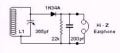
You will also need to detect the amplitude modulation on the incoming signal. Here is a basic circuit diagram. L1 is your ferrite coil. The diode, 1N34A detects the modulated signal. Use phones if you are in an area that has strong AM radio signals or you can connect the output to the input of an audio amplifier.


TRF.jpg
 

DickCappels

Joined Aug 21, 2008
10,661
In the schematic above, L1 would be the ferrite loop antenna.

As you can probably figure out, the 365 pf variable capacitor is used to tune the circuit to be resonant at the frequency of the desired signal.
 

BobTPH

Joined Jun 5, 2013
11,463
Along with the diode and resistor, it makes an envelope follower, which acts as an AM detector.

You could also add RF amp stage(s) between the tank circuit and detector.
 
Top