Why is voltage this way in this circuit and how to resolve it?

Thread Starter

hhsting

Joined Apr 25, 2024
395
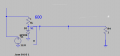
When look at voltage drop between zener D1 labeled V1 in this circuit I get 3.1824VDC.
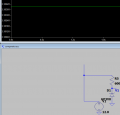
1717368630475.png


However when I attached the circuit with transistors and resistors and then measure the votlage V1 as follows then I get 1.343VDC instead of 3.182VDC. Why is that and how I can resolve to get 3.182VDC?
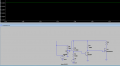

1717368729378.png
 

Thread Starter

hhsting

Joined Apr 25, 2024
395
Decrease value of resistor R5.
I dont get it why? Zener diode breakdown voltage is 3.12V. If zener diode is reversed biased and breakdown without attaching the circuit with transistor why would it change when attaching circuit with resistor? I shouldn't have to decrease resistor value
 

WBahn

Joined Mar 31, 2012
32,703
I dont get it why? Zener diode breakdown voltage is 3.12V. If zener diode is reversed biased and breakdown without attaching the circuit with transistor why would it change when attaching circuit with resistor? I shouldn't have to decrease resistor value
It's because you are insisting on using a zero-order model of a zener diode. Where are you getting the magical value of 3.12 V in the first place? Your model name implies that it is a 3.0 V zener. Be that as it may, like any diode of any kind, the voltage drop across it is a function of many parameters, including primarily the current flowing through it and the temperature. Change either of those, and you change voltage across it. When you add the additional components to your circuit, some of the current in the 600 Ω resistor that used to go through the zener goes elsewhere, so less current is flowing in the zener and the voltage across it changes.

Assume, for the moment, that your zener someone magically stayed at 3.12 V. How much current would be flowing through it (and in which direction -- you might be surprised).

Look at the data sheet and see how much current needs to flow through it in order for it to operate at a relatively constant voltage.
 

crutschow

Joined Mar 14, 2008
38,321
As noted by WBahn, A Zener's voltage is not an absolute fixed value, it varies some with the temperature and the current through it.
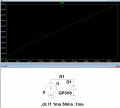
LTspice example sim below showing the voltage variation of a 3.9V Zener with current.:

1717372376318.png
 

Thread Starter

hhsting

Joined Apr 25, 2024
395
I cant understand how its getting 1.34v. I get it current is not flowing through zener diode. However I would like to see some analysis mathematical with kvl kcl or anything as to how exactly 1.34vdc came from? Anyone know?
 

MrChips

Joined Oct 2, 2009
34,628
You cannot use KVL or KCL to analyze the circuit because you don't know the transfer function at the MOSFET.
Q1 is turned off. The voltage on the gate of the MOSFET tries to rise. The MOSFET tries to conduct and pulls V1 down.
Hence you have a negative feedback that settles at V1 = 1.34V.
 

Thread Starter

hhsting

Joined Apr 25, 2024
395
You cannot use KVL or KCL to analyze the circuit because you don't know the transfer function at the MOSFET.
Q1 is turned off. The voltage on the gate of the MOSFET tries to rise. The MOSFET tries to conduct and pulls V1 down.
Hence you have a negative feedback that settles at V1 = 1.34V.
So then what can be done to correct the situation?
 

LowQCab

Joined Nov 6, 2012
5,101
You appear to want to Power a 1-Ohm-Load with 3-Volts.
If You put 3-Volts across a 1-Ohm-Load, then 3-Amps of Current will flow.
This means that your Power-Supply must be capable of delivering 3-Amps at 3-Volts, ( which is 9-Watts ).

Your Shunt-Regulator contains a 600-Ohm Resistor,
it is impossible to get 3-Amps to flow through a 600-Ohm Resistor when You are starting with ~12-Volts.
The maximum amount of Current that is available is 12V / 600 = 0.02-Amps, or 20mA.

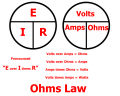
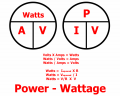
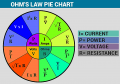
All of this is very easy to calculate using Ohms-Law ...........
.
Ohms Law FLAT .png.
Power-Watage Formulas FLAT  .png.
Ohms-Law-Pie-Chart .png.
.
.
 

WBahn

Joined Mar 31, 2012
32,703
So then what can be done to correct the situation?
What is the "correct" situation?

Unless I missed it (which is possible), you've given no indication of what the problem is that you are trying to solve. What it is that you are trying to accomplish. What the purpose is of this circuit.

R4 is my load. Then where i put my load?
And what is it that you are trying to do with (or to) this 1 Ω load?
 

Thread Starter

hhsting

Joined Apr 25, 2024
395
What is the "correct" situation?

Unless I missed it (which is possible), you've given no indication of what the problem is that you are trying to solve. What it is that you are trying to accomplish. What the purpose is of this circuit.


And what is it that you are trying to do with (or to) this 1 Ω load?
Two transistors together are switch which turn off light load R4 when the V2 voltage is 0.5vdc or above and turn on when v2 is below 0.5vdc.

I am trying to get zener diode series resistor so that i can get stable 3.1V supply since my voltage source v1 varies from 3v to 12v.

my load R4 is light that takes 200mA at 3VDc so R4 is little larger than 1 ohms.

my problem is when i attach zener didoe series resistance to the circuit with transistors and when V2 is at or below 0.5vdc i dont get 3.1V voltage at zener diode. How can I correct this situation to get 3.1V?
 

sarahMCML

Joined May 11, 2019
695
Two transistors together are switch which turn off light load R4 when the V2 voltage is 0.5vdc or above and turn on when v2 is below 0.5vdc.

I am trying to get zener diode series resistor so that i can get stable 3.1V supply since my voltage source v1 varies from 3v to 12v.

my load R4 is light that takes 200mA at 3VDc so R4 is little larger than 1 ohms.

my problem is when i attach zener didoe series resistance to the circuit with transistors and when V2 is at or below 0.5vdc i dont get 3.1V voltage at zener diode. How can I correct this situation to get 3.1V?
R4 is 3V/0.2A = 15 Ohms, not "little larger than 1 ohm". Why don't you just use a 3.3V regulator instead!
 
Top