Node Labeling for the highest voltage magnitude node in circuit

Thread Starter

alphRabon

Joined Dec 3, 2025
1
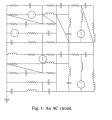
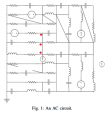
Below is the question given for the circuit. I am having trouble labeling the nodes so I can do a node analysis. Could someone explain how to label the nodes? A lot of them feel very ambiguous. Thank You

In the below circuit, the resistance of each resistor is 1 Ohm, the impedance of each capacitor is −j Ohm,
and the impedance of each inductor is j ohm, where j = √−1. The voltage phasor of the each source of
voltage is 10∠0◦ volts and electric current phasor of each source of current is 10∠0◦ amps. What is the
voltage magnitude of highest voltage magnitude node of the circuit?
 

Attachments

WBahn

Joined Mar 31, 2012
32,703
Below is the question given for the circuit. I am having trouble labeling the nodes so I can do a node analysis. Could someone explain how to label the nodes? A lot of them feel very ambiguous. Thank You

In the below circuit, the resistance of each resistor is 1 Ohm, the impedance of each capacitor is −j Ohm,
and the impedance of each inductor is j ohm, where j = √−1. The voltage phasor of the each source of
voltage is 10∠0◦ volts and electric current phasor of each source of current is 10∠0◦ amps. What is the
voltage magnitude of highest voltage magnitude node of the circuit?
Node labels are arbitrary. For a circuit like this, start in the upper left corner and start with 'A' and work your way across, incrementing the label as you get to each previously unlabeled node (note that the top left node is already labeled -- it's GND or COM or 0V or whatever you prefer to call your common reference node). The trick is to be sure that you are putting a new label only on nodes that have not been previously labeled. A good way to manage this is to highlight each node with a different color line drawn on top of all of the wires that make up that node.

Then analyze the circuit and find the voltages for each node. Whichever one has the highest magnitude voltage, that's your answer. If you want to relabel the nodes with more meaningful names once you are done with the analysis, you can.

The first step in you analysis should be to make as many simplifications as you can. Remove shorted components and combine simple series parallel elements.

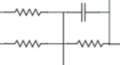
One thing to make sure of right away is whether crossing wires are connected or not. For instance:

1764801853585.png

Is the vertical wire that starts at the T between the top resistor and the capacitor connected to the junction of the two resistors below it, or does it simply cross over it? It depends on the drawing convention being followed. The most common convention presently is that wires that meet in a T (like the top) are connected, regardless of whether there is a connection dot, but wires that fully cross (like the bottom) are only connected if there is a connection dot there. That convention has evolved primarily due to the use of electronic schematic capture tools,

However, there are no connection dots in your entire schematic, so it's impossible to tell for sure which convention is being used. However, there are node junctions like the following:

1764802132277.png

This suggests (pretty much demands) that all five wires coming into the junction are connected together, otherwise there would be no way to know which of the two crossing wires the diagonal wire is connected to. So let's go with that.

Your circuit has 42 LRC components and five power supplies. That's an absurd number of components to expect someone to analyze (without a simulator) unless it simplifies enormously. So it's a pretty safe bet that it simplifies enormously. First, look for components that are outright shorted (connected to the same node on both sides). Those can be removed. Then look for simple combinations of LRC components that, as a group, are shorted out. This alone eliminates over 2/3 of the components from the diagram.

Next, redraw the circuit, replacing series and parallel RLC combinations with their equivalents. You will discover that your circuit reduces to something that is almost trivial to analyze. After this step, assuming I'm doing this in my head well enough, you will end up with four isolated subcircuits, two of which have a single passive component and one that has two passive components (plus a single supply in each). The fourth has two supplies and two passives, although that one also has two internal nodes that should be considered as well, given the nature of RLC circuits driven by sinusoidal sources.
 

MisterBill2

Joined Jan 23, 2018
27,181
In ADDITION to the CORRECT ANALYSIS by "W" in post #2, this looks a lot like some sort of homework problem that is a trick! This is not the homework help section.

MOD NOTE: Thread moved to Homework Help.
 
Last edited by a moderator:

MrAl

Joined Jun 17, 2014
13,667
Below is the question given for the circuit. I am having trouble labeling the nodes so I can do a node analysis. Could someone explain how to label the nodes? A lot of them feel very ambiguous. Thank You

In the below circuit, the resistance of each resistor is 1 Ohm, the impedance of each capacitor is −j Ohm,
and the impedance of each inductor is j ohm, where j = √−1. The voltage phasor of the each source of
voltage is 10∠0◦ volts and electric current phasor of each source of current is 10∠0◦ amps. What is the
voltage magnitude of highest voltage magnitude node of the circuit?
Hi,

That either has to be the worst schematic drawn that I've ever seen, or the question is meant to also get you to figure out what nodes can be joined and what nodes shouldn't be joined.

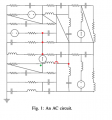
For a few examples, you can see the RED dots in the attachment where the nodes are most likely connected to all the crossing lines, and that one RED 'jumper' must be a jumper or else it would short out the capacitor above it.
The diagonal lines would be more of a challenge to figure out.
This also leave that possible node where the GREEN dot is next to, where it gets harder to figure out if it is connected or not. It may take a few entire circuit analysis calculations to figure that one out, but that seems too complicated for this kind of question.
The other question is are shorted components allowed in this circuit or not. Some entire sections are shorted out if we assume the most generous use of connection dots. If we assume that none are shorted, then we have to work out how to split the wiring so that they are not shorted.

These problems don't stop you from labeling the nodes A, B, C, or n1, n2, n3, or v1, v2, v3, etc., but they do make it impossible to be sure which crossing lines are connected and which are not. The nodes are wherever two components connect or two lines connect. If you think some sections are shorted out, then you don't have to calculate the internal nodes of those sections, they will have a node voltage very easy to calculate once you know the associated node voltages.

You either have to get some info on this or assume what you think is best and just draw the dots where you think they should go, then do the analysis.

This is a pretty complicated circuit but it's not impossible to analyze.
 

Attachments

WBahn

Joined Mar 31, 2012
32,703
Hi,

That either has to be the worst schematic drawn that I've ever seen, or the question is meant to also get you to figure out what nodes can be joined and what nodes shouldn't be joined.

For a few examples, you can see the RED dots in the attachment where the nodes are most likely connected to all the crossing lines, and that one RED 'jumper' must be a jumper or else it would short out the capacitor above it.
The diagonal lines would be more of a challenge to figure out.
This also leave that possible node where the GREEN dot is next to, where it gets harder to figure out if it is connected or not. It may take a few entire circuit analysis calculations to figure that one out, but that seems too complicated for this kind of question.
The other question is are shorted components allowed in this circuit or not. Some entire sections are shorted out if we assume the most generous use of connection dots. If we assume that none are shorted, then we have to work out how to split the wiring so that they are not shorted.

These problems don't stop you from labeling the nodes A, B, C, or n1, n2, n3, or v1, v2, v3, etc., but they do make it impossible to be sure which crossing lines are connected and which are not. The nodes are wherever two components connect or two lines connect. If you think some sections are shorted out, then you don't have to calculate the internal nodes of those sections, they will have a node voltage very easy to calculate once you know the associated node voltages.

You either have to get some info on this or assume what you think is best and just draw the dots where you think they should go, then do the analysis.

This is a pretty complicated circuit but it's not impossible to analyze.
This is actually a pretty typical circuit given at the beginning of a circuits class, though usually before capacitors and inductors have even been mentioned. The entire point is for the student to identify nodes that cause the removal of components because they are actually shorted out and then to see that the circuit is actually so trivial that if can be analyzed by inspection, or close to it. This is the same thing, but presented at the very beginning of the AC portion of the class, and almost certainly for the same purpose.

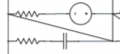
It's unreasonable to assume that some crossings are connections and others aren't. Either they all are, or they all are not. It hard to justify a claim that some crossings aren't connections because, if they were, they would short out components. There are several places where components are shorted out regardless. For instance:

1765163532493.png

There's no crossing at either end of the diagonal, so the remaining wires coming into each junction must be connected to a single junction, which means that the diagonal has to also be connected to that same junction. No other interpretation is reasonable. But that means that the RC in the bottom branch is shorted out. It also means that the voltage supply and resistor in the top branch is effectively isolated and can't interact with any other part of the circuit.


As I pointed out in my first response, some of the diagonals coming into a crossing point can only be interpreted if crossing lines are considered connected. so that is, by far, the most reasonable way to interpret the schematic baring additional external information.
 

MrAl

Joined Jun 17, 2014
13,667
This is actually a pretty typical circuit given at the beginning of a circuits class, though usually before capacitors and inductors have even been mentioned. The entire point is for the student to identify nodes that cause the removal of components because they are actually shorted out and then to see that the circuit is actually so trivial that if can be analyzed by inspection, or close to it. This is the same thing, but presented at the very beginning of the AC portion of the class, and almost certainly for the same purpose.

It's unreasonable to assume that some crossings are connections and others aren't. Either they all are, or they all are not. It hard to justify a claim that some crossings aren't connections because, if they were, they would short out components. There are several places where components are shorted out regardless. For instance:

View attachment 360160

There's no crossing at either end of the diagonal, so the remaining wires coming into each junction must be connected to a single junction, which means that the diagonal has to also be connected to that same junction. No other interpretation is reasonable. But that means that the RC in the bottom branch is shorted out. It also means that the voltage supply and resistor in the top branch is effectively isolated and can't interact with any other part of the circuit.


As I pointed out in my first response, some of the diagonals coming into a crossing point can only be interpreted if crossing lines are considered connected. so that is, by far, the most reasonable way to interpret the schematic baring additional external information.
Hi there,

Yes, and I have to agree with most of that.

However, I will point out that you included a bit of a contradiction. Although it's not that big of a deal and I am not going to go crazy with dwelling on this, but you did say:
"No other interpretation is reasonable"
but then you said:
"by far, the most reasonable way to interpret the schematic baring additional external information".

So we have to figure out which one you meant to be true:
Either no other interpretation is reasonable, or with additional information there might be another way.

I am only pointing this out because I happened to spot some things that, if this was a real schematic, would make me question some of the connections. That led to thinking about an exercise where the student has to adjust lines and dots to make the schematic look entirely reasonable. And that is partly because as it stands, it's not reasonable as a real circuit.

To put it another way, if I saw this circuit in real life I would probably think that the shorts were not there, and then I would have to go on to figure out the intended function so that I could figure out what connections are really there and which are just crossing lines. In the end it would take some work to get this right.

So basically it would just be a different kind of exercise. I thought about this because of the two sets of series resistors that would make MORE sense if they had a connection in the middle (see attachment with the red dots placed near possible junction nodes), and at the same time many that would make more sense if there was no short circuit of components. Granted this would make the circuit much harder to analyze.
Note the top red dot indicates a butt joining of two lines, while the lower two red dots indicated a possible connection because the series resistors probably have a connection between them. There are also two places where a mutation of the circuit was done so that those sections appear more normal. The idea was just to morph the circuit into something that might be real, or should I say "real-ish".

However, I still agree with most of your explanation and if this is a beginning class it makes a lot of sense. In the advanced classes we see more difficult circuit problems.
 

Attachments

Last edited:

WBahn

Joined Mar 31, 2012
32,703
Hi there,

Yes, and I have to agree with most of that.

However, I will point out that you included a bit of a contradiction. Although it's not that big of a deal and I am not going to go crazy with dwelling on this, but you did say:
"No other interpretation is reasonable"
but then you said:
"by far, the most reasonable way to interpret the schematic baring additional external information".

So we have to figure out which one you meant to be true:
Either no other interpretation is reasonable, or with additional information there might be another way.

I am only pointing this out because I happened to spot some things that, if this was a real schematic, would make me question some of the connections. That led to thinking about an exercise where the student has to adjust lines and dots to make the schematic look entirely reasonable. And that is partly because as it stands, it's not reasonable as a real circuit.

To put it another way, if I saw this circuit in real life I would probably think that the shorts were not there, and then I would have to go on to figure out the intended function so that I could figure out what connections are really there and which are just crossing lines. In the end it would take some work to get this right.

So basically it would just be a different kind of exercise. I thought about this because of the two sets of series resistors that would make MORE sense if they had a connection in the middle (see attachment with the red dots placed near possible junction nodes), and at the same time many that would make more sense if there was no short circuit of components. Granted this would make the circuit much harder to analyze.
Note the top red dot indicates a butt joining of two lines, while the lower two red dots indicated a possible connection because the series resistors probably have a connection between them. There are also two places where a mutation of the circuit was done so that those sections appear more normal. The idea was just to morph the circuit into something that might be real, or should I say "real-ish".

However, I still agree with most of your explanation and if this is a beginning class it makes a lot of sense. In the advanced classes we see more difficult circuit problems.
Your approach would have hundreds, if not thousands, of solutions, all of which are just as justifiable as any of the others. I don't consider that reasonable.
 

MrAl

Joined Jun 17, 2014
13,667
Your approach would have hundreds, if not thousands, of solutions, all of which are just as justifiable as any of the others. I don't consider that reasonable.
Hi,

I understand your reasoning here, and for the possible thousands of solutions, the student would only be required to find just one of those. They would have to consider the uselessness of a shorted-out section just like before, but they would also have to find a way to improve it.
It's not like this is a mandatory exercise here though, it's just a possibility. I thought it would be interesting but not everyone would, perhaps.

Extra credit if they find two ways :)

I had problems like this in my time. I remember one well because the book was wrong and we proved it. It was about the N number of ways you could follow the edges of a cube around by an M number of edges. N was what was being sought after, M was a given, but I don't remember that far back what M was, it may have been 4 or 5 or 6, maybe more. The book fell short though on N, which turned out to be really much higher.
 
Top