Why do I get two different transfer functions for the same gain?

WBahn

Joined Mar 31, 2012
32,871
In another thread this circuit was given:
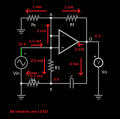
View attachment 296492

I remember thinking that in this circuit if an actual short is placed between nodes 3 and 4 the circuit behavior is not changed, but the unity gain buffer between nodes 7 and 6 can't be replaced by a true short.
I'm not seeing that you can short nodes 3 and 4 without significantly affecting the circuit behavior.

First off, if 3 and 4 are shorted, there is no feedback for that opamp and so it's output will be zero (in the ideal opamp case) or completely determined by the input offset voltage of the amp.
 

WBahn

Joined Mar 31, 2012
32,871
In real life opamps don't have infinite gain. It's a puzzle, don't you think, that the assumption of ideal opamps means that in a particular circuit we have an opamp with infinite gain such that the voltage between plus and minus inputs is truly zero, but the output of the opamp is some finite value? Apparently, sometimes zero volts times infinite gain (0 * ∞) is a finite value.
Not surprising at all. It's all an artifact of the limiting process and good ole L'Hospital's rule. What is sin(x)/x at x = 0? This is 0 / 0, but in this case the limit is 1.

The ideal opamp model is NOT that the gain is infinite, but rather the circuit behavior is determined by it behavior in the limit that the gain tends toward infinity.
 
Not surprising at all. It's all an artifact of the limiting process and good ole L'Hospital's rule. What is sin(x)/x at x = 0? This is 0 / 0, but in this case the limit is 1.

The ideal opamp model is NOT that the gain is infinite, but rather the circuit behavior is determined by it behavior in the limit that the gain tends toward infinity.
It's not a puzzle to me or you, but I'm suggesting that to the beginning student it's going to be a puzzzle; the better students may wonder about this, but the others just accept it. As you know full well, the explanation you're giving in this post is not given to the beginner. They are told about so-called "ideal opamps", which have infinite gain even as the voltage between the plus and minus inputs is zero. Even on this forum it is often advised to use the "ideal opamp" shortcuts.
 
I'm not seeing that you can short nodes 3 and 4 without significantly affecting the circuit behavior.

First off, if 3 and 4 are shorted, there is no feedback for that opamp and so it's output will be zero (in the ideal opamp case) or completely determined by the input offset voltage of the amp.
I'm referring to the network behavior as given by the solution to the network equations in the limiting case where opamp gain is infinite. If a resistor Rx is connected between nodes 3 and 4, the variable Rx does not appear in the solution for Vo when the opamps are considered to be ideal. The network equations as usually set up for this problem will include a constraint: V3=V4, which will exclude Rx from the solution. L'Hospital's rule in action as the gain → ∞.

The value of Rx can be anything, including zero. Of course, I'm not suggesting that in the real world this would have no effect.

Things like infinite gain, zero and infinite resistance, etc., often lead to seemingly paradoxical results.

However, there's no way for the unity gain buffer to be replaced with a short.
 

MrAl

Joined Jun 17, 2014
13,707
I'm not seeing that you can short nodes 3 and 4 without significantly affecting the circuit behavior.

First off, if 3 and 4 are shorted, there is no feedback for that opamp and so it's output will be zero (in the ideal opamp case) or completely determined by the input offset voltage of the amp.
Hi,

I am sure you are very familiar with the concept of a "virtual ground" when the non inverting input is at ground. Maybe it would be better to call it a "virtual equality" when the two inputs are equal.

With this in mind, I am sure he meant what I like to call as another type of "aniselectric short", meaning it has different properties depending on how you measure it or use it. It can be an actual short for some things or uses, but an open circuit for other things or uses.

This comes up from time to time I am surprised it has not been given a formal name in the past history of electronics or electrical theory.
 

WBahn

Joined Mar 31, 2012
32,871
It's not a puzzle to me or you, but I'm suggesting that to the beginning student it's going to be a puzzzle; the better students may wonder about this, but the others just accept it. As you know full well, the explanation you're giving in this post is not given to the beginner. They are told about so-called "ideal opamps", which have infinite gain even as the voltage between the plus and minus inputs is zero. Even on this forum it is often advised to use the "ideal opamp" shortcuts.
While I obviously can't speak to every textbook out there, I have just looked at every introductory circuits textbook I have on my shelf. This includes texts by Dorf, Hambly, Nilsson & Riedel, Cogdell, Del Toro, Higgins, Rizzoni, Cunningham & Stuller, and Thomas & Rosa. Several of these are very widely used texts. Every single one of them -- including one by an author whom I believe writes horrible textbooks -- introduces opamps as a voltage-controlled voltage source with a very high gain. Several problems are then worked using this model. Only then is the behavior when the gain is allowed to go to infinity discussed. Most, not all, of the texts also use this as the point where they introduce the notion of common-mode and differential-mode signals and the constraint that the opamp input signals can't go outside the supply rails. All of the texts do start off with the ideal assumption that no current flows into or out of the input pins and only a couple of them mention, at this point, that this is an approximation. Similarly, most of the texts assume from the start that the output impedance of the opamp is zero with only a few mentioning that this is also just an approximation. All of them, however, cover these points in pretty short order, along with several other non-ideal characteristics. One of them (don't recall which one and I don't feel like going and looking again) even addressed the need to confirm that the feedback is, in fact, negative and how to do that even before getting to the approximation of infinite gain. I was kind of surprised by that.
 

MrAl

Joined Jun 17, 2014
13,707
Not surprising at all. It's all an artifact of the limiting process and good ole L'Hospital's rule. What is sin(x)/x at x = 0? This is 0 / 0, but in this case the limit is 1.

The ideal opamp model is NOT that the gain is infinite, but rather the circuit behavior is determined by it behavior in the limit that the gain tends toward infinity.
Hi,

Are you making the distinction between a gain that is infinite and a gain that is tending toward infinity?
I like to say that it tends to infinity, like maybe the gain tends to infinity while the input voltage difference tends to zero, but if i have to say that every time it gets a little tedious so i will sometimes also take the shortcut as many others do and just say the gain is infinite.
 

MrAl

Joined Jun 17, 2014
13,707
While I obviously can't speak to every textbook out there, I have just looked at every introductory circuits textbook I have on my shelf. This includes texts by Dorf, Hambly, Nilsson & Riedel, Cogdell, Del Toro, Higgins, Rizzoni, Cunningham & Stuller, and Thomas & Rosa. Several of these are very widely used texts. Every single one of them -- including one by an author whom I believe writes horrible textbooks -- introduces opamps as a voltage-controlled voltage source with a very high gain. Several problems are then worked using this model. Only then is the behavior when the gain is allowed to go to infinity discussed. Most, not all, of the texts also use this as the point where they introduce the notion of common-mode and differential-mode signals and the constraint that the opamp input signals can't go outside the supply rails. All of the texts do start off with the ideal assumption that no current flows into or out of the input pins and only a couple of them mention, at this point, that this is an approximation. Similarly, most of the texts assume from the start that the output impedance of the opamp is zero with only a few mentioning that this is also just an approximation. All of them, however, cover these points in pretty short order, along with several other non-ideal characteristics. One of them (don't recall which one and I don't feel like going and looking again) even addressed the need to confirm that the feedback is, in fact, negative and how to do that even before getting to the approximation of infinite gain. I was kind of surprised by that.
Hi,

I like to describe it as a voltage controlled voltage source also as that seems to lead to the simple analysis, but also sometimes a voltage controlled current source with a fixed output shunt resistor usually of low value. The VCCS seems to be more well behaved in some situations.
 

WBahn

Joined Mar 31, 2012
32,871
Hi,

I am sure you are very familiar with the concept of a "virtual ground" when the non inverting input is at ground. Maybe it would be better to call it a "virtual equality" when the two inputs are equal.

With this in mind, I am sure he meant what I like to call as another type of "aniselectric short", meaning it has different properties depending on how you measure it or use it. It can be an actual short for some things or uses, but an open circuit for other things or uses.

This comes up from time to time I am surprised it has not been given a formal name in the past history of electronics or electrical theory.
As I stated, calling it a virtual ground when one of the terminals is actually forced to be at ground potential is not unreasonable. The problem, again as I stated, is that people see this terminology used in the first few opamp circuits they are introduced to and then incorrectly generalize that to the notion that the inputs of an opamp are ALWAYS forced to be a the ground potential -- and then proceed to make errors because they apply this incorrect understanding. The better terminology to use is that there is a "virtual short" between the inputs when the opamp is stable and operating within its active region, stressing that what this means is that the circuit as a whole acts to drive voltage differential between the inputs to a value very close to, and ideally at, zero.
 

MrAl

Joined Jun 17, 2014
13,707
In real life opamps don't have infinite gain. It's a puzzle, don't you think, that the assumption of ideal opamps means that in a particular circuit we have an opamp with infinite gain such that the voltage between plus and minus inputs is truly zero, but the output of the opamp is some finite value? Apparently, sometimes zero volts times infinite gain (0 * ∞) is a finite value.
Hi,

Yes it does seem as little weird when you think about it like that, and maybe that is why there is confusion sometimes.
I guess i hardly pay attention to it anymore as in the analysis it just always works out to zero on the input if the gain goes toward infinity and it is still in the linear mode.
 

WBahn

Joined Mar 31, 2012
32,871
Hi,

Are you making the distinction between a gain that is infinite and a gain that is tending toward infinity?
I like to say that it tends to infinity, like maybe the gain tends to infinity while the input voltage difference tends to zero, but if i have to say that every time it gets a little tedious so i will sometimes also take the shortcut as many others do and just say the gain is infinite.
These distinctions are important when talking about situations in which the distinctions are important, such as resolving the seeming paradox of a circuit with zero input and infinite gain can produce a finite output.

In most practical situations, it is perfectly reasonable to talk about the ideal opamp having infinite gain and a properly designed circuit operating with a 0 V differential across the opamp inputs, but it's reasonable because the groundwork for what that means and where it comes from should be properly laid out early on. Every text I have does that, to greater or lesser degrees of mathematical rigor.
 

MrAl

Joined Jun 17, 2014
13,707
As I stated, calling it a virtual ground when one of the terminals is actually forced to be at ground potential is not unreasonable. The problem, again as I stated, is that people see this terminology used in the first few opamp circuits they are introduced to and then incorrectly generalize that to the notion that the inputs of an opamp are ALWAYS forced to be a the ground potential -- and then proceed to make errors because they apply this incorrect understanding. The better terminology to use is that there is a "virtual short" between the inputs when the opamp is stable and operating within its active region, stressing that what this means is that the circuit as a whole acts to drive voltage differential between the inputs to a value very close to, and ideally at, zero.
Hi,

Yes that is a good way to put it too. I just brought up the virtual ground idea as an introduction to the virtual equality, or virtual short as you said.
I am sure Electrician knows about this as well.

Oh, I almost forgot, after I read your post about the authors and the unusual mention of negative feedback check, when I don't forget I like to also mention that the circuit has to be checked for stability if it has positive feedback also. The circuit we had been talking about probably falls into that category also.
 

WBahn

Joined Mar 31, 2012
32,871
I'm referring to the network behavior as given by the solution to the network equations in the limiting case where opamp gain is infinite. If a resistor Rx is connected between nodes 3 and 4, the variable Rx does not appear in the solution for Vo when the opamps are considered to be ideal. The network equations as usually set up for this problem will include a constraint: V3=V4, which will exclude Rx from the solution. L'Hospital's rule in action as the gain → ∞.

The value of Rx can be anything, including zero. Of course, I'm not suggesting that in the real world this would have no effect.

Things like infinite gain, zero and infinite resistance, etc., often lead to seemingly paradoxical results.

However, there's no way for the unity gain buffer to be replaced with a short.
The constraint that V3 = V4 does NOT exclude Rx from the solution if Rx = 0. Because then, as you have already noted, you end up with a current in Rx that is 0 V / 0 Ω, which can be anything.

For example, consider the following perfectly valid solution to the system when there is a short between nodes 3 and 4.

1686878542408.png

In this case we are not relying on the opamp having infinite gain at all -- we are allowing the output to be 0 V when the differential input voltage is 0 V.

Or you can say that Vo will be the positive supply rail on the basis that the tiny voltage drop across the short will drive it there.

Or you can simply say that the output is indeterminate since ANY value of Vo will result in a valid static solution to the network equations.
 

WBahn

Joined Mar 31, 2012
32,871
Hi,

I like to describe it as a voltage controlled voltage source also as that seems to lead to the simple analysis, but also sometimes a voltage controlled current source with a fixed output shunt resistor usually of low value. The VCCS seems to be more well behaved in some situations.
That's doing nothing other than converting the voltage source to it's Norton equivalent. But, as implied by the presence of a shunt resistor, you are modelling the circuit has having non-ideal output characteristics since an ideal voltage source has no Norton equivalent (and vice versa). So, whether you realize it or not, you are starting with a VCVS with a non-zero output resistance and then converting it to a VCCS with that same output resistance.
 

RoofSheep

Joined Mar 7, 2023
36
In post #1 you said " I was thinking that maybe not considering the current that goes into the output of the op-amp when applying Kirchhoff's current law at the O node is an error "

In post #4, WBahn said " KCL applied to the output node HAS to account for the current sourced or sunk by the opamp. "

That's all there is to it; there's no mystery.

The standard opamp symbol conceals this. Remember that an opamp is just a dependent source; it's a VCVS (voltage controlled voltage source). If you redraw the circuit with the opamp replaced with a VCVS having the appropriate control law, it will be obvious that the current supplied or absorbed by it must be accounted for.

The circuit is not inherently infeasible; what does that even mean? An opamp with its non-inverting input connected to its output (this is a unity gain buffer) is not the same as a short circuit. A buffer is unilateral, whereas a true short circuit is bilateral. A true short circuit works in both directions, but a buffer only works in one direction.
You are correct.

However, an opamp with its non-inverting input connected to its output is not a unity gain buffer.
 
Last edited:

MrAl

Joined Jun 17, 2014
13,707
That's doing nothing other than converting the voltage source to it's Norton equivalent. But, as implied by the presence of a shunt resistor, you are modelling the circuit has having non-ideal output characteristics since an ideal voltage source has no Norton equivalent (and vice versa). So, whether you realize it or not, you are starting with a VCVS with a non-zero output resistance and then converting it to a VCCS with that same output resistance.
Hi,

Yes, the idea is to make it slightly non-ideal to help with convergence sometimes, and also by adding a shunt capacitance we can get a little non-ideal frequency response too. We might find this model as part of the LT Spice package but I've used it long before that program ever came about.
To stay within the bounds of pure, simple op amp theory though I usually like to stick to the VCVS. Also along that line of thinking, I don't always place a limit on the output voltage either until it is time to consider the practical aspects of a circuit that has to be implemented in real life.
 

MrAl

Joined Jun 17, 2014
13,707
The constraint that V3 = V4 does NOT exclude Rx from the solution if Rx = 0. Because then, as you have already noted, you end up with a current in Rx that is 0 V / 0 Ω, which can be anything.

For example, consider the following perfectly valid solution to the system when there is a short between nodes 3 and 4.

View attachment 296508

In this case we are not relying on the opamp having infinite gain at all -- we are allowing the output to be 0 V when the differential input voltage is 0 V.

Or you can say that Vo will be the positive supply rail on the basis that the tiny voltage drop across the short will drive it there.

Or you can simply say that the output is indeterminate since ANY value of Vo will result in a valid static solution to the network equations.
Hi there,

I am not sure what you are trying to say here. That is not a REAL short it is an aniselectric short or virtual short. I use the word "aniselectric" because its properties depend on how you measure it. It is a short for voltage, but an open circuit for current, so when you measure the voltage difference you get zero, but when you measure it for current you also get zero. A 'regular' short would normally have zero voltage across it, but nonzero current through it, most typically. That also means that it is a real short for voltage, but an open circuit for current.

Maybe you are thinking that the Electrician did not know that? I can't see how anyone involved in this stuff for years cannot have realized that (or something like it) by now. I guess anything is possible, or maybe he really did mean an actual real life short and you wanted to point that out.

Or maybe you just want to stress the fact that it cannot be an actual short, the kind we use in real life when we use a wire jumper or something? I guess that's not a bad idea when discussing this anyway.
 

WBahn

Joined Mar 31, 2012
32,871
Hi there,

I am not sure what you are trying to say here. That is not a REAL short it is an aniselectric short or virtual short.

Or maybe you just want to stress the fact that it cannot be an actual short, the kind we use in real life when we use a wire jumper or something? I guess that's not a bad idea when discussing this anyway.
No, we are talking about a REAL short, because the following claim was made (Post #17): "I remember thinking that in this circuit if an actual short is placed between nodes 3 and 4 the circuit behavior is not changed, but the unity gain buffer between nodes 7 and 6 can't be replaced by a true short." So, yes, I'm stressing that it cannot be an actual short because the claim was made that it could be and the context of that is made clear in the material that was quoted in my responses.
 

WBahn

Joined Mar 31, 2012
32,871
You are correct.

However, an opamp with its non-inverting input connected to its output is not a unity gain buffer.
He made an editorial mistake, the kind all of us have make on occasion, and explained that when it was pointed out earlier.
 
Top