Facebook
 Google
 GitHub
 Linkedin
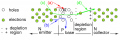
Hi. So my question is about npn bipolar transistors. As we know, the moment you apply high enough voltage to the base emitter junction swarms of electrons flow into the base where they recombine, they fill all the holes in there and those who are still free can't go back to the emitter because of the negative electric field from the acceptor ions and so they get sucked in the collector by its strong positive e field. No base voltage = no turning on.
And here comes the essential part of my question: if the collector is in possession of such a positive electric field, why can't it by itself free the electrons from the base-emitter junction? I remember reading this somewhere that the collector's electric field is not strong enough to reach that area and that's the reason why.
And here comes the essential part of my question: if the collector is in possession of such a positive electric field, why can't it by itself free the electrons from the base-emitter junction? I remember reading this somewhere that the collector's electric field is not strong enough to reach that area and that's the reason why.
Last edited: