Why are transformers so big, can't they get smaller?

Thread Starter

tsmspace

Joined Mar 16, 2026
35
So, I have been playing with toy kit electronics. I have a few radios put together by now, and over the years have done things with arduino and such, although all of the kits I will talk about now are from the last few weeks of hobby time.

So I have one of those lm317 power supply kits that are common on amazon, aliexpress, etc. It is famous for having a 200mw peak output, with some of the more expensive kits even discussing this in the documentation, while other kits don't have documentation at all. Well, I have two kits, one assembled and the other not yet assembled, and one had no page, just the pcb has component locations, the other has a pretty good printout.

Indeed, this power supply is as useless as the documentation says, it probably would run some kit radios, but any of the kit radios that require enough power to run a microcontroller I personally expect it will not run them. I had a brownout situation with it. So I thought, well, I want to try to use this power supply kit to do other kits, so maybe I will shop for some transformers, which are available if you look, various types including a perfect match of 1A on jameco for a perfectly liveable price,,, but it's too big to fit into the plastic enclosure. Basically, transformers are ENORMOUS , which has made me decide this is the legitimate inspiration for the transformers cartoon to feature huge robot characters, because transformers are just so much bigger than other components.

IS there really no solution for this? Lots of smaller transformers are used in power supplies, but they don't step down voltage, they just filter, so in this case I do think it seems as though a 12v power transformer might actually not get any smaller. I tried looking around a tiny bit on google searches but I couldn't find anywhere to learn in depth about this, does anyone have any thoughts?

Thanks!
 

dl324

Joined Mar 30, 2015
18,216
a perfect match of 1A on jameco for a perfectly liveable price,,, but it's too big to fit into the plastic enclosure. Basically, transformers are ENORMOUS
60Hz transformers aren't small. What do you consider enormous? What size is the enclosure, and how much of the space is available for the transformer?
 

Thread Starter

tsmspace

Joined Mar 16, 2026
35
60Hz transformers aren't small. What do you consider enormous? What size is the enclosure, and how much of the space is available for the transformer?
well, I measure the enclosure area occupied by the transformer with a ruler to be about 3cm wide, 6.5cm long and 4cm tall. This fits a "chassis mount" transformer as in this linked product on amazon

Amazon.com: WWZMDiB LM317 Adjustable Voltage Regulator Kit AC-DC 110V to 1.25V-12V DIY Electronic Components Kits for Adults : Electronics
 

Ian0

Joined Aug 7, 2020
13,097
So, I have been playing with toy kit electronics. I have a few radios put together by now, and over the years have done things with arduino and such, although all of the kits I will talk about now are from the last few weeks of hobby time.

So I have one of those lm317 power supply kits that are common on amazon, aliexpress, etc. It is famous for having a 200mw peak output, with some of the more expensive kits even discussing this in the documentation, while other kits don't have documentation at all. Well, I have two kits, one assembled and the other not yet assembled, and one had no page, just the pcb has component locations, the other has a pretty good printout.

Indeed, this power supply is as useless as the documentation says, it probably would run some kit radios, but any of the kit radios that require enough power to run a microcontroller I personally expect it will not run them. I had a brownout situation with it. So I thought, well, I want to try to use this power supply kit to do other kits, so maybe I will shop for some transformers, which are available if you look, various types including a perfect match of 1A on jameco for a perfectly liveable price,,, but it's too big to fit into the plastic enclosure. Basically, transformers are ENORMOUS , which has made me decide this is the legitimate inspiration for the transformers cartoon to feature huge robot characters, because transformers are just so much bigger than other components.

IS there really no solution for this?

Thanks!
Just rectify your mains supply, then switch it at a much higher frequency. Then you can use a smaller transformer. (Or persuade your power company to transmit it at a higher frequency)

Lots of smaller transformers are used in power supplies, but they don't step down voltage, they just filter, so in this case I do think it seems as though a 12v power transformer might actually not get any smaller.
Are you sure? Seems unlikely.
 

ronsimpson

Joined Oct 7, 2019
4,645
Transformer? What are you looking for. Here is an example of what I need to know.
240Vac input 12V 1A output. Or for a car 12Vdc to 5V 7 watts.

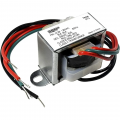
This transformer inputs 120vac 60hz and outputs 6+6 vac. There is no DC. Just to be clear I show two different types of transformers. In post #5 is a power supply that includes a transformer.
1775308334354.png
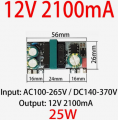
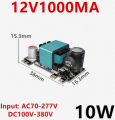
If you go back to post #5 there is a transformer that looks like this on that power supply. (blue/green) The power supply converts the 240Vac 60 hz to DC, then "switches" it or makes it AC again but at 120,000hz. Because the frequency is much faster a smaller transformer can be used. The output of the transformer is 12Vac which gets converted to dc.
1775308495079.png
 

MaxHeadRoom

Joined Jul 18, 2013
30,557
Switching supplies, (wall-warts). are generally smaller and lighter.
I prefer to use to use the mains Toroidal vertions, they are much easier to add (or subtract) the voltage value due to the overwind method.
 

crutschow

Joined Mar 14, 2008
38,316
Basically, transformers are ENORMOUS
Transformer size for a given power output is mainly inversely proportional to the lowest signal frequency, so 50-60Hz mains transformers are much larger that transformers for modern switching power supplies, which typically operate at 100kHz or higher.
 

WBahn

Joined Mar 31, 2012
32,702
And then me, badly informed reader, I ask why not 400 Hz for mains as well?
For a host of reasons, some of which are still relevant today, but many of which reflect the limits of technology at the time.

Transmission line losses at 400 Hz go up considerably due to things like skin effect and reactive losses. Also, generating lots of power at 400 Hz would require extremely large generators turning at very high speeds for a practical number of poles. These are being made with 19th century materials and manufacturing limitations. Early transformers also hated higher frequencies because of poor materials and lamination thicknesses.

In aircraft and ships, transmission distances are short and weight savings is a dominant consideration. In land-based power distribution, long-distance efficiency and economics are a driving concern.
 

AnalogKid

Joined Aug 1, 2013
12,043
Note that there is nothing in the post #3 circuit design that limits the output current to 200 mA. The rectifiers are rated 1 A and the regulator IC has an internal current limit of something greater than 1.5 A, plus over-temperature protection.

One possible reason for the stated limit is heat. If you have the output set to 3 V and are drawing 200 mA, the LM317 must dissipate 2.6 W. It can do that with no problem, but in a sealed box with a relatively small heatsink it will get hot; hot enough to burn fingertips (lawyers!) or push the 317 into thermal shutdown.

Based on nothing but a visual estimate, you probably can pull 0.5 A out of that supply with the cover off. Counterintuitive fact: The higher the output voltage, the more current you can draw before regulator overheating.

ak
 

Jon Chandler

Joined Jun 12, 2008
1,560
Counterintuitive fact: The higher the output voltage, the more current you can draw before regulator overheating.
Linesr Voltage Regulator Power Dissipation – applies to all linear regulators.

Pd = (Vin – Vout) × i

Pd = power dissipated in watts
Vin = input voltage to regulator
Vout = output voltage
i = current in amps
 
Top