Facebook
 Google
 GitHub
 Linkedin
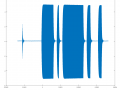
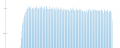
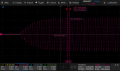
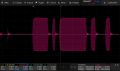
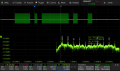
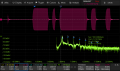
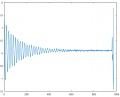
I've captured two signals from a cochlear implant (Cochlear Spectra 22 in this case), operating at a carrier frequency of 2.5 MHz. The first is from the pins to the transcutaneous inductive coil: it's the actual electrical signal sent to the coil. The second is from the coil to a loop of wire connected to the scope probe, so it's kinda what the coil inside my head would see. They're largely similar.
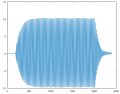
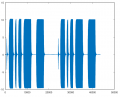
It's supposed to be 6 blocks: sync, active electrode, mode, amplitude, phase 1, and phase 2. You can see the blocks of the packets easily enough. The file format is ofig, which you should be able to open in Matlab, or Octave, so you can zoom in and out.
According to the documentation I can find, the RF data is modulated using ASK. Further, Cochlear Co uses five cycles of RF to represent a 1, where five cycles of no RF indicate a 0. I'm not seeing any difference in heights of the waves, so I'm not sure where the "amplitude" shift keying comes in. I'm also not seeing any blocks of non-RF.
Looking at these waves, what am I missing?
Thanks.
It's supposed to be 6 blocks: sync, active electrode, mode, amplitude, phase 1, and phase 2. You can see the blocks of the packets easily enough. The file format is ofig, which you should be able to open in Matlab, or Octave, so you can zoom in and out.
According to the documentation I can find, the RF data is modulated using ASK. Further, Cochlear Co uses five cycles of RF to represent a 1, where five cycles of no RF indicate a 0. I'm not seeing any difference in heights of the waves, so I'm not sure where the "amplitude" shift keying comes in. I'm also not seeing any blocks of non-RF.
Looking at these waves, what am I missing?
Thanks.
Attachments
-
5.2 MB Views: 10