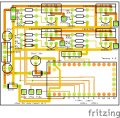
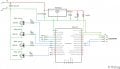
Why are my Teensy 4.0 processors dying?

bertus

Joined Apr 5, 2008
22,911
Hello,

What type of voltage regulator do you use?
I do not see the decoupling capacitors for it.
Without the decoupling capacitors, the regulator may oscillate.

Bertus
 

Thread Starter

PickyBiker

Joined Aug 18, 2015
144
Expand on your meaning of “killing”, “dying”.
Is a component being damaged? Which one? In what manner?

The "killing" means the Teensy stops working. There are no signs of anything overheating or burnt, it just stops working. Normally, when you plug a Teensy into a USB, the computer recognizes it and beeps. In this case, when the teensy is plugged in, it is not recognized and does not beep. This is true even when I pull the Teensy out of the PCB. It is just dead. I have built many things with Teensy's before and never saw anything like this.
 

panic mode

Joined Oct 10, 2011
4,952
have not worked with Teensy but use all kind of other boards... and... there are potentials for problem in different places:

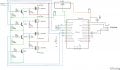
1. voltage regulator. no bypass caps, may oscillate and damage Teensy. need capacitors both on input and output side of the regulator and - CLOSE to regulator... if you have board made, you can add some surface mount caps right at the regulator.
2. no overvoltage protection, positive series regulator can source rated amount of current but cannot sink. if there is anything else injecting current into 5V rail, its voltage level will increase and regulator cannot do anything about that. adding TVS or 5.6V zener across 5V output could help.
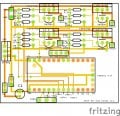
3. you are not connecting GNDs together, this means that any GND current will pass through Teensy instead of around it. this can fry it. pins 1 and 32 should be connected on the PCB, by you. this way C1 can do its job. see point 1. EDIT... just looked at your PCB and there is a GND trace between 1 and 32... but this should be shorter. i tend to use large ground plane for this.
4. pins connected to J4 and J5 are not protected. any abuse here can kill the Teensy.
5. no reverse polarity protection for supply voltage. mistakes here can have grave consequences.
6. no power management... a single Schottky diode may have fixed the issue...."Teensy can operate from power applied to it's Vcc (or +5V) pin and Ground. But to use USB with external power, the power provided by the USB cable should be separated from the external power."

1728662797951.png
 
Last edited:

bertus

Joined Apr 5, 2008
22,911
Hello,

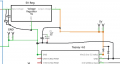
How are you using the buck module?
When you use the fixed voltages, the line at the adj place must be cut.

Bertus
 

Thread Starter

PickyBiker

Joined Aug 18, 2015
144
1. voltage regulator. no bypass caps, may oscillate and damage Teensy. need capacitors both on input and output side of the regulator and - CLOSE to regulator.
2. no overvoltage protection, positive series regulator can source rated amount of current but cannot sink. if there is anything else injecting current into 5V rail, its voltage level will increase and regulator cannot do anything about that. adding TVS or 5.6V zener across 5V output could help.
3. you are not connecting GNDs together, this means that any GND current will pass through Teensy instead of around it. this can fry it. pins 1 and 32 should be connected on the PCB, by you. this way C1 can do its job. see point 1.
4. pins connected to J4 and J5 are not protected. any abuse here can kill the Teensy.
5. no reverse polarity protection for supply voltage. mistakes here can have grave consequences.
6. no power management... a single Schottky diode may have fixed the issue...."Teensy can operate from power applied to it's Vcc (or +5V) pin and Ground. But to use USB with external power, the power provided by the USB cable should be separated from the external power."

#1 Yes, this could be a problem with the lm7805's
#2 Nothing provides voltage on the 5v line other than the regulator.
#3 Yes, this could very likely be the problem and I will fix that.
#4 These connections are permanent and probably aren't the problem
#5 agree, this is bad practice, but not affecting this current issue
#6 I will add a 1N5819 diode between the 5V reg and the Teensy's 5V input pin.
 

Thread Starter

PickyBiker

Joined Aug 18, 2015
144
This should take care of most of the concerns. Let me know if there is something else I need to do.
also, that is an LM7805 not LM7809 as shown.

Despite these efforts, a 4th Teensy is now dead.
I have more information about the failures.
1. When it is dead, the 3.3v output is 0v, but The ICM20948 which is powered by the 3.3v output draws only 2.5mw.
2. The mosfets were connected to LEDs and the system worked as expected. It was only when I connected the system to the actual directional bulbs that the teensy died. So high current (about 4 amps) on the directionals is what does the damage.

FYI: The external power was separated from the USB power by cutting the appropriate etch on the Teensy.
The high current etches were supplemented with 18-gauge wire soldered to the underside of the board.
The ground to The Teensy pins 1 and 32 had 18-gauge wire as well.
All the above was done before the test with LEDs and the actual connection to the motorcycle.

I'm really stuck here because I cannot see a high current or high voltage path to the teensy that might be killing it.

I am considering changing the wiring on all the lights so they are connected to the battery on one side and my directional control will use FPQ20N06 mosfets to light them up by pulling the other end to ground. This will simplify the circuit and eliminate the 2N3904's and some resistors.
 
Last edited:

Alec_t

Joined Sep 17, 2013
15,112
Is a star ground arrangement being used for the Teensy and the high current devices? If not, there could be 'ground bounce' causing issues.
 

hrs

Joined Jun 13, 2014
525
These LM7xxx regulators require a minimum load to guarantee regulation, 5mA or something like that.

I have in the past seen an LM7908 with insufficient load that wouldn't regulate. It just passed the -15V or whatever it was.
Maybe during booting the Teensy doesn't instantly load the LM7805 enough, possibly getting all of the nasty vehicle supply for a brief period.
 

Thread Starter

PickyBiker

Joined Aug 18, 2015
144
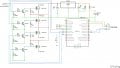
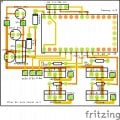
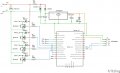
I decided to simplify the circuit by eliminating the 3904's and the resistors. The linear regulator will be replaced with a TPSM84205EAB buck converter. The etches for the IRFZ44N n-channel mosfets will be supplemented with 18-gauge wire to handle the 4amps for the lights. The motorcycle lights will be adjusted to need grounding to light them up. I have done another motorcycle this way and it worked fine. Guess I never will understand wat went wrong with the original design. Here is the new design and comments are welcome.
 

Attachments

Sensacell

Joined Jun 19, 2012
3,780
the 1N5819 diode should go BEFORE the regulator, it does nothing but reduce your Vdd, as placed.
It also looks like you have some schematic editing errors all over the diagram, all those odd dots in odd places, and wires that go beyond where they should end.

It's usually not a good idea to have MOSFET drains going straight to an off-board connector like that, at least place a Schottky clamping diode from drain to the power input.
The internal body diode clamps NEGATIVE voltages to ground, but the drain can easily see destructive over voltages going POSITIVE, the diode clamps these voltages. (ESD etc.)
 

bertus

Joined Apr 5, 2008
22,911
Hello,

The IRFZ44 mosfet can not be driven by the teensy as given in the schematic.
The irf needs a higher gate voltage.
The IRLZ44 might be a better solution.

Bertus
 

cmartinez

Joined Jan 17, 2007
8,749
Placing an inverse diode between the 12V supply and GND in parallel with a 16V zener prior to the voltage regulator would probably be a good idea to both eliminate negative transients and snub overvoltage peaks before they reach the system
 
Top