Teensy 4.0 and Audio Board Rev D Overheating 7805 Voltage Regulator

Thread Starter

TonyAm

Joined Oct 12, 2022
83
Hello,

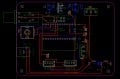
I have a project where I am using the Teensy 4.0 with the Rev D Audio Board together on a custom PCB that I made. Previously, I had used the Rev D2 Audio board successfully with my custom PCB. However, now using the Audio Board RevD my 7805 power regulator overheats when using either a 9V battery or a 9V power adapter.

Originally when using the Rev D2 Audio board I had AGND connected to GND as seen in the schematic (no overheating).
I did remove the connection between AGND and GND and still have the same problem with the Rev D audio Board.

(When using usb power from laptop there is no overheating).

Grateful if anyone can offer any advice.
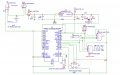
TeensySynthI2C.png
CustomPCB_Teensy_AudioBoard.jpg
 

MrChips

Joined Oct 2, 2009
34,627
How much current are you drawing from the regulator?
If you are taking 1A, then the regulator has to dissipate 4 W. It will get very hot.
 

xox

Joined Sep 8, 2017
936
What value of resistor would you recommend?
Well, it just depends on how low the current can go before the circuit stops working. ;) An 8Ω resistor would lower the current to about 500mA (cutting the power through the 7805 in half, to ~2W) whereas 16Ω should yield about 250mA of current bringing it down to roughly 1W, etc. (Just make sure that the resistor used is rated at or above the given power level.)


I should use a lower Voltage and current? Any recommendations?
If you can easily swap out the 9V battery with, say, 4 AA's (connected in series of course, yielding ~6V) that would give you a full 1A at 1W power dissipation, with no resistor needed. That might be a better option if you are wanting to be able to supply the maximum current.
 
Last edited:

MrChips

Joined Oct 2, 2009
34,627
Thank you. What value of resistor would you recommend?
You can calculate the value of the resistor using Ohm's Law.
Let us say that the drop out voltage of the regulator is 2 V, as per the datasheet.
Hence the voltage regulator needs an input voltage of 2 + 5 = 7V.
The voltage across the resistor is 9 - 7 = 2 V
Hence the resistor value is 2 V/ 1 A = 2 Ω
The resistor has to dissipate 2 W, while the regulator has to dissipate 2 W also, total of 4 W, same as before.
So, instead of 4 V across the regulator, there is now 2 V across the regulator and 2 V across the resistor. The heat dissipation is shared equally by the regulator and the resistor.
 

Thread Starter

TonyAm

Joined Oct 12, 2022
83
Well, it just depends on how low the current can go before the circuit stops working. ;) An 8Ω resistor would lower the current to about 500mA (cutting the power through the 7805 in half, to ~2W) whereas 16Ω should yield about 250mA of current bringing it down to roughly 1W, etc. (Just make sure that the resistor used is rated at or above the given power level.)




If you can easily swap out the 9V battery with, say, 4 AA's (connected in series of course, yielding ~6V) that would give you a full 1A at 1W power dissipation, with no resistor needed. That might be a better option if you are wanting to be able to supply the maximum current.
Thank you. I guess a 6V @ 1A power adapter could also work? (*I have to check what the DO voltage is for the 7805 that I am using)
 

MrChips

Joined Oct 2, 2009
34,627
Thank you. I guess a 6V @ 1A power adapter could also work? (*I have to check what the DO voltage is for the 7805 that I am using)
No. Drop out voltage is the overhead that the voltage regulator requires.
If the drop out voltage is 2 V, you need 7 V input for 5 V output.

Another option is to use a different voltage regulator that has a lower drop out voltage.

If there is ripple on the input voltage, you have to take into account the lowest input voltage, not the average voltage.
 

Thread Starter

TonyAm

Joined Oct 12, 2022
83
No. Drop out voltage is the overhead that the voltage regulator requires.
If the drop out voltage is 2 V, you need 7 V input for 5 V output.

Another option is to use a different voltage regulator that has a lower drop out voltage.

If there is ripple on the input voltage, you have to take into account the lowest input voltage, not the average voltage.
Thank you, ok I see what you're saying.
 

Thread Starter

TonyAm

Joined Oct 12, 2022
83
The output current is determined by what the load takes, not what the regulator can deliver.

What is the actual current of your load?
Right, got confused. I'm trying to figure out what the load current is with a digital multimeter. I haven't measured current (in circuit) before with a multimeter.
 

xox

Joined Sep 8, 2017
936
Right, got confused. I'm trying to figure out what the load current is with a digital multimeter. I haven't measured current (in circuit) before with a multimeter.
Assuming your multimeter can handle the current, simply connect it in series with the power supply (for example, red lead to the positive battery terminal, black lead to the board). Make sure that the current setting on the meter is set to amps (not milliamps).

Otherwise if you have a high-wattage, low-valued resistor you can actually measure it with a voltmeter. Just connect the resistor in series, with the positive battery terminal on one side, board on the other. Then measure the voltage drop across the resistor. If a 1Ω value is used, then 1V = 1A. (In other words if your meter reads 900mV, the current draw is 900mA.) For any other resistor value just use Ohm's law (I = V/R). Just keep in mind that it needs to be fairly low (I wouldn't suggest going higher than say 10Ω).
 

Thread Starter

TonyAm

Joined Oct 12, 2022
83
Assuming your multimeter can handle the current, simply connect it in series with the power supply (for example, red lead to the positive battery terminal, black lead to the board). Make sure that the current setting on the meter is set to amps (not milliamps).

Otherwise if you have a high-wattage, low-valued resistor you can actually measure it with a voltmeter. Just connect the resistor in series, with the positive battery terminal on one side, board on the other. Then measure the voltage drop across the resistor. If a 1Ω value is used, then 1V = 1A. (In other words if your meter reads 900mV, the current draw is 900mA.) For any other resistor value just use Ohm's law (I = V/R). Just keep in mind that it needs to be fairly low (I wouldn't suggest going higher than say 10Ω).
Thanks very much. Will test tomorrow. Appreciate it.
 
Maybe just use a heatsink? When I didn’t have one I slit a 25mm length of 15mm copper pipe along its length, flattened it out and bolted it to my TO-220 regulator
 

MrChips

Joined Oct 2, 2009
34,627
If you are new to electronics, pay attention to what xox said. Many of us have blown the fuse in the DMM, usually by doing the wrong thing, and often enough, by being forgetful.

1) Set the DMM to measure amps (A), not milliamps (mA), since in your case your measurement exceeds 200 mA.
2) For many DMMs, you have to move the red test lead to a different socket.
3) In order to measure current, you must break the circuit.
4) The current meter must be inserted in series with the circuit.
5) Never attempt to make a measurement across a circuit while the DMM is set for measuring current.
6) When finished, always remember to reset the DMM to measure voltage immediately.

There is a safer option for determining current. Measure voltage across a series resistor and use Ohm's Law to calculate the current.

I = V / R

In your case, this is easy. If your series resistor is 2Ω,

current I = V / 2

If the voltage across the 2Ω resistor is measured as 1 V, the current is

I = V / R = 1 / 2 = 0.5 A
 
Top