“We now observe preparation gaps so severe that instructors must reteach middle-school mathematics while simultaneously teaching the material students need for sciences, engineering, economics, and other quantitatively demanding fields”
While I agree with the sentiment, one objection I have is that it is largely still blaming the problem on COVID and now AI. This is a problem that has been going on for decades, though the rate of decline is largely increasing.
Well one doesn't need a slide rule to understand that "multiplication can be reduced to simple addition".But the slide rule had one major advantage:
The user had to determine the order of magnitude of the result on their own.
And besides, they learned that by applying logarithms, multiplication can be reduced to simple addition.
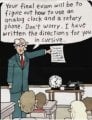
This would be an excellent exam idea for an archaeology class.
I've heard a lot of stories like that about home schooling in this country, I guess if you are teacher, with teaching qualifications then it's better but some of the home schooled people I've met are socially inept and even anti-intellectual, obsessing over Bibles and so on, like the anti-vaxxer crowd.When I taught at the private academy, I ran into problems with home schooling parents. "The books are too hard! Why don't you use the ones I use at home." Typically published by some Bible Education group. Which is because the content in the books I selected for them is based on what the students are supposed to be learning to pass the ACT/SAT tests with at least a score compatible with earning a H.S. Diploma by passing the now required Basic Equivalency Test or high enough for college entrance (all of those little darlings parents' KNEW their child was College Bound. Especially teaching Sciences, even the students who had been in the Academy for years were very ill equipped in mathematics and poorly prepared for Chemistry and hopeless for Physics. I'm not one for rote memorization of times tables but they even had problems with full access to calculators. Even basic beginning Algebra (which they probably made an A in) was beyond reach for many of them. The public schools here in Georgia now have to pass a basic competency test to advance a grade or graduate (also now required for home schooled as well). The problem arose when it was found out many of the teachers were teaching the multiple guess test and not the methods of reasoning and basic knowledge of the subject matter needed to pass the test. After all, it made the parent's very happy to know that their child had received a first-rate education because they passed the test even if they couldn't do basic math or even reading skills. Don't get me started on teaching Cursive Handwriting...
I had a hard time getting through the video because I found her presentation style very off-putting. I want facts delivered dispassionately and reasoned conclusions stemming from them, not emotional histrionics jumping all over the place assuming that just yelling stuff somehow makes a point. Most of the actual examples of problems she gives from the modern book are very similar to problems from Ray's, of which I have a digital copy. Yet in Ray's, she lauds how the question, "How many pine-apples, at 10 cents each, will pay for 5 peaches, at 6 cents each?" introduces "straight-up algebra" in second grade, yet blasts the modern text's question, "Tony has ten apples, six are red, the rest are green. How many apples are green?" as being beyond the developmental ability of a second grader.
She's a teacher talking about teaching, I simply thought you'd find it interesting.I had a hard time getting through the video because I found her presentation style very off-putting. I want facts delivered dispassionately and reasoned conclusions stemming from them, not emotional histrionics jumping all over the place assuming that just yelling stuff somehow makes a point. Most of the actual examples of problems she gives from the modern book are very similar to problems from Ray's, of which I have a digital copy. Yet in Ray's, she lauds how the question, "How many pine-apples, at 10 cents each, will pay for 5 peaches, at 6 cents each?" introduces "straight-up algebra" in second grade, yet blasts the modern text's question, "Tony has ten apples, six are red, the rest are green. How many apples are green?" as being beyond the developmental ability of a second grader.
One thing that I have learned (well, "realized" is probably the better word) is that, like most areas of controversy, their is no shortage of material out there that ranges from well-researched and impartially presented, to well-researched but presented with significant bias, to poorly-researched and cherry-picked to support a particular agenda, to made up out of whole cloth. I think the book, "The Deliberate Dumbing Down of America" falls pretty squarely in the second category. It is extremely well-documented and sourced, but then goes way beyond anything that is supported by the "evidence" (much of which is given without sufficient context or arguably taken out of context) and makes sweeping claims about everything being part of a grand conspiracy.
You also have to be very cautious about the many claims out there (not talking about this video -- at least she is actually using a real text from 1877) about how math expectations (as well as many other areas) were so much higher than they are today. There's no shortage of claims that supposedly present examples of problems that were expected of 6th graders or 8th graders and equate them with college-level problems today. In almost all such cases, the problem has no historical basis and is sometimes simply pulled from a current college-level assignment.
I appreciate the link, don't get me wrong. I just found her to be a teacher with an agenda that was pushing it hard in a rather poorly-supported way.She's a teacher talking about teaching, I simply thought you'd find it interesting.