What type of circuit would this be?

Thread Starter

gte

Joined Sep 18, 2009
363
I'm looking for the name of a circuit type so I can do some web searching on it. The functionality is to monitor voltage on a 0 to 5vDC sensor and if the voltage drops below a certain threshold or goes above a certain threshold, my Arduino/the circuit will add or remove voltage to keep the sensor within the predetermined thresholds I set in the code.

The sensor is a pressure sensor and I'd like to clip it at a floor and ceiling threshold values, similar to a hysteresis, to manipulate the value.

Is there a name for a circuit like this?
 
Last edited:

Papabravo

Joined Feb 24, 2006
22,084
I'm looking for the name of a circuit type so I can do some web searching on it. The functionality is to monitor voltage on a 0 to 5vDC sensor and if the voltage drops below a certain threshold or goes above a certain threshold, my Arduino/the circuit will add or remove voltage to keep the sensor within the predetermined thresholds I set in the code.

Is there a name for a circuit like this?
I'm not entirely sure I understand the operation of such a sensor. Why is the output voltage changing, or what is the sensor sensing?
 

Reloadron

Joined Jan 15, 2015
7,893
I would start with a differential amplifier circuit where I have a reference voltage applied of whatever your target voltage is. When the monitored voltage goes above or below the reference voltage you get the difference voltage out. Now what you do with that delta is up to you. This is generic as your post is sort of vague. You make no mention of the voltage source or how you plan to control it as in raise or lower.

Ron
 

Dodgydave

Joined Jun 22, 2012
11,395
If it's a supply for the sensor, then a Voltage regulator, if you're looking at the output of the sensor then a Window Comparator circuit.
 

MrChips

Joined Oct 2, 2009
34,920
An analog sensor puts out a current or voltage in response to some environmental parameter.

If you want to manipulate the output to produce a fixed voltage then what you need is a constant voltage source, not a sensor.
 

ApacheKid

Joined Jan 12, 2015
1,762
I'm looking for the name of a circuit type so I can do some web searching on it. The functionality is to monitor voltage on a 0 to 5vDC sensor and if the voltage drops below a certain threshold or goes above a certain threshold, my Arduino/the circuit will add or remove voltage to keep the sensor within the predetermined thresholds I set in the code.

The sensor is a pressure sensor and I'd like to clip it at a floor and ceiling threshold values, similar to a hysteresis, to manipulate the value.

Is there a name for a circuit like this?
In times gone by this would generally be described as a servomechanism, something that relies on negative feedback.
 

crutschow

Joined Mar 14, 2008
38,563
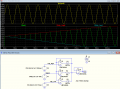
Here's the LTspice sim of an analog circuit that, I think, does what you want:
It accurately clamps the input (yellow trace) to the voltage set by the high clip voltage (red trace) and the low clip voltage (blue trace).
The arbitrary high and low clip voltages can be generated by a D/A output from the Arduino (could be filtered PWM).

It requires a rail-rail type op amp (as shown) if you want the output to go near the supply rails (here ground and +5V)

1707938020294.png
 
Last edited:

Thread Starter

gte

Joined Sep 18, 2009
363
Thank you for this, it does look like what I'm after and you are correct that I would like rail to rail operation.

It appears I can use the Arduino to read the analog voltage through an (Ax) analog in pin and then output a spoofed identical value as long as it is within my hysteresis thresholds and supplement/clip if it is not.

With the 6484, I can provide the PWM reference voltages with 2 output pins and I could also use an analog in pin to monitor what V1 on the 6484 was seeing, so that I could also handle open or closed shorts, correct? Meaning that if V1 went too far out of bounds, I could change what the Arduino sends to V2/V5, to allow Vout to mirror V1 and therefore indicate a dead open or dead closed scenario, in case the sensor stopped working?

Here's the LTspice sim of an analog circuit that, I think, does what you want:
It accurately clamps the input (yellow trace) to the voltage set by the high clip voltage (red trace) and the low clip voltage (blue trace).
The arbitrary high and low clip voltages can be generated by a D/A output from the Arduino (could be filtered PWM).

It requires a rail-rail type op amp (as shown) if you want the output to go near the supply rails (here ground and +5V)

View attachment 315242
 
Last edited:

crutschow

Joined Mar 14, 2008
38,563
With the 6484, I can provide the PWM reference voltages with 2 output pins and I could also use an analog in pin to monitor what V1 on the 6484 was seeing, so that I could also handle open or closed shorts, correct? Meaning that if V1 went too far out of bounds, I could change what the Arduino sends to V2/V3, to allow Vout to mirror V1 and therefore indicate a dead open or dead closed scenario, in case the sensor stopped working?
Sounds correct.

I think you mean V2/V5.
 

Reloadron

Joined Jan 15, 2015
7,893
It appears I can use the Arduino to read the analog voltage through an (Ax) analog in pin and then output a spoofed identical value as long as it is within my hysteresis thresholds and supplement/clip if it is not.
Yes, you can use an Arduino or similar uC (micro-controller) with an A/D to read a 0.0 to 5.0 volt DC level. That assumes a 5.0 volt Arduino like for example an Arduino Uno Rev 3. That is not the case with, for example, a 3.3 volt Arduino. An Arduino will not give you an analog out identical value.

The functionality is to monitor voltage on a 0 to 5vDC sensor and if the voltage drops below a certain threshold or goes above a certain threshold,
If you are just monitoring a sensor output through a voltage as you mention, 0 to 5 volts, there is no need for any kind of clipping or signal conditioning. Your control is a matter how you write your code including any hysteresis you include. Just as an example I want to maintain a liquid level in a tank of 25". If Water Level < 23" add water, if Water Level > 27" dump water. This is just "process control" by definition. The same could be done with for example pressure in a tank, it's process control. This is all DC correct?

Ron
 

Thread Starter

gte

Joined Sep 18, 2009
363
Yes all in DC. I need to supplement/clip if the values go outside of the range I want to set to keep another uC happy, so that's what is behind all of this. I have a 5v Mega 2560 that I'm using.

@crutschow yes I did mean v5

Yes, you can use an Arduino or similar uC (micro-controller) with an A/D to read a 0.0 to 5.0 volt DC level. That assumes a 5.0 volt Arduino like for example an Arduino Uno Rev 3. That is not the case with, for example, a 3.3 volt Arduino. An Arduino will not give you an analog out identical value.


If you are just monitoring a sensor output through a voltage as you mention, 0 to 5 volts, there is no need for any kind of clipping or signal conditioning. Your control is a matter how you write your code including any hysteresis you include. Just as an example I want to maintain a liquid level in a tank of 25". If Water Level < 23" add water, if Water Level > 27" dump water. This is just "process control" by definition. The same could be done with for example pressure in a tank, it's process control. This is all DC correct?

Ron
 

crutschow

Joined Mar 14, 2008
38,563
Following on Reloadron's comments, you could conceivable to it all with a micro.

You monitor the input with the micro A/D and output the same voltage with the D/A unless it is outside the limits, where you would then just output that maximum or minimum value.
Of course the accuracy of the replicated sensor output would be determined by the accuracy and resolution of the micro's A/D and D/A.
 
Top