Existing old type LM324 based automatic voltage stabilizer circuit evaluation

Thread Starter

Hasan2019

Joined Sep 5, 2019
199
Hi there,
I wanted to build up a voltage stabilizer to study its performance.
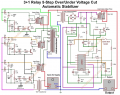
I got a simple circuit diagram from online, perhaps someone design it without understanding the LM324 op-amp action.
This has made me curious because I wanted to know it works or not.

Take a look below.
Circuit.PNG

he most obscure part is transformer TR1.
The main winding (taps A … E) is most likely a specific, commercial part; but without knowing the expected voltages (or turns ratios) of that winding and taps AND the smaller, isolated one (possibly another 18V, like TR2?), it simply cannot be fully functional.


The three relay drivers on the left side almost beg to be modelled as identical subsections, easily done with the information shown. Same with the High/Low cutout circuit on the right side.

I was trying to simulate this circuit in LTspice, here is the image. Kindly help me to match with the upper one.
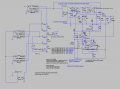
LM324_voltage_stabilizer.png


Lets calculate the op-amp gain, and fault.

I will be waiting for your response and guidance and comment. Your similar suggestions are appreciable.

NB: DONT comment something that you are not sure about it, I might be silly for you.
 

panic mode

Joined Oct 10, 2011
4,864
you can use any autotransformer that has several taps that are above and below line voltage. you would choose it based on power requirements. i would say forget about the extra secondary and replace it with either another small transformer 220/18 (primary wired in parallel with primary of 24V transformer) or select 24V transformer that has dual secondary..
 

Thread Starter

Hasan2019

Joined Sep 5, 2019
199
you can use any autotransformer that has several taps that are above and below line voltage. you would choose it based on power requirements. i would say forget about the extra secondary and replace it with either another small transformer 220/18 (primary wired in parallel with primary of 24V transformer) or select 24V transformer that has dual secondary..
Yes, from the simulation we can understand how the transformer should design. Important issue is how you select the Pot postion to detect HIGH /LOW voltage cut by the comparator. Q1,Q2, Q3 should turned ON with different input AC range.
 

panic mode

Joined Oct 10, 2011
4,864
two zeners wired to pins 1 and 14 of the LM324 are added to "convert" those OpAmp outputs into comparator outputs (open collector). so if either U4 or U5 go low, Q4 will turn off and that will kill the Output receptacle.

so when testing and calibrating this device you will need a variac to power this device and simulate fluctuations in supply voltage.

set variac to what you think is a lowest permissible voltage (190V for example) and adjust low cutoff until output is dead (Q4 off).
then set variac to what you think is highest permissible voltage (240VAC for example) and adjust high cutoff until output is dead (Q4 is off).

when variac is within those limits output outlet should have power. when variac is set outside permissible range, output outles should be off.
 
Last edited:

panic mode

Joined Oct 10, 2011
4,864
of course. why do you ask?

it is all done the same way...
they are simply used to select correct tap to get right voltage out.
so use variac to adjust voltage when input relay should activate, then set trimmer to turn that relay on. increase variac voltage and set the next one...

so when done, you can test it.
output voltage should be close to nominal 220V (within tolerance) as you change input voltage using variac. all the circuits on the left do is select correct tap on the transformer. when the input voltage is low, lowest tap is used, when it is higher, then next higher tap is used etc. the circuits simply automates the process of selecting correct tap on the autotransformer so you do not have to select one manually, and this is better (faster) if there are fluctuations in the mains voltage
 
Last edited:

Thread Starter

Hasan2019

Joined Sep 5, 2019
199
I am guessing that U4 and U5 (together with their associated components) are a "window" detector, checking to see if the rectified output level is within a window, neither too low nor too high. If so, then one of the pots (U8 or U9) sets the lower trip point (the lower edge of the window) and the other sets the upper trip point.

To see the correct operation of switch S1 in the simulation, there should be a load connected to the OUT net. The LTspice switch is not an ideal switch, and even when it is "open" it is a 10G resistance. With no load connected to the OUT net, all of the voltage passes through the 10G resistor, as if the switch (relay) was closed even when it is open. ll it needs to do is shunt the signal to ground when S1 is "off" but S1 is not an infinite resistance.(See main diagram)
 

dl324

Joined Mar 30, 2015
18,216
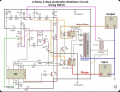
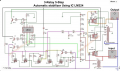
Take a look 2 similar circuit here and make some comment which one is comparative good that we were talking about.
The symbols used for the opamps are useless; as are the colored wires, unnecessary wire bends, and the non-standard "flow". Use schematics from a more reputable source to study.
 

Thread Starter

Hasan2019

Joined Sep 5, 2019
199
The symbols used for the opamps are useless; as are the colored wires, unnecessary wire bends, and the non-standard "flow". Use schematics from a more reputable source to study.
@Dennis, welcome to this chat. If you look the first post of this thread you can see to understand opamp action I tried to simulate the whole circuit, but still its difficult to understand. Not sure those circuit will workable.
 
Top