Finding optimal JFET replacement for existing common source amp

Thread Starter

Sifunkle

Joined Aug 3, 2024
6
Hi all,

I’m fairly new to electronics as a hobbyist of a couple of months. Making my first foray into JFETs in trying to recreate a self-biasing common source amp circuit based around a long-obsolete FET. From what I’ve read so far, with JFETs having such wide tolerances, it’s perhaps more common to adapt the circuit to the given JFET, but I’m wondering if it’s possible to approach it the other way and determine the ideal JFET for a given circuit.

In practice, I think I’m trying to determine tolerance ranges for Idss and Vgs(off) such that the circuit will bias correctly, but I’m not having much luck determining even a single optimal value for each parameter (let alone understanding how to expand that to a range: is that about inspecting the transfer curves?). Happy to hear if there are other parameters worth considering, although I think it’s an amp of low enough gain that transconductance, etc are probably not pivotal.

The info I‘ve got to go on is everything noted in this diagram (apologies if it shows up as large as I worry it will, I’ve tried to scale it down but my smart device is too smart for its own good):
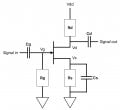
IMG_0581.jpeg
I didn’t state the exact values as I’d prefer to understand the concepts than just be given an answer, but I can provide the values if needed. I’m not sure exactly what the original designer’s objectives were either, meaning it’s not safe to assume anything like ‘Vd will be half of Vdd’.

I’ve tried messing with the Shockley equation/transfer function Id = Idss x [1 - (Vgs/Vgs(off))]^2 although with two unknowns, Idss and Vgs(off), I didn’t get very far. Is there another pertinent equation I’ve overlooked?

Any contributions appreciated!
 

Papabravo

Joined Feb 24, 2006
22,058
IIRC a typical JFET has an Idss of about 10 mA and a Vgs(off) of -4 volts. Check a couple of JFET datasheets for comparison like these ones:
MMBFJ270
MMBFJ112

If you don't know the parameters of the device you are replacing, defining an optimal replacement may be a virtual impossibility.
 

dl324

Joined Mar 30, 2015
18,219
The info I‘ve got to go on is everything noted in this diagram
There are no resistor values, supply voltage, input/output voltage range/frequency.
I’ve tried messing with the Shockley equation/transfer function Id = Idss x [1 - (Vgs/Vgs(off))]^2 although with two unknowns, Idss and Vgs(off), I didn’t get very far. Is there another pertinent equation I’ve overlooked?
You have too many variables. You need to know Idss, Igss, and Vp. Without a part number (and resistor values), you have nothing to work with...
 

DickCappels

Joined Aug 21, 2008
10,661
Note that the transistor in the post above is an eary Bipolar Transistor (as early as they get!) (not a Junction Field Effect Transistor.
 

Thread Starter

Sifunkle

Joined Aug 3, 2024
6
Thanks for the attention everyone. Apologies if my initial post wasn’t clear enough (electronics neophyte + 4am insomnia post = mea culpa).

There are no resistor values, supply voltage, input/output voltage range/frequency... Without a part number (and resistor values), you have nothing to work with...
I didn’t state the exact values as I’d prefer to understand the concepts than just be given an answer, but I can provide the values if needed.
My hope was to pursue this from as theoretical/mathematically provable a stance as possible, prioritising the learning experience over physically emulating the circuit (although both would be good). Part of the learning process might be finding that it’s only possible to get so far with theory before experimentation/simulation/etc is necessary (as I think Papabravo alludes to). From my inexperienced perspective, I‘d equally believe that I’m just unaware of other important mathematical descriptors (e.g. the significance of Igss). Basically, “I don’t know what I don’t know”.

My first paragraph acknowledged that the JFET’s parameters are usually the starting point from which the circuit is designed. However I’m curious as to whether one can reverse-engineer the circuit schematic for its starting point.

Is this audio? RF? What frequency?
Sorry - it’s small signal audio. Shortsighted moment on my part, forgetting how broad the field is. The discontinued FET is the TIS58 (Idss 2.5 - 8.0mA; Vgs(off) -0.5 - -5.0V) run on ~22V supply voltage. I’ve actually ordered some 2N5484s (Idss 1.0 - 5.0mA; Vgs(off) -0.3 - -3.0V) to start playing with. The original circuit‘s appeal/success/mojo is considered to vary significantly between units with the specific TIS58 present. I therefore expect I’ll need to test and cherry-pick FETs, so hope to hone in on what parameter values to look for.

Note that the transistor in the post above is an eary Bipolar Transistor (as early as they get!) (not a Junction Field Effect Transistor.
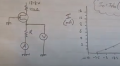
I drew that, so having a good laugh not only because my naivete is showing, but because the original schematic coincidentally also shows a BJT (definitely a JFET per the annotations and circuitboards though). Erm… feeling stupid as I’m googling symbol images and failing to appreciate where my attempted JFET went awry - could you save me some future embarrassment?

If people are curious, I’m looking at the (preamp section of the) Maestro Echoplex EP-3 tape delay unit (specifically the earliest iteration of it). The original documentation includes the schematic and I think readily available online (let me know if you can’t find it).

Once more, thanks all for taking the time to read and reply
 

sparky 1

Joined Nov 3, 2018
1,218
Most hobbyist of a few months will not be able to absorb the procedures or discipline needed to characterize a replacement JFET in circuit.
You preliminarily determine input and output impedance and plot a transfer graph and Calculate Rs and transconductance shown in the second circuit page 2 of the video. The JFET bias setting differs from BJT. Also page two set up for determining pinch off done in circuit. Your impedance analysis is needed, it puts a load on the circuit, the input and output will not be even reasonably close without impedance matching your overall circuit.

The procedure for determining JFET pinch off in picture below and shown actual on bench testing in the video.

determine Jfet pinch off .png

Ltspice saves time and gives better organization.
We also check the simulation model that it does behave at least well enough to approximate and improve the circuit. Then you can
optimize. As shown in the video the JFET is a different animal than the BJT having metal oxide insulation layer, After all that you notice an op amp is closer to ideal and begin searching for an ideal breakout board that converts smd to through hole without a microscope or remain content with a Jfet like the video.

 
Last edited:
Top