finding suitable power supply to bias five CGHV1A250

Thread Starter

yef smith

Joined Aug 2, 2020
1,446
Hello, I need to bias five CGHV1A250 amplifiers at once.
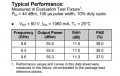
From the datasheet each amplifier is 1A quescent current and 16A when its pulse(I plane to do 300ns pulse)
The amplifiers need 50V for proper work so I think it need a little extra.
So in quescent mode the power supply needs to deliver 6A and in pulse 16*5=80A.

I was told that I could use something similar to the LS200-7 shown in the link below.
Also I know that power supplier cannot deliver 80A so we need to use huge capacitors about 50uF for supplying the pulsed current.
What device do you reccomend me to use for this purpose?
Thanks.

https://www.macom.com/products/product-detail/CGHV1A250
https://www.digikey.com/en/products/detail/tdk-lambda/LS200-7-5/2339572
1767269105997.png
 

Irving

Joined Jan 30, 2016
4,996
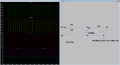
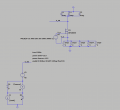
A single amp needs 50W at idle rising to 800W peak. You haven't said what your duty cycle is - how often these 300nS pulses occur - but each amp needs a dedicated supply with a capacitor following. Using LTSpice we can estimate the effect that the capacitor has on the power supply - here we can see that a 51v PSU followed by a 10,000uF capacitor stays within the spec for a 100W (50v @ 2A) power supply, assuming pulses occur every 1uS. This is based on a power supply having a constant current output and an internal resistance of approx 300milliOhm (R1) which is roughly the same as a load regulation of 1%. A suitable supply would be the LS200-48, but check out the Meanwell 100W supplies at around $30. The 10,000uF capacitor should be made up from 10 x 1000uF/100v in parallel to give a low ESR and good pulsed current handling.

1767294689184.png
 

MisterBill2

Joined Jan 23, 2018
27,178
With five amplifiers each drawing 16 amps at 50 volts, it seems like that would be a sound system for a TV surround-sound system. So really you do need a serious power supply able to deliver the full 80 amps some of the time.
50 volts is not a common power supply voltage, but 48 volts is quite common.
So I suggest a 48 volt 50 amp power supply, and a number of large filter capacitors, one for each amplifier. The capacitors will need to be rated for at least 60 volts working, probably 75 volts would be a standard voltage , and at least 1000MFD, although 2000 would be better.
 

Irving

Joined Jan 30, 2016
4,996
With five amplifiers each drawing 16 amps at 50 volts, it seems like that would be a sound system for a TV surround-sound system. So really you do need a serious power supply able to deliver the full 80 amps some of the time.
No, the amps in question are single GAN RF transistors giving 11dB gain at 8GHz. This is a project Yef (and, it seems, a small team outside AAC) has been working on for a while with around a dozen or so threads on AAC and elsewhere.
 

Thread Starter

yef smith

Joined Aug 2, 2020
1,446
Hello Irving few question regarding the good advices :
1." but each amp needs a dedicated supply with a capacitor following. "
I have found LS200-48, so you say I need five such device one for each of my amplifiers?
Why cant I use one LS200-48 for all 5 devices?

2. "10 x 1000uF/100v in parallel to give a low ESR and good pulsed current handling."
these 300ns pulses accure every 3000ns (duty cycle of 10%) the I=C*dV/dt

why did you choose 1000uF why 10X100uF will not be suitable?

3. those 1000uF or 100uF will have very very sharp spikes threw them ( my pulse rise time is 20ns)
can you reccomend a capacitors type which could be suitable?
Thanks.

https://www.digikey.com/en/products/detail/tdk-lambda/LS200-48/2336560
 

Attachments

MisterBill2

Joined Jan 23, 2018
27,178
OK, RF amps! I was thinking audio amps, I seldom research part numbers! Pulsed RF amps ?? Are they pulsed sequentially?? or all at one time?? The power supply demands are quite different. My suggestion was based on it being a five channel audio system, and so the requirements will be a bit different. For short, fast rise time current pulses the capacitors will need to be different than those for an audio system. ( I missed that detail about Gigahertz in post#1. That should have been a clue)
This difference is why it is wise to provide more details than just "what we need to know."
A very big part of being able to answer questions correctly is being able to get the correct questions.
 

Thread Starter

yef smith

Joined Aug 2, 2020
1,446
Hello,I am trying to understand an advice regarding the capacitors.
I am simulating the system as shown below.
my capacitors are in paralel to the supply .
few questions:
1.why FPLS1AJ473B092LH 0.047uF is better then electrolithic 470uF.
2.How ESR ESL make the voltage 48 drop?
they are in parralel.

1767640004754.png
 

MisterBill2

Joined Jan 23, 2018
27,178
Consider the pulsed nature of the load on the power supply. Then understand that the regulator response time of a regulated power supply is not instant! That is where a low ESR capacitor is useful, which is because it will tend to hold the voltage the same instantly, with the only effective resistance being thru the capacitor's inductance. That factor is hard to understand and tedious to explain. The purpose of the capacitor is to supply current while the regulator circuit is responding. Sort of similar to inertia keeping the engine torque up until the next power stroke starts delivering. ( The best analogy I can come up with).
 

Irving

Joined Jan 30, 2016
4,996
Another point to consider is the power delivered. Energy cannot be created, it must come, ultimately, from the PSU. The capacitors help manage the delivery of the energy but do not create it.

The RMS power is simply the quiescent power + the pulsed power x duty cycle = 1 x 50 + 15 x 50 x 0.1 = 125W per amp, plus a safety margin. Therefore you need at least 150W per amp minimum. You cannot run all 5 amps from a single LS200-48!

As to the capacitors - you need to run your simulation for several 100 if not 1000s of cycles to see the real impact - then you'll see that larger is necessary.

Your simulation may be flawed. You are switching the power on and off via a MOSFET, is that what plan to do, rather than pulsing the RF into the final amp stage? Actually it makes little difference from the supply perspective; the difference being whether there is a quiescent current or not ie 150w PSU v 120w PSU.

That 300nS pulse with 20nS rise/fall represents frequencies from 1MHz to 10MHz, to within 18dB of the fundamental. To get any realistic chance your pulse shape will be close to what you want will require the capacitors for each amp to be tightly clustered to the amp's supply pin and a MOSFET per amp.. Also you may need to consider skin effect - higher frequencies only travel in the outer skin of a conductor. For copper,1MHz travels in the outer 0.06mm whilst 10MHz only in the outer 0.02mm. So while an average DC current from MOSFET switch to amp would have been 2.5A, requiring say 20awg cable (0.5 sq mm) you now need the same area in a 0.06mm thick ring, i.e. 14awg minimum.
 
Top