What Stabilizes The Electron Orbit In An Atom?

Thread Starter

Glenn Holland

Joined Dec 26, 2014
703
How can a person answer that, IMO your question is mainly nonsensical. You're taking classical electromagnetic wave theory into nuclear physics and obsolete atom models to a place we know today can't possibility be correct because atoms would collapse in a tiny fraction of a second.
OK - If you don't like my continued inquisitiveness about quantum mechanics, I'm going to post a new thread called the "Twilight Zone" where people can post questions and answers about witchcraft, exorcism, and how haunted houses could be purged of demons. :):p:D
 

nsaspook

Joined Aug 27, 2009
16,344
OK - If you don't like my continued inquisitiveness about quantum mechanics, I'm going to post a new thread called the "Twilight Zone" where people can post questions and answers about witchcraft, exorcism, and how haunted houses could be purged of demons. :):p:D
I've no problem with questions but your current line of questions point to a "Twilight Zone" of misunderstanding. Step back, read the basic texts, watch the basic videos so you can ask reasonable questions.
 

Motanache

Joined Mar 2, 2015
652
If an electron is converted from mass to energy, the electromagnetic wave would be a Gamma ray.
https://en.wikipedia.org/wiki/Electron–positron_annihilation

When the electron meets his soulmate, the positron, they annihilated each other and two gamma quantaes appear. 511Kev each.

https://en.wikipedia.org/wiki/Pair_production
The reverse process, when a radiation of 2x511KeV passes through the proximity of matter, It gives birth to a electron-positron pair.
 

Motanache

Joined Mar 2, 2015
652
So what part of the electromagnetic wave corresponds to an orbiting electron as shown in the Bohr model?
That's why they asked you to post # 20 to imagine nothing. That's how they do. You do not do that!
As long as you keep trying to visualize what is physically happening in the quantum world you will remain largely confused.

We work with models. They are not perfect.
In mathematics, the rule with preferential exceptions is absurd.

The Bohr model that includes quantification of the electron's energy on the orbit, only explain the energy of the electron of the quantum number n (n=1,2,3,4..... corresponding to shell in chemistry - K,L,M.....)

This model does not explain the electron energy on the subshell. quatum number l=....

It does not even not explain the probabilities of transition.
Why is white LED spectrum so?

Seems that the electron might correspond to the point when the electric field component (E) of the wave is at maximum. Another possibility is when E is at minimum -IE- when the displacement current dE/Dt has reached a maximum.
But for shell M, n=3. The de Broglie(not electromagnetic wave) wavelength enters 3 times in the orbit size.
It has 3 maximums and 3 minimums. Where is the electron? In all three points?

From ECPSSR model, when a proton hits a body with a certain speed, the maximum probability is to extract that electron that has an orbit speed approximately the incident proton speed.

Having the same speeds have a longer interaction time, the proton has time to "persuade" the electron to leave the atom.
 
Last edited:

Motanache

Joined Mar 2, 2015
652
I have come to the following conclusions-

The electron behaves like the wave only near the atomic nucleus. Let me know please if I'm wrong.
It seems the nucleus is playing a music that the electron has to play.
(Electron-spin/nuclear-spin interactions)

de Broglie wavelength
https://en.wikipedia.org/wiki/Matter_wave


CodeCogsEqn.gif

CodeCogsEqn1.gif ??????????

Einstein was a good student with great grades -
Brilliant in math


The exam can not check creativity. Although pedagogy teaches us that it can. Let the student compose a response. And what grade do you give, what is the scale?


Last edited:

Thread Starter

Glenn Holland

Joined Dec 26, 2014
703
I have come to the following conclusions-

The electron behaves like the wave only near the atomic nucleus. Let me know please if I'm wrong.
It seems the nucleus is playing a music that the electron has to play.
(Electron-spin/nuclear-spin interactions)

de Broglie wavelength
https://en.wikipedia.org/wiki/Matter_wave


View attachment 132579

View attachment 132580 ??????????

Einstein was a good student with great grades -
Brilliant in math


The exam can not check creativity. Although pedagogy teaches us that it can. Let the student compose a response. And what grade do you give, what is the scale?
If the electron in an atom exists in the form of an electromagnetic wave (EMW) in a "shell" wrapped around the nucleus, it seems that the negative peak of the wave would represent the peak negative charge of the electron. If the EMW is a traveling wave, then would the moving negative half of wave represent the moving electron?

Since an EMW has a magnetic component (at a right angle to the electric component), then what is the effect of the magnetic field on an atomic electron?

Also, if an atomic electron is actually an EMW (rather than a discrete particle), then what represents the electron's spin?
 

nsaspook

Joined Aug 27, 2009
16,344
Electrons are not electromagnetic waves. I've no idea if that comes from this kook paper or what but it's simply not possible in classical or QM.
http://vixra.org/pdf/1106.0006v1.pdf

Charge is not a property of electromagnetic waves (electromagnetic waves are produced whenever charged particles are accelerated and represent the changed fields of those charged particles) and the wave duality of the photon is also charge-less.
 

Thread Starter

Glenn Holland

Joined Dec 26, 2014
703
Electrons are not electromagnetic waves. I've no idea if that comes from this kook paper or what but it's simply not possible in classical or QM.
http://vixra.org/pdf/1106.0006v1.pdf

Charge is not a property of electromagnetic waves (electromagnetic waves are produced whenever charged particles are accelerated and represent the changed fields of those charged particles) and the wave duality of the photon is also charge-less.
OK - In the De Broglie electron scattering experiment, what exactly are the "waves" that produced the interference patterns? Seems the electrons themselves produced a scattering pattern like they were some kind of waves, but they actually retained a particle characteristic. Then what kind of wave is an atomic electron?
 

nsaspook

Joined Aug 27, 2009
16,344
They are De Broglie matter waves.

https://en.wikipedia.org/wiki/Matter_wave#The_de_Broglie_hypothesis
The physical reality underlying de Broglie waves is a subject of ongoing debate. Some theories treat either the particle or the wave aspect as its fundamental nature, seeking to explain the other as an emergent property. Some, such as the hidden variable theory, treat the wave and the particle as distinct entities. Yet others propose some intermediate entity that is neither quite wave nor quite particle but only appears as such when we measure one or the other property. The Copenhagen interpretation states that the nature of the underlying reality is unknowable and beyond the bounds of scientific inquiry.
 

Motanache

Joined Mar 2, 2015
652
Charge is not a property of electromagnetic waves (........)and the wave duality of the photon is also charge-less.
And the atom is charge-less That's because the negative charge is equal to the positive one. If we remove an electron it becomes positive.

Can this be done with the wave?
Crazyness, right?


electromagnetic waves are produced whenever charged particles are accelerated and represent the changed fields of those charged particles.
?
deceleration(bremsstrahlung)
 
Last edited:

nsaspook

Joined Aug 27, 2009
16,344
Enter PEDANTIC mode. :rolleyes:

Acceleration is a vector quantity and it can be either positive or negative in value.
https://socratic.org/questions/why-is-acceleration-a-vector-quantity

The Bremsstrahlung photon is produced at the time of the vector change because of conservation of mass/energy if there is a loss of kinetic energy.

Basic Radiation Protection Technology
Bremsstrahlung is a word of German extraction which translates literally as “breaking radiation”, that is, radiation generated when the charged particle puts on the breaks. The causative agent is again the Coulomb force which produces a deflection in the path of the charged particle. This change in direction is, in the physics sense, a negative acceleration (a de-celeration if you prefer) because the velocity vector changes with the directional change and the speed of the particle is reduced due to the energy loss. The radiation emitted by the particle, the Bremsstrahlung, is electromagnetic in nature.

http://www.studyphysics.ca/newnotes/20/unit01_kinematicsdynamics/chp04_acceleration/lesson10.htm
Negative Acceleration
In physics, acceleration is not just an increase in velocity, but also a decrease in velocity.

  • Even though you might have heard people use the word deceleration to describe an object slowing down, this isn’t really proper physics.
    • Deceleration can only mean one thing.
  • Instead, we call a decrease in velocity a negative acceleration.
  • This actually helps us when doing calculations and also allows us to give more meaning to acceleration.
 
Last edited:

Motanache

Joined Mar 2, 2015
652
Do you know how I see the subatomic world?
Imagine a superfluid.
https://en.wikipedia.org/wiki/Superfluidity

A fluid that is full lacking friction.
In this fluid appear wave and they can not disappear due to friction. This is the equivalent in my model of electromagnetic wave.

(Be careful, it's just my model.I did not copy it, I do not know it is somewhere. I would be very glad, instead, if others have this idea)

This is where in superfluid under certain conditions it transforms into stationary wave or vortex. This is the equivalent in my model of particle.
A vortex can interact with another vortex at a certain distance.This is the equivalent in my model of interactions at distance.

Repeat. It's just my model. I'm not saying it's right.
It's a theory that would make fire me from any serious job in science.
 

Papabravo

Joined Feb 24, 2006
22,083
Whenever you have a vector quantity, it can change in two entirely different ways:
  1. The magnitude can increase or decrease
  2. The direction can change
 

Thread Starter

Glenn Holland

Joined Dec 26, 2014
703
If an atomic electron is actually a wave phenomenon, then what are other atomic electron waves interacting with when a chemical bond (such as a covalant bond) is formed?

Seems there must be some kind of "center of charge" in the so called "electron cloud" that's interacting with other charge centers. Or does this electron cloud have a homogeneous charge that's spread evenly around the nucleus?
 

nsaspook

Joined Aug 27, 2009
16,344
Saying 'actually' is the main conceptual problem. Actually, we don't know (and maybe never will know) the reality. What we do know is the results from experiments and observations of our theories that predict what's happening. Electrons seem to propagates through space like a wave while it interacts at a point like a particle. All experiments so far have proved that quantum theory is correct and that our notion of reality is at fault.

Richard Feynman
The "paradox" is only a conflict between reality and your feeling of what reality "ought to be."
 

Thread Starter

Glenn Holland

Joined Dec 26, 2014
703
If an electron wave can be represented by simple equation such as A = Amax Sin wx where
A = the amplitude at any instant
w = the angular frequency

Then what is the "amplitude" and what is x? Is x a function of time or the distance along the path around the nucleus? When the value of Sin wx is zero, then does the electron also go to zero?
 

Thread Starter

Glenn Holland

Joined Dec 26, 2014
703
Saying 'actually' is the main conceptual problem. Actually, we don't know (and maybe never will know) the reality. What we do know is the results from experiments and observations of our theories that predict what's happening. Electrons seem to propagates through space like a wave while it interacts at a point like a particle. All experiments so far have proved that quantum theory is correct and that our notion of reality is at fault.

Richard Feynman
The "paradox" is only a conflict between reality and your feeling of what reality "ought to be."
From my reading on this subject, a fast moving electron has a De Broglie wave length about the same length as X Rays. If one electron equals one wave length, then I can visualize how a traveling electron wave will interact with a stationary "particle" such as another electron or a photon. The interaction might be something like a water wave moving past a floating object.

However as I asked in a previous post, what is the electron wave composed of -IE- is it the components of an electric or magnetic field or something else? Is the displacement of the wave transverse to the direction of travel (like light) or longitudinal (like a sound wave)?
 
Last edited:

nsaspook

Joined Aug 27, 2009
16,344
From my reading on this subject, a fast moving electron has a De Broglie wave length about the same length as X Rays. If one electron equals one wave length, then I can visualize how a traveling electron wave will interact with a stationary "particle" such as another electron or a photon.

As I asked in a previous post, what is the electron wave composed of -IE- is it the components of an electric or magnetic field or something else?
It's pretty clear that de Broglie "matter waves" don't work as the components of an electric or magnetic field or something else and have been replaced by QM.
http://www.chemistry.mcmaster.ca/esam/Chapter_1/intro.html
http://www.chemistry.mcmaster.ca/esam/Chapter_2/section_2.html
So indeed the wavelengths postulated by de Broglie to be associated with the motions of particles are in reality the wavelengths of the probability amplitudes or wave functions. There is no need to postulate "matter waves" and the results of the electron diffraction experiment of Davisson and Germer for example can be interpreted entirely in terms of probabilities rather than in terms of "matter waves" with a wavelength l = h/p.
 

Motanache

Joined Mar 2, 2015
652
However as I asked in a previous post, what is the electron wave composed of -IE- is it the components of an electric or magnetic field or something else? Is the displacement of the wave transverse to the direction of travel (like light) or longitudinal (like a sound wave)?
We had an electric field - reference to the capacitor
We had a magnetic field - reference the coil
(I'm sorry I know you know that, but it's good to make the discussion clear)

Radio waves are electromagnetic waves. It was later discovered that light is part of the same category.

About the link between electric field and the magnetic field we had in Maxwell equations.

It has been observed that electrons suffer diffraction as they behave like light.

http://wanda.fiu.edu/teaching/courses/Modern_lab_manual/Electron_diffraction.html

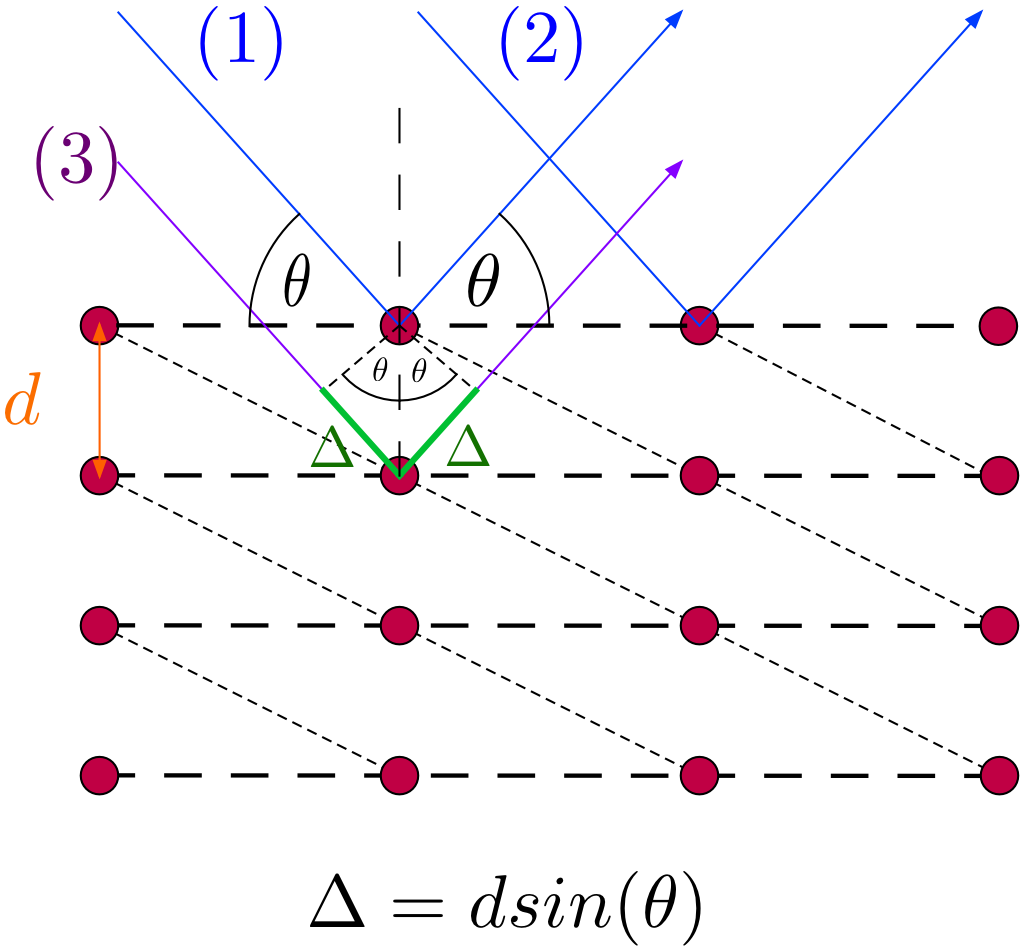
With red are the nodes of the crystalline network (atoms)And with blue electron trajectory. Why it is so?
De Broglie presented a theory according to which any particle is behave like a wave, or can be associated with a wave.

He was on the point (if I'm not mistaken) to fall his doctorate with such an idea.
These are not electromagnetic waves are just a concept that explains the phenomenon.

Then great was the wonder when applying this type of waves-It perfectly matched as an explanation of the energy levels of electrons in the atom(I was imprecised here, but I'm not going on)
 
Top