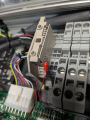
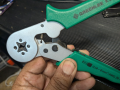
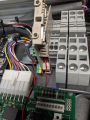
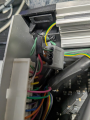
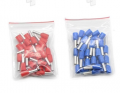
I have these crimps and need a crimper to crimp them. Don't know what they're called and having difficulty finding one.
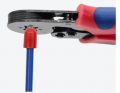
This is the sort of crimper I need:
Ferrules are great, they really clean up wiring and they can prevent stray conductors from shorting across terminals. The thing, about ferrules, tbough, is that there are so many sizes, and the color of the insulator/strain relief is usually just an indication of wire size and I really don’t like that as it can get confusing when you have, say, a red insulator on a ground wire.
You can buy ferrules with color codes of your choice on whatever size, but that can get expensive. For cases where i don’t want to make a mistake because my brain registers the color as indicating what signal is on that wire I put a small piece of heatshrink of the proper color over the ferrule’s insulation. If I have the time I prefer to mark all wires this way with a color that indicates the nature of the signal (e.g.: red = DC +, black = DC -, green = ground, yellow = dry contact, &c).
But this takes extra time and may not be worth as much to you as it is to me, so… YMMV, &c.
One thing to be careful about is ensuring you have selected the correct size ferrule. While you just can’t fit the wire into one that is too small, using one that is too big can be a problem as the metal used in thin and somewhat brittle. If the ferrule isn‘t supported by being filled sufficiently, they will tend to crack and split. This won’t necessarily show up immediately since it will be held together by the terminal’s clamp—it shows up when you try to remove the wire for whatever reason and the ferrule stays in the clamp or falls off.
Concerning your question, I have used iCrimp products (available on Amazon) for quite a while and they have been a really nice option that lies between the ≤$20 junk and the ≥$100 overkill (beautiful tools but unless you are building a plane or something like it, the often insanely high prices are just too much to pay).
The iCrimp pliers tend to be at the ~$40 price point and, in my experience, give excellent value for money. I use this crimper, and it’s done very well for me.
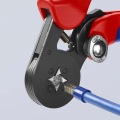
I prefer the six-jaw, hexagonal type, because the minimize the size of the result and are less likely to cause trouble if the terminal I am trying to connect to is small for whatever reason. In the end, four-jaw square or six-jaw hexagonal is not a critical parameter outside of specific industrial applications where a manufacturer might specify one over the other.
In the end I went with this crimper. However, I am starting to understand the reason for having a wide variety of ferrules. I can see how using the wrong size ferrule can be a problem. One option I had considered was just tinning the wire ends before inserting them into their clamps. And since this is the first time in my entire life where I would consider that I actually needed to go this route, a cheap crimper should be good enough for a one off job. I'll have less than 20 crimps to make. Then may quite possibly never use it again. But who knows what will come of the future?
I will have pictures today - wired without the ferrules. As it is right now I'm almost ready to do a first power up.
You can buy a whole lot with 100x 0.14mm2, 100x 0.34mm2, 100x 0.5mm2, 100x.0.75mm2..... so for like 5-10 dollars you will be equipped for a long time. After that usually you will spend those smaller than 1mm2 faster than the others so you can refill only those.
After I began using these, I never mount anything without the crimp. First of all is a lot more professional, also it allows you to insert/remove the wire from the terminal infinite number of times, while if you dont have the crimped end the wires usually are destroyed after couple of removals.
In the end I went with this crimper. However, I am starting to understand the reason for having a wide variety of ferrules. I can see how using the wrong size ferrule can be a problem. One option I had considered was just tinning the wire ends before inserting them into their clamps. And since this is the first time in my entire life where I would consider that I actually needed to go this route, a cheap crimper should be good enough for a one off job. I'll have less than 20 crimps to make. Then may quite possibly never use it again. But who knows what will come of the future?
I will have pictures today - wired without the ferrules. As it is right now I'm almost ready to do a first power up.
So much better than tinned wires for durable connections. Tinning small stranded wire always creates a stress boundary that will crack under harsh condition. A crimp, done properly, is a cold weld with a much more uniform transition from wire to ferrule.
The good crimpers create nice patterned sides for better grip. https://www.grainger.com/product/GREENLEE-Crimper-Square-Insulated-Single-34E994
A square crimp puts more stress on the ferrule material than does a hex crimp. However, for the same wire/ferrule diameter, a square crimp creates larger mating surface areas. I prefer this when mating to a cage block connector.
A square crimp puts more stress on the ferrule material than does a hex crimp. However, for the same wire/ferrule diameter, a square crimp creates larger mating surface areas. I prefer this when mating to a cage block connector.
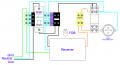
This is close to the actual wiring. I made this drawing so I can trace everything out before powering it up. Pictures to follow.
As for wiring - at present it's just stranded wire clamped beneath the screws. Nothing is tinned or crimped yet.
The lack of a neutral or ground coming out of the receiver (right side) is because ground and neutral are common on both ends of the receiver. I'm only using the switched hot to trigger the relay. Once triggered the relay stays latched until the system is shut down and then re-energized. Even the receiver can not shut it off. That means once activated someone has to respond.
The reset has to be about 2 seconds long. Using a push button to break the connection after the receiver would mean the receiver could still be active, and thus would once again engage the relay and alarm. On the other hand I could put a switch in line with the power to the receiver - but there's already a switch there in the form of a breaker. Given that the breaker is rated for 10 amps one would assume the contacts are rated higher than 10 amps. The receiver itself probably (the key word) isn't drawing more than an amp. The relay also is using very low power. So adding a switch in line from the breaker to the receiver doesn't make a whole lot of sense to me.
As for the other comment about being overkill - - -
This is in keeping with what I already had and intended to use. To be the simplest form I could have used the receiver alone to directly power the alarm without the need for the relay. However, knowing my soon to be patient, she would likely activate then worry about disturbing us (wife and I) and deactivate it. The receiver is just a flip-flop activated by the FOB. So if she activates it - she can't change her mind. In the long run she may be reluctant to activate it at all, but she has to take some responsibility for her recovery. I could have dead-bug wired it but I wanted to do something a little more professional, though this is the first time I've ever used DIN Rail construction. With dead-bug wiring the relay would flop about loosely, and remotely possible short to something unintended. So having things mounted in a way that keeps things in place seemed like a no brainer.
We all build to what we know. Or what we don't know but want to experience. I do this all the time with woodworking, taking on jobs I wouldn't have thought to do otherwise. Right now a client wants a bunch of lumber cut to a 1 to 16 dimension. That means for every 16th of an inch equals 1 inch in model form. 2/16th's by 4/16th's is a 2 x 4 for his model. To do this I made a thin ripping jig. You can find that in my library. A bit dodgy at times with materials not wanting to sit quietly on the table saw, but with practice I've gotten it down to a real science. Something new is a learning experience.

 Facebook
 Google
 GitHub
 Linkedin










 adding plastic waste to our ecosystem though