Do Intersecting SPI signal return paths cause major issues or do they kind of just pass through each other like light?

Thread Starter

tdengineer

Joined Oct 21, 2025
36
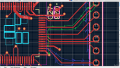
Ads1299 on left.
MCU input pins on right.
SPI signals going between them on layer 1
Layer 2 is a ground plane
0.11mm dielectric between planes
Frequency of signals is around 60mhz. 8ns rise time.

DOUT is GREEN and returns to DGND pin on the ADS1299

DIN is BLUE and returns the the MCU GND pin on the top of the picture out of frame.

I am having a hard time understand how the return paths can literally intersect across each other and not cause a ton of issues.
The traces are spaced more than enough for their frequency. It's just the returns paths.
 

Attachments

WBahn

Joined Mar 31, 2012
32,702
The return path for the image current doesn't come back in through the same pin, but through the DGND pin on that connector. It will then move over to the signal trace as quickly as it can, but then it has to split away to make it over to the DGND pin of the part. This is where the EMC antenna loop comes from. You want to keep the AC loop as small as possible -- you want it to be able to stay as close to the signal trace for as much of the length as possible.

Yes, in the ground plane the signals essentially move through each other like light, though they do interact since the result in the voltage on the ground plane not being the same everywhere (since it's not a perfect conductor), and thus creates an avenue for crosstalk. With a solid ground plane, however, this aspect is pretty well minimized.
 

Thread Starter

tdengineer

Joined Oct 21, 2025
36
The return path for the image current doesn't come back in through the same pin, but through the DGND pin on that connector. It will then move over to the signal trace as quickly as it can, but then it has to split away to make it over to the DGND pin of the part. This is where the EMC antenna loop comes from. You want to keep the AC loop as small as possible -- you want it to be able to stay as close to the signal trace for as much of the length as possible.

Yes, in the ground plane the signals essentially move through each other like light, though they do interact since the result in the voltage on the ground plane not being the same everywhere (since it's not a perfect conductor), and thus creates an avenue for crosstalk. With a solid ground plane, however, this aspect is pretty well minimized.
Ok so basically you can have two return currents just literally passing through each other in the same spot and they will for the most part maintain their paths relatively unimpeded?
 

BobTPH

Joined Jun 5, 2013
11,463
Are you saying you have a junction with two paths in and two paths out and you expect all of the current coming in one path to go out on only one of the out paths? If so, no, it does not work that way. The current coming in on each path finds it way out via both paths, split according to the resistances of the two paths.
 

Thread Starter

tdengineer

Joined Oct 21, 2025
36
Are you saying you have a junction with two paths in and two paths out and you expect all of the current coming in one path to go out on only one of the out paths? If so, no, it does not work that way. The current coming in on each path finds it way out via both paths, split according to the resistances of the two paths.
I dont understand what you're saying. The spi outputs return to the ground pins of the ic that outputted them. The return currents on the ground plane below the top signal layer have to intercept at some point. there is no avoiding it.
 

BobTPH

Joined Jun 5, 2013
11,463
Let me out it another way.

Do you think an electron that enters a chip through a SPI input eventually goes back to the chip it left via a SPI? If so, the answer is still no.
 

BobTPH

Joined Jun 5, 2013
11,463
He's talking about the image currents in the ground plane.
Ok so basically you can have two return currents just literally passing through each other in the same spot and they will for the most part maintain their paths relatively unimpeded?
It is the above statement that I am taking issue with. No, currents in a conductor do not “pass through each other in the same spot.” At any point in space, a current is only flowing in one direction. Perhaps he is not speaking literally, and I do not understand what he is saying.
 

WBahn

Joined Mar 31, 2012
32,702
It is the above statement that I am taking issue with. No, currents in a conductor do not “pass through each other in the same spot.” At any point in space, a current is only flowing in one direction. Perhaps he is not speaking literally, and I do not understand what he is saying.
It's the same with light -- at any point in space the EM field has one configuration at any moment in time. Yet we have no problem talking about two images passing through each other without interacting. Well, they do interact, but in a way that doesn't cause any lasting distortion to either image, provided the medium is linear (if it's nonlinear, all kinds of interesting things, some useful, most not, happen).

The same here. Yes, at any given point the current is a combination of the two, but for most purposes it can be treated as separate, non-interacting currents that are superimposed.
 

Thread Starter

tdengineer

Joined Oct 21, 2025
36
It is the above statement that I am taking issue with. No, currents in a conductor do not “pass through each other in the same spot.” At any point in space, a current is only flowing in one direction. Perhaps he is not speaking literally, and I do not understand what he is saying.
Return currents on a ground plane can overlap and interact
 

Thread Starter

tdengineer

Joined Oct 21, 2025
36
It's the same with light -- at any point in space the EM field has one configuration at any moment in time. Yet we have no problem talking about two images passing through each other without interacting. Well, they do interact, but in a way that doesn't cause any lasting distortion to either image, provided the medium is linear (if it's nonlinear, all kinds of interesting things, some useful, most not, happen).

The same here. Yes, at any given point the current is a combination of the two, but for most purposes it can be treated as separate, non-interacting currents that are superimposed.
Wow. I have been trying to find some visuals of two currens crossing and the vectors but i cant find anything
 

nsaspook

Joined Aug 27, 2009
16,249
Even if they directly crossed eachother horizontally like a plus sign?
Those little current electrons are moving slower than a slug, in a North Dakota winter, in a typical electronic circuit. Without the electric field effects of resistance and inductive reactance they would almost never influence each other.
 

Thread Starter

tdengineer

Joined Oct 21, 2025
36
Those little current electrons are moving slower than a slug, in a North Dakota winter, in a typical electronic circuit. Without the electric field effects of resistance and inductive reactance they would almost never influence each other.
dam i forgot that they move slow im over here thinking in terms of 2 rivers colliding horizontally and creating some messed up vortex intersection lol
 

WBahn

Joined Mar 31, 2012
32,702
I mean a perfect ground plane with zero resistance and inductance would cause no overlap interaction between the two signals.
There would be no interaction due to the physical ground plane, but the image currents are still antenna loops and will cross couple, all the more so if they overlap.
 

nsaspook

Joined Aug 27, 2009
16,249
dam i forgot that they move slow im over here thinking in terms of 2 rivers colliding horizontally and creating some messed up vortex intersection lol
2 rivers colliding is in the EM field, so we need to look for sources of EM field interaction, not electron currents.

Your signal energy travels in the dielectric surrounding the conductors. They form a transmission line (that acts as a single point connection for low frequency signals) for EM signal energy, where that EM energy is used to move electron current into the conductors, it's lost (the amount is usually small with good conductors.). As signal frequencies increase/traces and grounds get longer, that transmission line starts to act less and less like a single point connection, so signal energy travels in the dielectric surrounding the conductors starts to interact across a wider section of board space IRT the constrained area mainly between the conductors.


https://forum.allaboutcircuits.com/threads/ground-plane-power-plane.205342/post-1983325
 
Last edited:

Thread Starter

tdengineer

Joined Oct 21, 2025
36
2 rivers colliding is in the EM field, so we need to look for sources of EM field interaction, not electron currents.

Your signal energy travels in the dielectric surrounding the conductors. They form a transmission line (that acts as a single point connection for low frequency signals) for EM signal energy, where that EM energy is used to move electron current into the conductors, it's lost (the amount is usually small with good conductors.). As signal frequencies increase/traces and grounds get longer, that transmission line starts to act less and less like a single point connection, so signal energy travels in the dielectric surrounding the conductors starts to interact across a wider section of board space IRT the constrained area mainly between the conductors.


https://forum.allaboutcircuits.com/threads/ground-plane-power-plane.205342/post-1983325
yes I understand this i have watched many videos including that one. The exact specific question I had is not directly explained in that video or any others I could find. I ended up speaking with one of the top experts in the field and he broke some stuff down to me similar to some of these replies, I am aware that you are just trying to guide me in the general direction of the associated concepts with what im thinking about i appreciate it a lot. I now understand that the lack of impedance in the ground plane allows currents and fields to overlap with minimal interference although I would still absolutely love to see an exact visualization of it.
 
Top