What is the effect of increasing voltage fed to an electric horn?

Thread Starter

enduro250z

Joined Jul 6, 2010
77
I am trying to work out what the effect of increased voltage is on a 12v electric motorcycle horn is.

The specs on the horn says ‘12v @ 1.5a’ and running that through the ohms law calculator, its 8ohms and draws 18w

What I am trying to work out is does it draw more or less current & power when voltage applied is increased up to 14.5v. Does the resistance stay the same and therefore current and power increases or does power or current stay the same? I couldn’t work out which2 input to the calculator changes and which 2 does not, so I ran the calculations for each 3 scenarios below. I know this has to be basic stuff but since i always try to find the answer to things by searching myself i've searched all over the web and I cant find a good answer of what will happen when the voltage is increased to a horn. Can anyone tell me which is the correct one below? Thanks

ELECTRIC HORN
Specs – ‘12v @ 1.5a’ = 18w & 8ohms

CALCULATIONS

A) If resistance stays at 8ohms


12.5v = 1.56a - 19.53w
13v = 1.62a - 21.12w
13.5v = 1.68a - 22.78w
14v = 1.75a - 24.5w
14.5v = 1.81a - 26.28w

B) If current stays at 1.5amps

12.5v = 1.5a - 18.75w
13v = 1.5a - 19.5w
13.5v = 1.5a - 20.25w
14v = 1.5a - 21w
14.5v = 1.5a - 21.75w

C) If power stays at 18w

12.5v = 1.44a - 18w
13v = 1.38a - 18w
13.5v = 1.33a - 18w
14v = 1.28a - 18w
14.5v = 1.24a - 18w
 

Alec_t

Joined Sep 17, 2013
15,101
A is correct.
Bear in mind that the power rating of many products may be a tad optimistic. It is never a good idea to run things at their maximum rated power if you want them to live a long and happy life. Running at more than the rated power is asking for trouble.
 

LesJones

Joined Jan 8, 2017
4,511
If it is a simple non electronic horn then it will just consist of a solenoid and a set of contacts. The solenoid will attract the diaphragm when energised. The set of contacts will break the circuit cauaing the attraction stop. So the contacts close again . This reapeats at the resonant frequency of the diaphragm. So although you have measured the resistance and calculated the current the average value of the current will be less than that calculated.

Les.
 

MisterBill2

Joined Jan 23, 2018
27,160
Consider that the electric horn is similar to a buzzer, in that as the magnetic force moves the diaphram it opens a contact causing the field to be switched off until it moves back. My experience with increased horn voltage was operating a set of trumpet-style 6 volt horns from an old DeSoto on 12 volts, in a much newer car. The increased power was obvious because they were MUCH LOUDER. The current thru the coil, limited by just the small resistance, was much higher, about twice as much current, in fact. This was compensated by the fact that the contacts opened faster because of the doubled magnetic field force. So while the average current increased, it did not double. The contact wear did increase, I recall opening them and filing the contacts once.

As for the motorcycle horn voltage rising from 12.5 volts to 14.5 volts, consider that the resistance will not change, but that the current thru the coil will certainly increase a bit. But because of the increased magnetic force, the contacts will be open for a bit longer time. so the average power will increase a bit as will the on-state current. But not as much as the math indicates.

The values posted for power and current are mostly useful for service diagnostics. But they are also handy for for legal horn power issues.
 
Last edited:

Thread Starter

enduro250z

Joined Jul 6, 2010
77
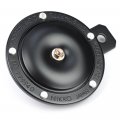
Yes its just a basic solenoid type. Like they have been for over 70-80 years. Same as this photo but smaller version. Its only a horn so it gets intermittent use. 12v horns work fine at up to 14v or there about's which is the typical regulated voltage in a motorcycle system. Its actually more than '12v' so the manufacturers take this into consideration.
So if the resistance will always be 8ohms across the range of voltages, at max voltage i will have 14.5v = 1.81a - 26.28w so i will design the rest of the circuit capable of 1.83a and 27watts and that should be plenty good enough or are you saying that even at 14.5v its never going to draw 1.81a & 26.28w and will be bit less than the calculations?
Thankyou
 

Attachments

LesJones

Joined Jan 8, 2017
4,511
Yes it will draw less than it would if the supply voltage was directly supplying the solenoid. (I.E If the contacts were not allowed to open.) The best thing to do would be to measure the current when connected to the supply. I cant see a way to calculate the current.
Les.
 

Ian0

Joined Aug 7, 2020
13,097
If it is a simple non electronic horn then it will just consist of a solenoid and a set of contacts. The solenoid will attract the diaphragm when energised. The set of contacts will break the circuit cauaing the attraction stop. So the contacts close again . This reapeats at the resonant frequency of the diaphragm. So although you have measured the resistance and calculated the current the average value of the current will be less than that calculated.

Les.
I had one like that With an adjustment screw. At a higher voltage, the magnet attracted the diaphragm and it stuck there until the switch was released. It worked at 12V, but 14.4V was enough to make it stick. So, I had a car where the horn works when the engine is stopped, but stops working as soon as I start the engine.
Shall we say, it wasn’t my speediest bit of fault finding . . .
 

Tonyr1084

Joined Sep 24, 2015
9,744
What is the effect of increasing voltage fed to an electric horn?
More heat.

If you double the voltage you double the current. That results in four times more wattage.
At 12V & 8Ω you see (intermittently) 1.5A. 1.5A x 12V = 18W.
At 24V & 8Ω you see (intermittently) 3A. 3A x 24V - 72W. Four times the wattage. That means four times the heat to be dissipated. Given that you're only tapping the horn momentarily and merely periodically, the heat should not be too much of a concern. But it IS a factor that needs to be considered.

And as others have said, the current draw is only when the diaphragm is moving in the (let's call it) positive direction. As soon as the contacts open the current ceases and the diaphragm stops moving forward and returns in the negative direction. And as soon as the contacts close the whole thing repeats. At whatever resonant frequency the diaphragm resonates at. I'd opt for a 50% time of positive movement and 50% time of negative movement. Based on 50/50 I'd say the average wattage would be half of what you're seeing. The best way to determine the average current is to use an amp meter. But keep in mind that when the points (contacts) break there's going to be a BEMF (Back Electro Motive Force) or high voltage kickback. Considering the higher operating voltage that would mean an even higher BEMF. Points will be more likely to fail quickly.

Since you ponder the effects of using a higher voltage, from where do you intend to get the extra V? You mention 14.5V but that's common for only a short period of time. Once the battery has taken a recharge the voltage should settle down around 13.6 to 13.8V. And because the resistance doesn't change (relatively speaking - higher heat will increase the resistance, thus lowering the current) you can assume with relative accuracy what the current will be during normal (13.8V) operation.
At 13.8V & 8Ω, current is 1.725A and 23.8W. The difference in wattage from 12V to 13.8V is only a mere 5.8W. OK, that's not an insignificant change but it isn't a huge change either. Likely the horn manufacturer has taken these max numbers into consideration when engineering the operation of the horn. Yes, it's going to be louder at 13.8V (normal operation) versus just blowing the horn without the engine running. Depending on the state of charge of the battery, 12V to 12.6V is normal. Below 12V and the battery is old and weak. 12.6V is a new battery.
 

MisterBill2

Joined Jan 23, 2018
27,160
The voltage was only increasing two volts. Not at all like me running the two sx volt horns on 12 volts. That did make it louder. That was back in 1967, and the donor car was probably 15 years old at the time. And the horns never burned out. Of course, they did not get used a whole lot. But they were very effective.
 

Thread Starter

enduro250z

Joined Jul 6, 2010
77
The 14.5v can be measured at the battery at higher RPM's when there is little to no other load on the system. But more specifically in my case i am working with an AC system (no battery), which will require a bridge rectifier for the horn. So the horn will receive DC. AC horns are hard to find/not common, and i want to use the nice quality Japan made12v DC ones i bought.. AC regulators can typically be 13.-14.5v. Anything much more than than 14.5v shortens the life of halogen globes. I have not got up to testing the cut off voltages of the regulators i have yet but i plan to do that once i get a 24v power supply i can hook the regulator to and test on a bench. I have this one https://www.trailtech.net/en-us/sho.../ac-regulator-adjustable-power-dimmer-switch/ which is adjustable up to about 16v. Most are fixed to a set voltage and of course with lower RPM's the alternator out put will drop a bit so at idle there is often 12v or maybe a l little less if its not a alternator with lot of output or not wound for good low rpm output. I will hook that horn up to a 12v DC battery and see if its current compares to the 1.5a spec. I haven't got a DC supply that be set to 14.5v but when i have the 24v AC supply i can use this regulator/rectifier https://www.trailtech.net/en-us/sho...gulator-rectifier-150-watt-full-wave-w-relay/ which has adjustable output voltage . Then i can set up a steady DC 14.5v supply for testing. I will be needing to figure out the best design for the bridge rectifier and capacitor. to work on the AC system. Still trying to get my head around that. That will be a question for another thread though. Thanks again.
 
Last edited:

MisterBill2

Joined Jan 23, 2018
27,160
If the horn is not at all electronic, it may work quite well with an AC supply. Unless it has a diode in somewhere in the system. Is there any information available about the horn??
 

Tonyr1084

Joined Sep 24, 2015
9,744
I will be needing to figure out the best design for the bridge rectifier and capacitor. to work on the AC system.
When converting AC to DC through a single diode you get a pulsing DC losing half of the wave form. When using a capacitor to filter out that pulsation you get a higher voltage. When converting AC to DC through a bridge rectifier you still get a pulsating DC but you don't lose that half wave. But filtering will give you a substantial increase in voltage.

Assuming full wave rectification and capacitive filtration 12VAC will result in 16.97VDC. Depending on how heavy a load you place on that voltage it will drop. Especially if the source voltage doesn't have a lot of power behind it. Just be aware that rectifying AC and filtering it results typically in an increase of 1.414 times the AC voltage. That's because AC is measured in RMS (Root Mean Squared). In other words, the effective voltage of AC is 0.707 times the peak voltage. 12VAC RMS has a Peak voltage of 16.968V Peak AC.
 

MisterBill2

Joined Jan 23, 2018
27,160
Given that it seems we do not have any details about the horn, except for voltage and current, I suggest an experiment with a simple single diode in series. IF the performance is adequate then a single diode will be the solution. At the same time, a similar experiment would be to test the operation on the AC supply. That would allow the very simplest installation with the best reliability and the lowest cost.
 

Thread Starter

enduro250z

Joined Jul 6, 2010
77
There would not be anything 'electronic' in the horn as far as i am aware. These are the same old school type horns been the same since the 70's. I could be wrong but i very much doubt it. Its the MF type here http://www.nikko-global.com/en/products/

I think they are similar to a relay inside, therefore the coil wont like AC.

Today I connected up a 12v battery to the horn to see what the current draw was. Battery I pre charged a few hrs earlier and sat at 12.72v. Connected the horn and to my surprise the amp meter showed around 0.700-0.750amps. It jumped around a bit. After the test the voltage dropped to 12.68 on the battery. No where near the claimed 1.5amp current. I then connected a battery charger to the battery and it was measuring 16v at the terminals. Tested current draw when I operated the horn and it was around 0.900 – 1amp. So what does this mean? Its draws no where near 1.5amps. Maybe 1.5a is the limit, but i cant see how it would see a voltage over 16 unless it it was connected to a 24v system. No bikes are 24v and this is specifically a bike horn. not car/truck.
 

Thread Starter

enduro250z

Joined Jul 6, 2010
77
When converting AC to DC through a single diode you get a pulsing DC losing half of the wave form. When using a capacitor to filter out that pulsation you get a higher voltage. When converting AC to DC through a bridge rectifier you still get a pulsating DC but you don't lose that half wave. But filtering will give you a substantial increase in voltage.

Assuming full wave rectification and capacitive filtration 12VAC will result in 16.97VDC. Depending on how heavy a load you place on that voltage it will drop. Especially if the source voltage doesn't have a lot of power behind it. Just be aware that rectifying AC and filtering it results typically in an increase of 1.414 times the AC voltage. That's because AC is measured in RMS (Root Mean Squared). In other words, the effective voltage of AC is 0.707 times the peak voltage. 12VAC RMS has a Peak voltage of 16.968V Peak AC.
Yep this is what i have learnt in the past week. I knew about full wave rectification but was not aware of the 1.414 voltage increase. Years ago i just connected a bridge rectifier and away i went. Horn did not sound the best but it was good enough for legallity and to pass competition test inspections. This time i want filtering and to do thing's a little better and am hoping to use the same rectifier set up for LED tail light. But like i said I will start a thread specific to that a bit later when i am ready and assume i don't find solutions my self before hand to controlling/reducing the voltage after the filtering. If the horn really does pull less than 1am which my tests today showed, then i can make my rectifier set up not have to suit such a broad current range. I haven't ruled out having one for horn and one for the tail light either but if i can do it as 1 unit its a bit simpler. Thanks for the help.
 

MisterBill2

Joined Jan 23, 2018
27,160
The current measured in post #14 was certainly the average current of a 50% duty cycle 1.5 amps. Just what it should be.
As for the horn "being like a relay inside", similar but not the same. And a DC relay will certainly operate on AC, but not as well. THAT is why I suggested trying it with and without a single series diode, with NO FILTER CAPACITOR.
 

be80be

Joined Jul 5, 2008
2,394
I can't imagine that a horn like that posted isn't made to be used at 14 volts seeing thats what most all car or motor bike battery are charged to.
 

MisterBill2

Joined Jan 23, 2018
27,160
There would not be anything 'electronic' in the horn as far as i am aware. These are the same old school type horns been the same since the 70's. I could be wrong but i very much doubt it. Its the MF type here http://www.nikko-global.com/en/products/

I think they are similar to a relay inside, therefore the coil wont like AC.

Today I connected up a 12v battery to the horn to see what the current draw was. Battery I pre charged a few hrs earlier and sat at 12.72v. Connected the horn and to my surprise the amp meter showed around 0.700-0.750amps. It jumped around a bit. After the test the voltage dropped to 12.68 on the battery. No where near the claimed 1.5amp current. I then connected a battery charger to the battery and it was measuring 16v at the terminals. Tested current draw when I operated the horn and it was around 0.900 – 1amp. So what does this mean? Its draws no where near 1.5amps. Maybe 1.5a is the limit, but i cant see how it would see a voltage over 16 unless it it was connected to a 24v system. No bikes are 24v and this is specifically a bike horn. not car/truck.
Your meter is reading the AVERAGE current of the horn, which is open circuit half the time. So the on portion of the current is 1.8 amps. To read the actual on-time current you will need a peak reading ammeter.
 

Thread Starter

enduro250z

Joined Jul 6, 2010
77
I also tried it on a bigger car battery as my small bike battery could have been suspect. It was fitted to a bike in 2022 and been out of service for a while. Don't know its history. Just found it i my workshop. Seems to be ok but i wanted to just try it on the car to be sure i was getting a good reading not affected by batteries condition. Much the same result though about .700-.900a. So I guess i will go back to the first post and still base everything around these predicted specs.
A) If resistance stays at 8ohms

12.5v = 1.56a - 19.53w
13v = 1.62a - 21.12w
13.5v = 1.68a - 22.78w
14v = 1.75a - 24.5w
14.5v = 1.81a - 26.28w

By the way do you have suggestions on sourcing a " peak reading ammeter. "
 

MisterBill2

Joined Jan 23, 2018
27,160
Some digital multimeters have a peak read option, many do not. Using an ammeter shunt with a half-wave rectifier and a capacitor filter could provide a close to peak reading.
AND, seriously, I suggest an experiment to see what the horn sounds like powered directly from the bike AC 12 volt system. That will certainly be the simplest arrangement for the horn installation.

ALSO, I am guessing that the reason for adding a horn is to make an off-road only bike street legal.
 
Top