What is a diode?

Thread Starter

Sulvek

Joined Aug 27, 2022
25
I know diodes allow for flow in only one direction but I don't understand why that is needed. What is a real life situation it would be required? I thought DC only flowed in one direction considering it isn't alternating. I'm aware there are a lot of diode types and applications but if anyone could put into a nut shell a very basic application they would be great.
 

MrChips

Joined Oct 2, 2009
34,758
Welcome to AAC!

There are about a dozen or more applications of diodes.

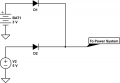
Here is just one of them. You can call this an uninterruptible power supply (UPS).

1661623920338.png

This is an automatic battery backup power switch (also known as an OR circuit).
Either the battery BAT1 or mains power adapter V2 will power the circuit. If there is a mains power failure the battery automatically takes over to power the system.
 

Papabravo

Joined Feb 24, 2006
22,080
I know diodes allow for flow in only one direction but I don't understand why that is needed. What is a real life situation it would be required? I thought DC only flowed in one direction considering it isn't alternating. I'm aware there are a lot of diode types and applications but if anyone could put into a nut shell a very basic application they would be great.
  1. Diodes are used in conjunction with a capacitor, to convert an AC voltage into a DC voltage
  2. A diode in conjunction with a capacitor can be used as a peak detector
  3. Diodes can be used to clamp a voltage to a specific level
  4. Diodes can be used to clip or limit an incoming voltage waveform
  5. Diodes can be used as transient voltage suppressors
  6. Diodes can be used in a RF mixer to multiply two incoming RF signals and produce outputs that are the sum and the difference in frequency
Shall I continue?
 

Thread Starter

Sulvek

Joined Aug 27, 2022
25
  1. Diodes are used in conjunction with a capacitor, to convert an AC voltage into a DC voltage
  2. A diode in conjunction with a capacitor can be used as a peak detector
  3. Diodes can be used to clamp a voltage to a specific level
  4. Diodes can be used to clip or limit an incoming voltage waveform
  5. Diodes can be used as transient voltage suppressors
  6. Diodes can be used in a RF mixer to multiply two incoming RF signals and produce outputs that are the sum and the difference in frequency
Shall I continue?
Thanks a lot! So in the case of the rectifier circuit why is a capacitor needed?
 

dl324

Joined Mar 30, 2015
18,308
I'm aware there are a lot of diode types and applications but if anyone could put into a nut shell a very basic application they would be great.
There are too many to list. It would be better if you did some learning on your own and asked questions about specific cases that you can't understand.
 

narkeleptk

Joined Mar 11, 2019
586
Thanks a lot! So in the case of the rectifier circuit why is a capacitor needed?
There are so many good videos on this subject. I would suggest asking google this question and searching the video results.

Short answer, Its stores energy to filter ripple.
 

Papabravo

Joined Feb 24, 2006
22,080
Thanks a lot! So in the case of the rectifier circuit why is a capacitor needed?
The rectifier acts like an absolute value function, turning the negative peaks into positive peaks. The capacitor holds the value of the positive peaks with only a small amount of droop between the peaks which is 8.33 milliseconds or the period equivalent to twice the line frequency. That would be 120 Hz. in North America.
 

MrSalts

Joined Apr 2, 2020
2,767
I know diodes allow for flow in only one direction but I don't understand why that is needed. What is a real life situation it would be required? I thought DC only flowed in one direction considering it isn't alternating. I'm aware there are a lot of diode types and applications but if anyone could put into a nut shell a very basic application they would be great.
For DC supplies, a diode can be used in parallel if you have an ac to DC adapter to power your device plus a battery back up. Current won't flow from adapter into battery because the diode is like a back flow preventer for gasses or liquids. If the adapter's voltage drops, the battery will not charge the adapter.

also, you can connect four diodes as a bridge so the DC will always be the right polarization (you don't have to worry if batteries are connected backwards or if the AC to DC power adapter's barrel connector should be "center positive" vs "center negative".
 

Thread Starter

Sulvek

Joined Aug 27, 2022
25
The rectifier acts like an absolute value function, turning the negative peaks into positive peaks. The capacitor holds the value of the positive peaks with only a small amount of droop between the peaks which is 8.33 milliseconds or the period equivalent to twice the line frequency. That would be 120 Hz. in North America.
Thanks. I understand now. I saw in a video the dc output before and after a capacitor. While working in HVAC for years I have always used capacitors but never seen anything on a scope until now. I just always thought of capacitors like a juice box for things that need a little extra sugar lol.
 

Papabravo

Joined Feb 24, 2006
22,080
Thanks. I understand now. I saw in a video the dc output before and after a capacitor. While working in HVAC for years I have always used capacitors but never seen anything on a scope until now. I just always thought of capacitors like a juice box for things that need a little extra sugar lol.
I hope that at some point your level of mathematical accomplishment will allow you to appreciate the behavior of devices that depend on the time rate of change of some quantity.
  1. For an inductor it is the time rate of change in current through the inductor that determines the voltage across it. Energy is stored in the magnetic field
  2. For a capacitor it is the accumulated charge over time that determines the voltage across it. Energy is stored in the electric field.
 
Top