what happen to the rest battery voltage when using voltage regulator ?

panic mode

Joined Oct 10, 2011
5,099
if you want efficiency do NOT use linear regulator (regardless if zener or 7805 or whatever), use SWITCHING regulator...
any regulator will add losses but losses using switching regulator are going to be much smaller and it will extend usable battery life
 

Thread Starter

andrew132

Joined Feb 2, 2017
96
This sounds quite a bit like homework. If so, what is the actual problem that was assigned?
its not a homework i was wondering about how to calculate efficiency while using regulator and diode zener and i want to know why regulator is better than diode zener
 

WBahn

Joined Mar 31, 2012
32,975
its not a homework i was wondering about how to calculate efficiency while using regulator and diode zener and i want to know why regulator is better than diode zener
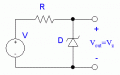
The regulator is specifically designed to not need a lot of excess current to achieve regulation. The zener regulator circuit is extremely brute force and requires a no load current through the zener that is considerably more than the maximum current in the load will ever be.

Sketch a classic 6 V zener circuit that is, say, powered from a 12 V DC source and that needs to deliver up to 2 A to the load. Further, let's say that the zener has to have a minimum current of 100 mA in order to achieve regulation. Don't worry about whether a suitable zener is available, let's assume that one is.

What is the lowest resistance that the load can be without violating the 2 A spec?

Starting with that lowest resistance, pick ten different loads by doubling the resistance for each one. A spreadsheet can make these calculations really fast and easy.

No calculate the power delivered to the load and the power drawn from the 12 V source. That's all that's needed to calculate the efficiency.

It's also instructive to calculate the power dissipated in the zener and in the resistor that's between the supply and the zener.
 

crutschow

Joined Mar 14, 2008
38,584
its not a homework i was wondering about how to calculate efficiency while using regulator and diode zener and i want to know why regulator is better than diode zener
The typical voltage regulator is a series type regulator and can be designed to draw only a slight amount of additional current (perhaps a few mA) in addition to the load current.

The zener is a shunt type regulator and must always draw the maximum load current plus the minimum zener current to stay in regulation.

This means that a zener (shunt) regulator always has a poorer efficiency than a series regulator, expect at full load, where they are near equal.
For that reason, shunt regulators are typically only used for small loads of perhaps a few tens of mA or less (such as to generate a reference voltage) where the lower efficiency is not a concern.
 

Thread Starter

andrew132

Joined Feb 2, 2017
96
The regulator is specifically designed to not need a lot of excess current to achieve regulation. The zener regulator circuit is extremely brute force and requires a no load current through the zener that is considerably more than the maximum current in the load will ever be.

Sketch a classic 6 V zener circuit that is, say, powered from a 12 V DC source and that needs to deliver up to 2 A to the load. Further, let's say that the zener has to have a minimum current of 100 mA in order to achieve regulation. Don't worry about whether a suitable zener is available, let's assume that one is.

What is the lowest resistance that the load can be without violating the 2 A spec?

Starting with that lowest resistance, pick ten different loads by doubling the resistance for each one. A spreadsheet can make these calculations really fast and easy.

No calculate the power delivered to the load and the power drawn from the 12 V source. That's all that's needed to calculate the efficiency.

It's also instructive to calculate the power dissipated in the zener and in the resistor that's between the supply and the zener.
i thought that i can calculate efficiency using 1 load
 

WBahn

Joined Mar 31, 2012
32,975
i thought that i can calculate efficiency using 1 load
That makes it all the more important to do the exercise that I outlined!

Plot the efficiency as a function of load (either of resistance or of load current) and you will see why this isn't the case.
 

WBahn

Joined Mar 31, 2012
32,975
You can.
What don't you understand about efficiency?
So what single load resistor will tell you the efficiency of a zener-based regulator?

The efficiency is a strong function of the load for such a regulator. It is near zero at light lights and near unity just before regulation fails at heavy loads.
 

crutschow

Joined Mar 14, 2008
38,584
So what single load resistor will tell you the efficiency of a zener-based regulator?
Any single load will tell you the efficiency with that load.
Obviously it varies with load.
The efficiency is a strong function of the load for such a regulator. It is near zero at light lights and near unity just before regulation fails at heavy loads.
It only approaches unity if the zener voltage is near the input voltage.
Otherwise the maximum efficiency is the same as a series regulator, i.e. Vout/Vin.
 

WBahn

Joined Mar 31, 2012
32,975
Any single load will tell you the efficiency with that load.
Obviously it varies with load.
Which is what the question was about. I think just a miscommunication.

It only approaches unity if the zener voltage is near the input voltage.
Otherwise the maximum efficiency is the same as a series regulator, i.e. Vout/Vin.
True -- mental faux pas on my part.
 

MrChips

Joined Oct 2, 2009
34,956
Put what ever value you want. The efficiency still remains the same.
If the load takes 1A @5V, power to the load is 1A x 5V = 5W
The battery still has to deliver 1A @ 12V = 24W
Efficiency = ( 5W / 12 W ) x 100 = 42%

For better efficiency, use a switching supply.
 

WBahn

Joined Mar 31, 2012
32,975
I don't think I've heard a rule of thumb that the zener current should be 10x the load current, either.

While I agree that this will nail down the zener voltage pretty securely since the current in it will always be within about 5% of the middle, I think the more typical approach is to ensure that the minimum current is well above the knee. There are a number of factors that come into play, of course, such as how variable the load is and how variable the supply voltage is. If both are pretty rigidly fixed, then you can get by with a lot less current in the zener.
 
Top