Hi all.
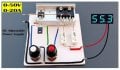
the circuit of adjustable voltage used TIP3055, there are two 0.1 Ohm 5W resistances from TIP3055's Emittor to output +, what function of this resistance for? can it be replaced by 2W R or even remove it? what will be?
They're ballast resistors to have the power transistors share current more evenly.
They messed up because the voltage drop on the ballast resistors and base emitter junctions will impact the output voltage. The output from the regulator should be tied to the low side to maintain voltage regulation (10A*0.1Ω=1V!! and the junctions will add a similar drop).
Take a good look at your output transistors. No two transistors, even matched pairs we run on a curve tracer will have identical conduction characteristics. So as mentioned we use ballast resistors to help even or balance the load on the transistors. Low resistance high wattage and if you remove them you can figure on replacing output transistors. I also agree that under full load I would be using higher wattage rated resistors.
They're ballast resistors to have the power transistors share current more evenly.
They messed up because the voltage drop on the ballast resistors and base emitter junctions will impact the output voltage. The output from the regulator should be tied to the low side to maintain voltage regulation (10A*0.1Ω=1V!! and the junctions will add a similar drop).
Do the calculation. With a 20A output, each resistor will have 10A through it. Would even 5W be sufficient?
Take a good look at your output transistors. No two transistors, even matched pairs we run on a curve tracer will have identical conduction characteristics. So as mentioned we use ballast resistors to help even or balance the load on the transistors. Low resistance high wattage and if you remove them you can figure on replacing output transistors. I also agree that under full load I would be using higher wattage rated resistors.
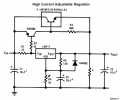
I'd be inclined to do something like this from a National Semiconductor datasheet:
The LM195 don't require ballast resistors because they're integrated power transistors that have protection built-in, as well as emitter ballast resistors.
I'd be inclined to do something like this from a National Semiconductor datasheet: View attachment 321069
The LM195 don't require ballast resistors because they're integrated power transistors that have protection built-in, as well as emitter ballast resistors.
The circuit in post #1 has serious thermal issues. That is a polite way of saying it cannot meet its own specs, and is innergoogle garbage.
If you dial down the output voltage from 50 V to 1 V and draw 20 A, the transistors and resistors are dissipating a minimum of 980 W, or around 500 W *per transistor*. That's a lot. IF you look at the datasheet for the transistor, you will see that it has a maximum power dissipation spec. that is waaaay less. So even if you had a very large heatsink with two fans, the parts still would fry.
This applies to *any* linear regulator at this power level. Better to re-examine your requirements and tell us the max-min voltage range you really need, and the max output current.
The LM195 don't require ballast resistors because they're integrated power transistors that have protection built-in, as well as emitter ballast resistors.
True, but it is rated for only 2.2 A and is relatively expensive, so it would take at least 20 of them for this application (based on what we know now). Better to use 10 real 10 A power transistors for a lot less, spreading out the worst case heat to around 100 W per device.
As you can see, a 1 kW linear power supply is not a simple design task.
The circuit in post #1 has serious thermal issues. That is a polite way of saying it cannot meet its own specs, and is innergoogle garbage.
If you dial down the output voltage from 50 V to 1 V and draw 20 A, the transistors and resistors are dissipating a minimum of 980 W, or around 500 W *per transistor*. That's a lot. IF you look at the datasheet for the transistor, you will see that it has a maximum power dissipation spec. that is waaaay less. So even if you had a very large heatsink with two fans, the parts still would fry.
This applies to *any* linear regulator at this power level. Better to re-examine your requirements and tell us the max-min voltage range you really need, and the max output current.
True, but it is rated for only 2.2 A and is relatively expensive, so it would take at least 20 of them for this application (based on what we know now). Better to use 10 real 10 A power transistors for a lot less, spreading out the worst case heat to around 100 W per device.
As you can see, a 1 kW linear power supply is not a simple design task.
If you stick with 0.1 ohms per transistor, the worst case power dissipation in each resistor is 10 W. That means you should use a resistor rated for 20 W. This is a common rule of thumb for improved reliability. And safety - those resistors will be so hot they will melt fingerprints.
Ten, 1 ohm, 2 W resistors in parallel will be big and bulky, but will work fine.
If you stick with 0.1 ohms per transistor, the worst case power dissipation in each resistor is 10 W. That means you should use a resistor rated for 20 W. This is a common rule of thumb for improved reliability. And safety - those resistors will be so hot they will melt fingerprints.
Ten, 1 ohm, 2 W resistors in parallel will be big and bulky, but will work fine.
I prefer to vary voltage: 0 - 48v if possible, may never use large current when in low V, but holp to have the best.
if it seems not possible with this KIND of design?
any simple other design?

 Facebook
 Google
 GitHub
 Linkedin