What Do MOSFET Specs Mean?

Thread Starter

oKCfGYhmJQi

Joined May 3, 2019
60
I was wondering if someone could correct/add to the definitions I have written below. I'm trying to understand what the various specifications associated with N-Channel MOSFETs in the Mouser table mean so I can select one. I'll be switching the transistor on and off fairly slowly, feeding 12-14v into its gate, which will in turn trigger another 12-14v across the drain-source. The component drawing energy across the latter will draw in the neighborhood of 5 amps, so we're looking at around 60-70 watts. I want to get a MOSFET that won't even come close to overheating and I'm unclear about how to go about it. I've read a bit and wanted to see if forum members would be so kind as to confirm or correct my understanding of these key terms:

Id — Continuous Drain Current
This number indicates the limit for the current that can be passed across the Drain-Source circuit.

Vgs — Gate Source Voltage
This number indicates the voltage differential that, when measured across the Gate and Source, results in the optimum operating condition, as indicated by the lowest resistance across the Drain-Source circuit. Applying voltage lower that Vgs results in a higher resistance on the Drain-Source circuit, and increased heat build-up in the MOSFET when power is passed through the Drain-Source circuit. Applying voltage higher than Vgs across the Gate and Source results in the same condition, and to a greater degree — that is, a volt higher than Vgs across the Gate and Source will generally increase the Drain-Source resistance (and heat) more than a volt lower will increase them. Systems should be designed to result in a voltage across the Gate and Source as close to Vgs as possible. It's better to be a little under than a bit over.

Vds — Drain Source Breakdown Voltage
This number indicates the voltage differential that, when measured across the Drain and Source, results in the resistance between these two being overcome and current being allowed to flow. This is a "fail mode" and as such, is above the limit for the voltage that should be switched with the component.

Rds On — Drain-Source Resistance
This number indicates the resistance measured across the Drain-Source circuit when the voltage differential between the Gate and Source is at Vgs.

Pd — Power Dissipation
This number indicates the limit of the MOSFET's ability to pass power across the Drain-Source circuit to a destination component without experiencing physical failure. Applying a particular voltage across the Gate and Source will result in a corresponding resistance across the Drain-Source circuit. Passing a given voltage through the Drain-Source circuit to a component with a particular resistance will result in a corresponding current passing across the Drain-Source circuit. This current can be calculated by dividing the voltage across the Drain-Source circuit by (the resistance across the Drain-Source circuit, added to the resistance across the component's leads). The power being dissipated can be found by multiplying this current by the voltage. This number must be kept under the Pd specification of the MOSFET.

I'm uncertain about all of these (*some especially), so please correct me. Thank you.
 

crutschow

Joined Mar 14, 2008
38,503
Vgs — Gate Source Voltage
This number indicates the voltage differential that, when measured across the Gate and Source, results in the optimum operating condition
That's not a complete definition.
Vgs has a least three values of interest:

One is the Vgs threshold voltage, which is the voltage where the MOSFET just starts to conduct current (typically rated at a mA or less of source-drain current).
The MOSFET operates near that Vgs voltage when being used as a linear amplifier.

The second is the Vgs voltage required to fully-turn the transistor on as a switch.
That voltage is stated where the Ron resistance value is given in the data sheet.
It's typically 10V for a standard MOSFET and 5V or less for a logic-level type MOSFET.
Operation below those voltages can result in an on-resistance higher than its rating.

The third is the maximum Vgs that can be applied without damage to the gate oxide.
It's typically ±20V, but can be less for some of the logic-level MOSFETs which have a thinner oxide layer.
 

Thread Starter

oKCfGYhmJQi

Joined May 3, 2019
60
Every one of your definitions contains inaccuracies. What research did you do to come ip with these?

Bob
These are literally me reading a bunch of junk on the web and inferring the heck out of stuff. Honestly I figured I'd be off in many respects, and so I'm asking people for help in straightening out my understanding. Feel free to correct.
 

Thread Starter

oKCfGYhmJQi

Joined May 3, 2019
60
That's not a complete definition.
Vgs has a least three values of interest:

One is the Vgs threshold voltage, which is the voltage where the MOSFET just starts to conduct current (typically rated at a mA or less of source-drain current).
The MOSFET operates near that Vgs voltage when being used as a linear amplifier.

The second is the Vgs voltage required to fully-turn the transistor on as a switch.
That voltage is stated where the Ron resistance value is given in the data sheet.
It's typically 10V for a standard MOSFET and 5V or less for a logic-level type MOSFET.
Operation below those voltages can result in an on-resistance higher than its rating.

The third is the maximum Vgs that can be applied without damage to the gate oxide.
It's typically ±20V, but can be less for some of the logic-level MOSFETs which have a thinner oxide layer.
Thank you, this is very helpful. I was wondering how to figure out what Vgs value I should look for, knowing the voltage I would be feeding to Gate. So it sounds like there are different flavors of Vgs as reported on the sheets, and that they're really more about establishing a range. The first is a threshold, which is the start of the "usable" range. The second is the "optimum" voltage in a condition where the MOSFET is being used as a simple switch, and can be found by looking for the Ron value and find the Vgs that's listed with it. And the third is the maximum, which is the end of the "usable" range. Correct?
 

Thread Starter

oKCfGYhmJQi

Joined May 3, 2019
60
Every one of your definitions contains inaccuracies. What research did you do to come ip with these?

Bob
Reading through the link provided by @danadak, I'm not finding a lot of errors in what I have written above, which has me worried. I'd be interested in hearing your specific corrections.
 

BobTPH

Joined Jun 5, 2013
11,514
Continuous drain current: It is not the max current the MOSFET can carry, it is the max it can carry continously. There is usually another spec that specifies a higher current that can be used intermittently with some period and duty cycle.

Vgs. In addition to what Crutshow said, there is not an optimal gate voltage. The resistance becomes lower as the raise the voltage until the gate breaks down and the device is destroyed. The Vgs max is not a recommended voltage to use it is the voltage above which it will be destroyed. Normally you would stay well below this voltage. The Vgs specified in Rdson specs is just that, the gate voltage at which it is measured. There are often several voltages mentioned with corresponding on resistances.

Vds. No, it not the voltage at which current flows. It is the voltage at which the device breaks down and is likely destroyed.

Rdson. Almost right, but only in the linear region of operation. If the MOSFET is operating in the saturated region. In the saturated region, the current barely changes with changes in Vds.

Power dissipation. No, it is not the amount of power the MOSFET can deliver to another device. That would generally be way higher when the MOSFET is fully on. For example, a MOSFET rated at 60V and 20A can deliver a power of 1200 Watts to, say a motor it is controlling. If the Rdson of that MOSFET is 100mOhm, then the power dissipation in the MOSFET, while supplying 1200 Watts to the motor is 160 Watts. This is the power limit that the power dissipation spec give you, how much the MOSFET itself can dissipate. And this specified max is only with massive heat sinking.

Bob
 

crutschow

Joined Mar 14, 2008
38,503
So it sounds like there are different flavors of Vgs as reported on the sheets, and that they're really more about establishing a range. The first is a threshold, which is the start of the "usable" range. The second is the "optimum" voltage in a condition where the MOSFET is being used as a simple switch, and can be found by looking for the Ron value and find the Vgs that's listed with it. And the third is the maximum, which is the end of the "usable" range. Correct?
Basically.
But I wouldn't call it different flavors of Vgs, it's just Vgs for different modes or conditions of operation.

One other Vgs voltage of interest is 0V, where it is totally off as a switch.
 

Thread Starter

oKCfGYhmJQi

Joined May 3, 2019
60
Continuous drain current: It is not the max current the MOSFET can carry, it is the max it can carry continously. There is usually another spec that specifies a higher current that can be used intermittently with some period and duty cycle.

Vgs. In addition to what Crutshow said, there is not an optimal gate voltage. The resistance becomes lower as the raise the voltage until the gate breaks down and the device is destroyed. The Vgs max is not a recommended voltage to use it is the voltage above which it will be destroyed. Normally you would stay well below this voltage. The Vgs specified in Rdson specs is just that, the gate voltage at which it is measured. There are often several voltages mentioned with corresponding on resistances.

Vds. No, it not the voltage at which current flows. It is the voltage at which the device breaks down and is likely destroyed.

Rdson. Almost right, but only in the linear region of operation. If the MOSFET is operating in the saturated region. In the saturated region, the current barely changes with changes in Vds.

Power dissipation. No, it is not the amount of power the MOSFET can deliver to another device. That would generally be way higher when the MOSFET is fully on. For example, a MOSFET rated at 60V and 20A can deliver a power of 1200 Watts to, say a motor it is controlling. If the Rdson of that MOSFET is 100mOhm, then the power dissipation in the MOSFET, while supplying 1200 Watts to the motor is 160 Watts. This is the power limit that the power dissipation spec give you, how much the MOSFET itself can dissipate. And this specified max is only with massive heat sinking.

Bob
Very helpful, thank you Bob. Especially with the Power Dissipation, I can see there's something important that I don't quite grasp yet. So with what you said above, I'm wondering how you derived the 160 Watts dissipation in the MOSFET while supplying 1200 Watts to the device.… Can you point me to the equation?
 

BobTPH

Joined Jun 5, 2013
11,514
The equation is:

P = I^2 R

I is 20, R is 0.1 so:

P = 20^2 * 0.1 = 40

Whoops, I got it wrong the first time!

A lot of beginners have this same misconception. The power dissipation spec has nothing to do with the power in the device the MOSFET Is controlling. It is the power wasted in the MOSFET itself due to the current through it and the on resistance.

Bob
 

crutschow

Joined Mar 14, 2008
38,503
The power dissipation spec has nothing to do with the power in the device the MOSFET Is controlling. It is the power wasted in the MOSFET itself due to the current through it and the on resistance.
It can also be the power dissipated in the MOSFET when used as an amplifier, such as in the output stage of an audio power amp.
That power is not related to the MOSFET's on-resistance.
 

Thread Starter

oKCfGYhmJQi

Joined May 3, 2019
60
Thank you all. I think I've got some of the story now, but I am curious how to select a part if I know that I don't want a heat sink on it.

Let's use a real-world example. Let's say I wanted to use an N-channel MOSFET as a relay on a motorcycle (which I do), which runs on 12 volts. First off, we know the 12 volt figure is incorrect, and that the system will actually be a little north of 13 volts, so let's say 13. Let's say we'll be using the same voltage for both Vgs and Vds.

The device I'll be powering with the Drain-Source circuit will draw 5 amps.

Vgs = 13 volts
Vds = 13 volts
Id = 5 amps

So let's say we find a MOSFET with an Rds(on) of 1.3 mOhms where Vgs = 10 volts (and the MOSFET is rated as having a Vgs limit of 20 volts). This would give us:

P = I^2 • R
P = 5^2 • 0.0013 = 0.0325 watts

Correct?

So if the total power dissipation, Ptot, is listed as 338 watts with a mounting base temperature, Tmb, of 25°c (77°F), decreasing linearly to 0 watts at Tmb = 175°c (347°F …wow), does that mean I'm in the clear? How can I tell what Tmb will be for my application? I would think that air temperature and current would need to be accounted for, at least…

Now to make this a little more real, let's look at an actual spec sheet. Here's a MOSFET I found by looking on Mouser's catalog, and from which I've taken the above Rds(on) and Ptot figures.

Nexperia PSMN1R1-30PL,127

I arrived at this one by looking at Mouser's MOSFETs table, filtering to just those with a Vgs of 10-15 volts (note: looking at the spec sheets, I am guessing that Mouser's Vgs column seems to be tracing the "saturation" Vgs, so I've aimed for values near my known range… correct me if I'm wrong), then sorting the table by Rds(on) and selecting the lowest one. I did this with the idea that the one with the lowest resistance would be the best in terms of temperature management, but I'm not sure if this is a good approach. I'm also curious whether I'm missing something here. It seems like my demands for this part are so far below the limits that perhaps I'm using the wrong part…

Here's the Mouser search I mentioned:

MOSFETS
 
Last edited:

shortbus

Joined Sep 30, 2009
10,050
filtering to just those with a Vgs of 10-15
That's a pretty narrow segment, since you will find more that work to 20V. But 10V will still turn them on fully, the 10V is the common number for a non-logic level mosfet gate. And just ignore the term "threshold" has no meaning in what your doing.

sorting the table by Rds(on) and selecting the lowest one.
That's good.

It seems like my demands for this part are so far below the limits that perhaps I'm using the wrong part…
Electronic parts should always be chosen for a higher value. Like 1 1/2 to 2 times the needed value for most things. Doing that gives a part a better chance of making a lasting circuit, by letting it operate below it's maximum, that's always a good thing.
 

Thread Starter

oKCfGYhmJQi

Joined May 3, 2019
60
Electronic parts should always be chosen for a higher value. Like 1 1/2 to 2 times the needed value for most things. Doing that gives a part a better chance of making a lasting circuit, by letting it operate below it's maximum, that's always a good thing
My concern, though, is that I'm overlooking something, or that I'm not actually calculating Tmb, as I mentioned, "How can I tell what Tmb will be for my application? I would think that air temperature and current would need to be accounted for…"
 

BobTPH

Joined Jun 5, 2013
11,514
The device I'll be powering with the Drain-Source circuit will draw 5 amps.

Vgs = 13 voltsVds = 13 volts
Id = 5 amps
If Vds is 13 volts and you are passing 5 amps, the power dissipated in the MOSFET is 5 * 13 = 65 Watts!

But do not despair.

Vds will only be 13V when the MOSFET is fully off and no current is flowing, and therefore the power is 0.

When the MOSFET is fully on, Vds will be I * Rdson.

A TO-220 can handle 1 Watt easily with no heat sink. So design backwards from this:

P = I^2 * Rdson = 1

25 Rdson = 1

Rdson = 1 / 25 = 40 mOhm

Bob
 

Thread Starter

oKCfGYhmJQi

Joined May 3, 2019
60
If we're saying that Vds is the voltage drop across the Drain-Source circuit, isn't it true that there is never a useful scenario involving the part I've described where Vds is 13 volts, Id is 5 amps and Ptot = 65 watts? Isn't this because, in order for the MOSFET to be dissipating 65 watts while passing 5 amps, wouldn't the voltage drop across just the Drain-Source circuit of the MOSFET need to be 13 volts, meaning Rds would be 2.6 ohms ( R = V / I )? This would entail a very low Vgs. It would also imply that nothing else appeared in series with Drain-Source, since we're accounting for the full amps in just the MOSFET (resistance and voltage drop) numbers…

Screen Shot 2019-05-11 at 14.58.46.png

I was thinking that Vds was the voltage drop across a circuit with multiple devices, the MOSFET being one of them, as opposed to a voltage drop across just the MOSFET. But I could be wrong. Does "Vds = 13 volts" mean that on the circuit with Drain-Source, this is the voltage being applied in total — is this the power source voltage — or is Vds really the drop across Drain-Source?

I got the second part of your rationale above, but the first part threw me for a loop. But it made me think this through. In combination of what I've been reading about basic electronics these past few days, this has been a great exercise, and I appreciate your insight. I particularly appreciate the bit where you said the TO-220 could easily handle 1 watt without a heatsink. Is "TO-220" shorthand for "a MOSFET with a total power dissipation rating of 220 watts?" << nevermind. I found out this is the type of case this part uses.

In case I'm wrong, please allow me to further explain my thinking so you can correct me. When the MOSFET is fully on, the voltage drop across the MOSFET will be equal to [ Id • Rds(on) ]. While all devices wired in series experience the same current, they each experience their own voltage. Given that my plan is to run this off of a 13-volt system (motorcycle), 13v is the voltage for the whole circuit. We can only use 13v in the equations [ V = I • R ] and [ P = V • I ] when the I and the R in those equations also account for the entire circuit, which in this case includes an accessory with a much higher resistance. Because this resistance of the accessory is so much higher than Rds(on), this accessory will have a much higher voltage drop than the MOSFET, and thus bear the lion's share of the power dissipation. Essentially, the accessory's higher resistance protects the MOSFET so while we have a very low Rds, we only have 5 amps of current flowing through the circuit, including through the MOSFET…

If we didn't have the accessory — if we just went battery(+)-->MOSFET-->battery(-) — then we could use this 13v with the MOSFET's numbers alone to describe the scenario. In this case 13 volts applied across the Drain-Source circuit with an Rds of 1.3 mOhms would fry the MOSFET immediately. This would occur because with this low resistance, we would experience extremely high current: [ I = V / R = 13 / 0.0013 = 10^4 amps ] (that worked out neat). This would imply a power dissipation of [ P = I^2 • R = 10^ 8 • 1.3e-3 = 1.3e5 watts ]. Vaporized. On fire.

Back in real life, we know the accessory being driven in series with the Drain-Source circuit will draw 5 amps and consume 65 watts when fed 13 volts (manufacturer's specs), so we can imply this accessory has a resistance of 2.6 ohms, and it's the much lower current allowed to pass through this device as a result of this resistance that we have used in calculating the power dispersion in our MOSFET, which again, sees the same current as the accessory but not the same voltage.

But to be thorough, let's also note that the Drain-Source circuit in the MOSFET is not perfectly transparent. It actually increases the circuit's total resistance to 2.6013 ohms, thus lowering the circuit's current to 4.9975 amps (-0.05% compared to 5 amps) when fed 13 volts. And so we'll be dropping 12.9935 volts across the 2.6 ohm accessory, leaving 0.0065 volts (calculated as either as 13 volts - 12.9935 volts; or 4.9975 amps by 0.0013 ohms) to drop across the MOSFET, resulting in a power dissipation of 0.03247 watts in the MOSFET, a slight decrease compared to our earlier calcs (0.035 watts), where we simplified by leaving the effect of the MOSFET's resistance out of the value for current. This simplification was possible because the accessory's resistance would be so much higher than the MOSFET's, correct?

Interesting… just looking at the [ P = I^2 • R ] equation, increasing resistance seems to increase the power dissipation linearly. However, the current is also decreasing linearly in relation to the resistance, and this current appears in power dissipation as well. Furthermore, since the current is squared in the power equation, an increase in resistance results in an exponential decrease in the current factor of the power equation, resulting in a net decrease in power dissipation.

P = I^2 • R = ( V^2 / R^2 ) • R = V^2 / R

So increasing resistance decreases power dissipation. However this does not always suggest a practical strategy for dealing with too much power. For example, using thinner wire increases resistance, but it also lowers power dissipation tolerances. And with "wire thinning," these tolerances presumably drop faster than dissipation does, because thinner wire definitely fries more readily than its thicker cousin, which I suppose would tend to fry other items on the same circuit (power sources, devices) instead, were they of deficient power dissipation ratings, with all those amps rushing across the thick wire due to less resistance. Must be why fuse wire is thin.

Incidentally, would this indicate that energy-consuming devices (like a lightbulb or a motor) are always designed to have higher resistances, or do design goals tend toward lower resistances, with the idea being to turn power dissipation into something useful, such as light or mechanical energy?
 

Attachments

Last edited:

Thread Starter

oKCfGYhmJQi

Joined May 3, 2019
60
This has really got me thinking… this is great.

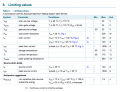
So in re-reading my post above I'm wondering if I am misunderstanding what Vds actually means. Here I'm thinking of the datasheet, where it says "maximum" and lists the Vds limit at 30 volts. It also lists the Ptot (power dissipation) limit as 338 watts:
Screen Shot 2019-05-11 at 17.34.05.png

For convenience, here is the link to the doc from which I pulled the above screenshot: https://assets.nexperia.com/documents/data-sheet/PSMN1R1-30PL.pdf

I thought the Vgs limit there was saying "don't hook this to anything higher than 30 volts."

So here's my question: Is the Vds limit related to how much of a given circuit's charge can be 'sunk into' the MOSFET rather than what voltage can be applied to the circuit in which the MOSFET appears? If so, is there a limit as to the voltage that can be applied to the entire circuit where the MOSFET appears, or is the voltage ceiling unlimited with tolerances only dependent on how much voltage is dropped across Drain-Source? If the circuit voltage is limited but the Vds limit isn't actually it, where do manufacturers specify this quantity?

If Vds = 30v really is the maximum voltage drop across the Drain-Source circuit, and the Ptot power dissipation must be at or below 338 watts (with heat sink), then does this imply that the current can only be higher than 11.27 Amps ( I = P / V => 338w / 30v ) if we place another device on the circuit with it?

Also, does it imply that with an Rds of 2.66 ohms [ R = V / I ] this component could withstand a 30 volt circuit on its own (with a heat sink)?
 
Last edited:
Top