What did you repair today ?

nsaspook

Joined Aug 27, 2009
16,405
Blue, even for cosmetics, sucks IMO. It's not the best for night vision or low light level clarity of dials (our eyes easily refocus on blue point sources), green would be better if you don't like red. I would change it if it was in my darkened shack back when we did 12 hours shifts in a vault.
 
Last edited:

SamR

Joined Mar 19, 2019
5,516
FYI here is the original incandescent burned-out bulb and the BLUE silicone tubing that it was encased in. So, it was always a shade of blue light.
IMG_1487[1].JPG
 

SamR

Joined Mar 19, 2019
5,516
Getting closer on my efforts to get all my antennas back up and tuned. All are back up (plus a couple of additions and changes) but not all tuning with low SWR.

3 Verticals- 10M 5/8 wave, Marine VHF, and 2M/90cm all working and low SWR.

There are still some problems with my wire antennas.
I took the new Alpha Delta DX-CC dipole down as I could not get a decent SWR tuning on it (capacitive coupling due too close to our metal roof) and put a 300W rated Off Center fed Dipole back up but will be taking it back down and putting up another Off Center Dipole antenna that I have for comparison. Am able to tune it on 15 and 20M and I've made a few contacts on 15 & 20M with it.

I put up another End Fed Half Wave Sloper and getting decent tuning on the 15, 20, and 40M bands. Able to get SWR to ~1.0 with the autotuner in my XCVR.

Then there are 2 antennas meant to be for my all band receiver but capable of also being used for transmit as well. They aren't giving a tuneable transmit value. One is an 111' End Fed Long Wire Sloper and it is (at best) only tuning (pre antenna tuner adjustment) with 2.6SWR on 15M @21.06MHz which is at the very bottom of the band and a 3.0SWR @ 21.7MHz which is a bit above the 21.44MHz end of the band. The other is another Alpha Delta SWL Sloper which MAY be used below a Yagi antenna on a tower. I did hang it from my 40' tower but there is no set of beams above it to act as a capacitive "hat". Not high on my priority list but some promising results. I am using them with my SDR dongle for band scanning with its computer software.

I had built with a hand wound toroid balun another End Fed Half Wave 10-40M sloper antenna but got terrible results so replaced it with the one above that does tune well. I did discover some loose coax connections on my window pass through bulkhead fittings and tightened all the bulkhead fittings.

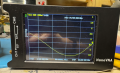
I've been giving my NanoVNA a pretty good workout testing coax and lightning arrestor dB insertion loss values and testing coax and antennas for SWR in the Amateur frequencies for 10 through 80M. Still not quite there on 40 & 80M and haven't even looked at 6M yet but at least making some progress!
 

nsaspook

Joined Aug 27, 2009
16,405
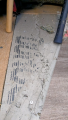
Bad spot on the older daughters floor in their old house. I hate DUROC and the idiot that that put in that patch without a proper support.
1757455763732.png
1757455787074.png
Clean it up, screw what's left back down and put some flex patch in the void. It's old carpet they plan on replacing soon.
 

MrChips

Joined Oct 2, 2009
34,987
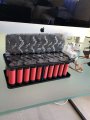
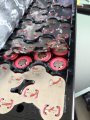
I’m in the process of repairing a 36 V battery pack for an ebike.
There are forty 18650 cells configured as 10S4P. One group of four cells connected in parallel is reading 0 V. The suspicion is that one cell is shorting. So now I have to break the welds to find the bad cell.

IMG_2289.jpeg

Wish me luck.

Edit: Looks like I am stymied. The way the battery pack was assembled, all the individual cells were sandwiched between the two plastic holders and then the contacts were spot welded to the cells. I would have to break all the welds on one side to get one cell out of the pack.
 

MrChips

Joined Oct 2, 2009
34,987
I have released the spot weld of one cell and have determined that I should be able to slide the cell out without having to dismantle the entire pack.

I am sitting in the south of France right now and have almost zero access to the tools I need to do this repair. I have found one 1.5 V D cell which I am going to use to put some charge into the suspect cell. All I have for hookup wire is a piece of #18 wire that was used to tie back shrubs in the garden.

I know that eventually I have to ride a non-electric bike to the nearest DIY store to get a soldering iron, solder, and wire. The store is about 30 minutes away but the hills are murder.

I will post progress reports as I make headway.

Edit: I should have mentioned that I already bought a cheap DMM yesterday.
 

MrChips

Joined Oct 2, 2009
34,987
Progress update.

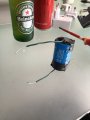
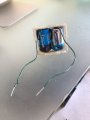
Here is my new improvised 3 V cell charger using the plastic blister packaging.

IMG_2296.jpeg

I charged three drained cells to 2.5 V each using the two D cells shown in the photo above. The entire battery pack now appears to be accepting charge from the AC charger.

I am going to order 18650 cells with solder tabs and will attempt to replace all four cells in that group since I had to break the welds, which are not actually welds but 4 angled puncture points through the connector and cell top and bottom.
 

Wolframore

Joined Jan 21, 2019
2,619
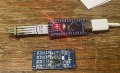
I took an AVR ICSP board I made and made it work with a NANO,
Then took an old project ATTINY13 with switched MOSFETS and made my wife's Halloween houses flash with lightening. The next project is pulsing lights for the Skull house eyes.

1758716033525.jpeg
 

SamR

Joined Mar 19, 2019
5,516
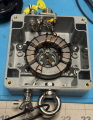
I built a 1:49 balun from a kit by HFkits of Great Britain that is being sold by the American Radio Relay League.
1758770780866.png
So, 50Ω x 49 = 2450Ω which for testing purposes I wired a few resistors together and placed across input/output and using my nanoVNA swept its input from 6.5 - 30MHz.
1758771075122.png
UH-OH! Not so good! So I recounted the turns and discovered I had 6x8 instead of 7x7. Dismantled and removed the windings and rewound carefully and as tightly as I could with evenly spaced turns and retested.
1758772044446.png
Now, pretty much all below a 1.5 SWR. Next to rehang it and test it in free air as a 10-40M End Fed Half Wave sloper antenna. Still to determine whether grounded end or ungrounded counterpoise. Starting with grounded. These seem to be the Antenna D'Jour now and not one of my favorites. I used to have inverted Vee multitrap dipole multiband antennas using Unadilla Traps (no longer made) that I worked stations all over the US and Europe with. I really miss those antennas! Those Unadilla Traps made some fine "shortened" multiband antennas but for some reason fell out of popularity. With limited real estate, multiband antennas are my goto. I have several monoband vertical antennas with ground planes on top of masts that work OK but a really good vertical antenna requires a large ground plane of radials installed to work properly. So far, I have 3 elevated vertical antennas on masts and this 10-40M EFHW, a 10-80M end fed long wire, an off center fed dipole, and a parallel end fed sloper SWL wide band antenna for listening only. So, I have my antenna farm back up but am now fighting to get it all tuned for max performance.
 

MrChips

Joined Oct 2, 2009
34,987
To wrap up the ebike battery repair, four 18650 cells and a soldering iron kit arrived. Three cells were replaced and the battery pack was repaired. I took the bike out for a test run for two hours on flat and hilly terrain. All went well.

This was not a simple repair by any means. One cell was leaking current and not holding a charge. Since I had to break the connection to three cells, I realized that I would have to replace all three cells even if they were still good.

Here are three problems encountered.
1) Lead-free solder is used in Europe. I could not find leaded solder.

2) I bought the highest wattage soldering iron kit (80 W, 500°C) I could find for a reasonable price. My Weller 140 W soldering gun would have been nice.

3) The cells are interconnected with large areas of metal that required a high wattage soldering iron. The one that came in the kit is designed for printed circuit work, not for this kind of repair. It had very low thermal capacity. I had made the correct decision to order replacement cells with solder tabs. Even then, making a proper solder connection proved to be difficult. I just managed to do the best I could given the tools I had.

Repair completed.
 
Top