What capacitor to use for 1940's project?

Thread Starter

xtal_01

Joined May 1, 2016
227
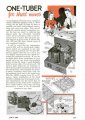
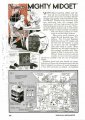
So, I got the bug to build a one tube regenerative radio.

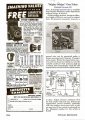
I found a design from 1940 that looks promising.

Question ... what capacitors do I use?

There are only three ... a .0001 MFD ... a .0002 MFD ... and a .5 MFD

The first two are Mica and the third I am guessing was paper.

The radio should cover the SW bands ... so say 1.8MHz to 30 MHz

What is the modern equivalent caps?

I am also having a bit of problems finding the choke ... I am thinking maybe I can wind one? Might also be a bit of a rabbit hole ... started reading about RF winding (Pi winding) and litz wire and ....

Thanks so much ....
Popular_Mechanics_07_1940_0177.jpgPopular_Mechanics_07_1940_0178.jpgPopular_Mechanics_07_1940_0223.jpg
 

LowQCab

Joined Nov 6, 2012
5,101
I would say that finding a ~45-Volt-Battery would be the biggest challenge.
But then I wouldn't recommend Batteries for a generally "non-portable" Short-Wave-Receiver.
An inexpensive, ~48-Volt Toroidal-Transformer would make a fine Power-Supply, and
the 4.5-Volt, and the 1.5-Volt-Power-Supplies can
easily be Hand-Wound on to the same Toroidal-Transformer.
All Mains-Isolated for safety.

A massive Power-Supply-Choke is not at all necessary with a modern Power-Supply design,
and much larger Bulk-Storage-Capacitors are readily available in the modern-World,
unlike the "good-'ole" days when this Radio was first conceived as a DIY-Project,
and a time when large-value Capacitors were massive and very expensive..

A Modern 2.5mH-RF-Choke will not "look" the same as the old-skool one,
and it will very likely have much better performance.

How bad do You want this project to look 100% "authentic" ?

Keep in mind that this Radio has no Audio-Amplifier that can drive a Speaker.
It will push "Crystal-Head-Phones" only.
But, of course, that Head-Phone-Output will drive any modern Integrated-Circuit-Audio-Amp
that can easily drive a Large-Speaker.
And, the Toroidal-Transformer can also Power the modern-Audio-Amp.

Crystal-Head-Phones may be difficult to find now days.

Can You find a ID-8-GT Vacuum-Tube ?, and a matching Socket for it ?
And, a matching Grid-Clip.

Can You find a Socketed Coil-Former and instructions for
all of the exact-dimensions, and exact-number of Turns, of what gauge-of-Magnet-Wire ?
The Radio will not work without exact Tuning of this Coil.
I wouldn't think that these "standard" Coils are produced commercially any more,
but who knows,
there may be a very dedicated Ham-Radio-Operator who will put one together for You.

C-1 Antenna-Trimmer should be readily available,
but should be made accessible on the Front of the Cabinet.

C-2 Tuning-Capacitor Should also be readily available,
( or at least a value that's close enough to work satisfactorily ).

C-3 Unidentified-Ceramic-Capacitor, most likely, 10nF will work ok, but also try a 1nF.

C-4 Mica-Capacitor may be replaced with a common COG/NPO rated Ceramic-Capacitor.

C-5 Main-Power-Supply-Filter-Capacitor, can be increased to 4.7uF at 63-Volts, Electrolytic-Capacitor.

The Audio-Transformer is a completely unknown quantity, except for having a ~3-to-1 Turns-Ratio.
Perhaps someone more familiar with Tubes could make an educated-guess for You as to the other Specs.

The Long-Wire-Antenna, and an excellent Ground-Connection,
will dictate the performance potential of this type of Radio.

Below is a Schematic that You might find interesting .........
.
.
.
 

Attachments

DickCappels

Joined Aug 21, 2008
10,661
The MK484 is good for the AM broadcast band but runs out of gas shortly past that.

Just about any small signal JFET should work to 30 MHz. If you want to do it with a tube, go ahead and start with this circuit.

My preference, in your case, would be to use a store-bought RF Choke rather than trying to wind your own, unless you have some experience hand-winding coils.
 

nsaspook

Joined Aug 27, 2009
16,276
Who listens to SW radio these days?
I do but I'm a former professional Radioman that uses it for working side-tone to keep that snooping audio part of the brain busy. It's a lot better than local 'Talk' radio. I also go FTA sat comm for mainly the same reason.
1744986745857.png

I don't work on old tube radio stuff anymore because that was the type of gear I repaired and operated on in the early years of my professional radio days. Lost interest, like working too long in the best possible donuts shop.
 
Last edited:

MaxHeadRoom

Joined Jul 18, 2013
30,609
I do but I'm a former professional Radioman that uses it for working side-tone to keep that snooping audio part of the brain busy. It's a lot better than local 'Talk' radio. I also go FTA sat comm for mainly the same reason.
Did you ever operate with Morse code?

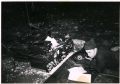
1744988837362.png

Keying out - Somwhere in the Libyan desert.
 

nsaspook

Joined Aug 27, 2009
16,276
Did you ever operate with Morse code?

View attachment 347400

Keying out - Somwhere in the Libyan desert.
I did at radio school and quickly forgot it as soon as I was at a station, in a location, with only emergency Morse capability. We had a nice Morse key but it was locked in a case that if you need to use code, you needed permission from the watch supervisor. Well, I was the watch supervisor on shift for two years at the station. Nobody asked for the key and if they did ask for, it was dooms-day because that key was for the backup TACAMO EAM authorization for nuclear launch. We had the book of daily authenticate codes the President uses. Some kids, fresh from code school would likely send the codes for WWIII.
https://www.northropgrumman.com/what-we-do/air/manned-aircraft/e-130j-tacamo
1744991350618.png
Navy's Take Charge And Move Out (TACAMO) mission
https://www.acq.osd.mil/ncbdp/nm/NMHB2020rev/chapters/chapter2.html
Facilities include the National Military Command Center (NMCC), the Global Operations Center (GOC), the E-4B National Airborne Operations Center (NAOC), and the E-6B Take Charge and Move Out (TACAMO)/Airborne Command Post.

The primary facility is the NMCC located within the Pentagon. The NMCC provides daily support to the President, the Secretary of Defense, and the CJCS, allowing for the monitoring of nuclear forces and ongoing conventional military operations.

Another command center resides within USSTRATCOM Headquarters at Offutt Air Force Base in Nebraska. The USSTRATCOM GOC enables the Commander of USSTRATCOM to conduct command and control while also enabling the day-to-day management of forces and the monitoring of world events.

If fixed command centers are destroyed or incapacitated, several survivable alternatives exist to which NC2 operations can transfer, including the E-4B NAOC and the E-6B TACAMO/Airborne Command Post (Figures 2.2 and 2.3). A NAOC aircraft is continuously ready to launch within minutes from random basing locations, thus enhancing the survivability of the aircraft and the mission.
 

Thread Starter

xtal_01

Joined May 1, 2016
227
You can still get mica RF capacitors and the other C5 is a old style electrolytic you can still find online.
Self-winding the frontend tuning coils would likely be the best option. Finding old stuff is hit and miss
https://www.rfparts.com/coils-and-c...0jsUnwgbX0uuWWHq3T3ielKkimNtjx-YomhpD4VIUZSMg

1.8MHz to 30 MHz is far too ambitious for this type of receiver.
Thanks for the link. Two questions if I may ...

1) is the line on the old style cap still negative? I just want to be sure to put it in the right way. In this radio, it looks like battery B is grounded ... the A battery positive goes to ground ... and the C battery does not go to ground at all.

2) why do you say 1.8 to 30 is ambitious? I have been trying to read up and figure out what limits the frequency of a radio. I was hoping since this was a bit newer of a tube and that it had coils I could swap out, it might do 30 but maybe not. There is nothing listed it the article about the frequencies it will cover. What makes a radio cover a wider band?
 

nsaspook

Joined Aug 27, 2009
16,276
We used the Russion news transmission site in the morse class, Itar-Tass, TX 24hrs a day at 22WPM.
I copied their Itar-Tass TTY service out of Afghanistan in the late 70's during the Soviet invasion. Strange that it was in English (likely torn-tape stolen from other news services) but most of the news was accurate if it was in the Soviets interest to send it.
 
Last edited:

MrChips

Joined Oct 2, 2009
34,725
Thanks for the link. Two questions if I may ...

1) is the line on the old style cap still negative? I just want to be sure to put it in the right way. In this radio, it looks like battery B is grounded ... the A battery positive goes to ground ... and the C battery does not go to ground at all.

2) why do you say 1.8 to 30 is ambitious? I have been trying to read up and figure out what limits the frequency of a radio. I was hoping since this was a bit newer of a tube and that it had coils I could swap out, it might do 30 but maybe not. There is nothing listed it the article about the frequencies it will cover. What makes a radio cover a wider band?
What radio transmissions do you hope to receive on the short wave bands?
 

nsaspook

Joined Aug 27, 2009
16,276
Thanks for the link. Two questions if I may ...

1) is the line on the old style cap still negative? I just want to be sure to put it in the right way. In this radio, it looks like battery B is grounded ... the A battery positive goes to ground ... and the C battery does not go to ground at all.

2) why do you say 1.8 to 30 is ambitious? I have been trying to read up and figure out what limits the frequency of a radio. I was hoping since this was a bit newer of a tube and that it had coils I could swap out, it might do 30 but maybe not. There is nothing listed it the article about the frequencies it will cover. What makes a radio cover a wider band?
It's an old, one tube, regen type receiver. You will be lucky to get a few 1MHz with that design.

A much better design with a 3A4 low voltage surface charge tube: https://www.tubesandmore.com/products/vacuum-tube-3a4-pentode-power-amplifier
https://w5dxs.tripod.com/receiver.htm


For anyone that enjoys old time radio as I do, this is a must do project. This receiver is a simple one tube regenerative type using minimum parts count and low voltages. Although very simple in design it is an excellent performer. The information for this receiver came from the September 1995 issue of CQ, pg. 48, "Red Hot Radio Returns". I made a few changes to the original circuit that really enhanced performance.
Cost of the project was $ 6.00 and a little scrounging in the junk box.

Receiver Circuit Diagram

My receiver is built in a 4 x 8 inch aluminum chassis. The front panel is 4 inches high. A vernier drive is required for tuning. This is because moving the capacitor a thousandth of an inch will change the frequency. It is very sensitive and must be tuned slowly. The tuning capacitor should have a value of between 90-100 pf. I used the smaller section of a dual gang capacitor from a 5 tube broadcast set having 9 plates. The pot for regeneration adjustment should be 1,000 ohm.
Coil construction is very important as it greatly affects receiver performance. I used a 1 inch o.d. pill bottle for the form and #22 enamel covered wire. This wire is about .016 of an inch in diameter. Both coils are close wound and wound in the same direction. L2 is 7 turns and I made L1 is 22 turns. Coils should have 1/4 inch spacing between them. L1 will affect frequency coverage. Using 22 turns and the tuning capacitor I used gives me a frequency coverage of 3500 kc to 8200 kc. It is important to keep the coil leads under two inches. Using less turns on L1 would raise the frequency. I am happy with my combination because it covers 80 & 40M ham bands as well as much of the popular shortwave broadcast bands. Copying code with this receiver is easy.
 

Thread Starter

xtal_01

Joined May 1, 2016
227
I would say that finding a ~45-Volt-Battery would be the biggest challenge.
But then I wouldn't recommend Batteries for a generally "non-portable" Short-Wave-Receiver.
An inexpensive, ~48-Volt Toroidal-Transformer would make a fine Power-Supply, and
the 4.5-Volt, and the 1.5-Volt-Power-Supplies can
easily be Hand-Wound on to the same Toroidal-Transformer.
All Mains-Isolated for safety.

A massive Power-Supply-Choke is not at all necessary with a modern Power-Supply design,
and much larger Bulk-Storage-Capacitors are readily available in the modern-World,
unlike the "good-'ole" days when this Radio was first conceived as a DIY-Project,
and a time when large-value Capacitors were massive and very expensive..

A Modern 2.5mH-RF-Choke will not "look" the same as the old-skool one,
and it will very likely have much better performance.

How bad do You want this project to look 100% "authentic" ?

Keep in mind that this Radio has no Audio-Amplifier that can drive a Speaker.
It will push "Crystal-Head-Phones" only.
But, of course, that Head-Phone-Output will drive any modern Integrated-Circuit-Audio-Amp
that can easily drive a Large-Speaker.
And, the Toroidal-Transformer can also Power the modern-Audio-Amp.

Crystal-Head-Phones may be difficult to find now days.

Can You find a ID-8-GT Vacuum-Tube ?, and a matching Socket for it ?
And, a matching Grid-Clip.

Can You find a Socketed Coil-Former and instructions for
all of the exact-dimensions, and exact-number of Turns, of what gauge-of-Magnet-Wire ?
The Radio will not work without exact Tuning of this Coil.
I wouldn't think that these "standard" Coils are produced commercially any more,
but who knows,
there may be a very dedicated Ham-Radio-Operator who will put one together for You.

C-1 Antenna-Trimmer should be readily available,
but should be made accessible on the Front of the Cabinet.

C-2 Tuning-Capacitor Should also be readily available,
( or at least a value that's close enough to work satisfactorily ).

C-3 Unidentified-Ceramic-Capacitor, most likely, 10nF will work ok, but also try a 1nF.

C-4 Mica-Capacitor may be replaced with a common COG/NPO rated Ceramic-Capacitor.

C-5 Main-Power-Supply-Filter-Capacitor, can be increased to 4.7uF at 63-Volts, Electrolytic-Capacitor.

The Audio-Transformer is a completely unknown quantity, except for having a ~3-to-1 Turns-Ratio.
Perhaps someone more familiar with Tubes could make an educated-guess for You as to the other Specs.

The Long-Wire-Antenna, and an excellent Ground-Connection,
will dictate the performance potential of this type of Radio.

Below is a Schematic that You might find interesting .........
.
.
.
Thanks for the info and the design. I actually wanted to say with a battery set. I would need only 5 nine volt batteries together. I don't care so much for looks ... I might after I get one working. I do have some 2000 ohm head sets that I use on crystal radio sets. I found the tube on ebay for $10. Just wanted to try a tube project for once .... this looked interesting.
 
Top