Facebook
 Google
 GitHub
 Linkedin
So, I'm trying to troubleshoot some RS485 problems that I think are due to leakage paths on our PCB, and I looked at the datasheet to see if I could tell what the internal circuit was like, and what sort of resistance I should expect from "A" and "B" inputs to ground. What I found was resistors measured in kW. Not what I expected.
I tried googling this, and got nowhere. I did find an RS485 design guide (also from TI) which also uses this unit in some places. What is it? Should I just treat it as ohms and move on with my life?
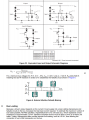
Aside from the units of impedance question, I suppose I may as well ask for help with my real issue while I'm here. Based on measurements from working boards, it seems like the resistance from "A" or "B" to device ground (pin 5) is anywhere from 2-20M. Meanwhile, I've got a malfunctioning board which measures all over the place, but generally between 30-70k from either pin to ground. I'm assuming that whatever leakage path is causing this difference in resistance readings is also the reason for our data corruption issues, but it's weird that the diagram in the datasheet seems to imply there should be lower resistance paths to ground within the chip... assuming "W" actually equals ohms, then the chip has a 54k path to ground from each input. Is that ground an internal signal ground that's separate from the chip ground on pin 5?
It's not critical that I understand every bit of these impedance questions, but it would help a lot with diagnostics if I could tell people the resistance from A or B to ground should always be at least [insert value here] ohms. Right now my real world measurements and what I think I'm reading in the datasheet aren't lining up at all.
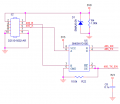
I don't think it should matter, but here's how the RS485 chip is incorporated into our circuit. There aren't any deliberate paths to ground for those data lines, so theoretically, measuring corresponding pins at J2 should be the same as measuring input pins on the RS485 chip.
Any insights on the "W" impedance units and/or what internal chip resistance I should be able to measure would be greatly appreciated. Thanks!
I tried googling this, and got nowhere. I did find an RS485 design guide (also from TI) which also uses this unit in some places. What is it? Should I just treat it as ohms and move on with my life?
Aside from the units of impedance question, I suppose I may as well ask for help with my real issue while I'm here. Based on measurements from working boards, it seems like the resistance from "A" or "B" to device ground (pin 5) is anywhere from 2-20M. Meanwhile, I've got a malfunctioning board which measures all over the place, but generally between 30-70k from either pin to ground. I'm assuming that whatever leakage path is causing this difference in resistance readings is also the reason for our data corruption issues, but it's weird that the diagram in the datasheet seems to imply there should be lower resistance paths to ground within the chip... assuming "W" actually equals ohms, then the chip has a 54k path to ground from each input. Is that ground an internal signal ground that's separate from the chip ground on pin 5?
It's not critical that I understand every bit of these impedance questions, but it would help a lot with diagnostics if I could tell people the resistance from A or B to ground should always be at least [insert value here] ohms. Right now my real world measurements and what I think I'm reading in the datasheet aren't lining up at all.
I don't think it should matter, but here's how the RS485 chip is incorporated into our circuit. There aren't any deliberate paths to ground for those data lines, so theoretically, measuring corresponding pins at J2 should be the same as measuring input pins on the RS485 chip.
Any insights on the "W" impedance units and/or what internal chip resistance I should be able to measure would be greatly appreciated. Thanks!