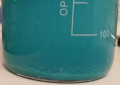
If no sulfur atoms are added then the solution is not likely a sulfate. But since most copper ion solutions are blue, the copper from the wire is clearly part of the solution. And copper does plate from solution quite readily. It could be copper oxide, even.
Although I did take the chemistry courses, I am not a master chemist by any means.
What is missing is the notation that there is an electric field present. At least my GUESS is that the TS applied an electrical potential between two electrodes, with at least one of them being copper. But now, reviewing the posts, BOTH of the electrodes are copper.
AND, once again, MOST copper-ion solutions tend toward blue, while electrical arcs from copper tend towards green. Also copper containing combustion products. (Probably toxic as well).
There was electrolysis applied to both copper electrodes to get this substance over period of several hours.
So copper carbonate can just look almost like copper sulfate in the right conditions?
I did filter it through 4 layers of coffee filters stacked to try to remove all the particles and solids I could. and I repeated and it was still coming out blue every time. no change. the particles must be molecule sized.
I re-experimented with epsom salt and it seems like it'll work I just need to use very pure ingredients. Distilled water won't cut it.
And I think the tin content is dramatically affecting the result reducing the effectiveness.
Need to use extremely pure lead plates also. very very thin ones. as thin as 0.3mm
Deionized type 1 water the purest stuff I can get my hands on. No unwanted side-reactions
And maybe also some unbleached parchment paper. since its just porous enough to wick the electrolyte through capilary action. and strong enough to prevent short circuits.
Using epsom salt/magnesium sulfate seems to work if I give it enough time. need about 75-90% saturated solution so it doesn't want to precipitate out of solution
Also going to use 2mm thick no-flux soldering wire as the terminals to give me something more durable.
So the copper-blue was not particles,it was a solution. Thus no particles to filter out.
One piece of information: Solder is not a pure substance, it is an alloy, unless you have found "pure lead" wire solder, which I don't even know if that is available. So much for pure materials. Not pure lead, anyway.
And now the question: What is the TS trying to achieve?? Battery development has been going on for at least a hundred years and so developing anything that is new and practical is not likely, especially when using common chemicals.
I know the soldering wire was not pure solder. That wasn't the point though!
I actually ordered some thin 100% lead roll sheets to try to use instead. 0.3mm very thin! from the fishing section
along with some 100% lead wire rolls 2mm diameter with no flux for connecting to the batteries. from the fishing section
this is just fun diy project experiment! it doesn't need to be serious.
I'm trying to achieve some fun!
No I did not use epsom salt in my copper electrode experiment at all.
Should of made a new topic on the copper experiment.
I tried epsom salt in a lead electrode battery experiment. No copper though. thats why the mention of TIN and lead
Completely separate experiments.
Should of split into a different thread. Sorry about the confusing string of events.
ok for my homemade battery it seems boric acid is completely useless. does not conduct even at 24v with the electrodes nearly touching.
Magnesium sulfate only "poorly" works. but has problems with precipitate buildup and junk. corrosion of the negative electrode.
Sodium carbonate works well in the right concentration level. but its way too dangerous to use. way too nasty.
Sodium bicarbonate works ok at full saturation. not quite as good as sodium carbonate but close enough its a good compromise. and safer.
Lead just works way better at long duration capacity and high power output. Higher energy density for the win.
Even baking soda and water as the electrolyte. its capable of holding a charge and running for a good while!
just baking soda and water alone is able to make it run for a long time.
over an hour running a small DC motor so far!
I believe this idea could be expanded upon using a really fine powder layer of lead particles pressed tightly to the lead electrode surfaces. wrapped tightly in a coil/roll.
and the capacity would be 100-1000x higher than my plain rolled sheet lead foil electrodes.
So instead of 100mAh it would be 1000-10,000mAh in the same or smaller size. and rechargeability would be EXTREMELY HIGH. you can charge/discharge as many times as you want. almost unlimited Like a capacitor.
more surface area ENORMOUSLY improves the energy storage capability. by a huge amount.
The more surface area. the lower the internal resistance. the longer the runtime. and the higher the voltage under load.
less voltage drop. so more efficient reaction. The reaction goes slowly. so the discharge time needs to be long to have high capacity and runtime.
So more surface area helps more and more.
At some point you would reach a balance point where you maximize the surface area and maximize the runtime and you get a good battery.
Its sorta like a weird curve.
Not enough surface area = very poor runtime and capacity.
higher surface area = more runtime at the same load. and more capacity. but at an INCREASING rate.
You gain runtime and capacity at an increasing rate with more surface area. So its faster than a double increase in runtime by a doubling of surface area.
The internal resistance is so low now. and the surface area is so high.
I had to actually raise the current to 0.5A to "get over the hump" when reversing the polarity to charge it the other way again.
otherwise it would want to self-discharge itself to 0v and stay there. even fooling me into thinking it was shorted internally.
but luckily it wasnt shorted. it was just tricking me with its crazy performance.
Update: I got it running good enough to run a small DC motor for over an entire hour straight. and I dont need to reverse charge it anymore. I can just simply cycle it the normal way now.
After being fully charged. it helps to keep it on charge at a low rate for an extended period of time. that really helps increase the capacity a lot.
it was still at 1v by the time the stopwatch timer hit 1 hour!
Ok that was a big pain in the rear end. I had to unroll it because there was an elevated self-discharge problem.
Replaced the paper towel layers with 4 layers instead of 2.
Made the layers not so excessive in width. so just enough to separate the plates. More efficient charging.
its also wound as tight as I can without damaging or ripping anything.
Seems to be working even better now. Has even more capacity than before! I'm not sure about the internal resistance but I don't think its increased by much by increasing the separator spacing.

 Facebook
 Google
 GitHub
 Linkedin