Weird homemade lead alkaline/basic rechargeable battery?

camerart

Joined Feb 25, 2013
3,830
I saw a reference to lemon someplace, at least I think that I did. That was the reason for the caution suggestion. Not trying to be a panic-monger.
Now that I go back and search for that reference I do not see it again. So maybe it was removed? Posts can be edited long after the fact.

Now I offer a suggestion, which is that discovering the chemical reaction that is happening will provide a lot more understanding of how the electrical energy is being produced. And it seems that the purpose has been education.
Hi,
I think the lemon, may be a schoolboy experiment where a copper nail and a galvanised nail are pushed into a lemon, and produce current.

I may be interesting to investigate the different metals that can be used in a cell. (Battery = multiple cells) some are common and less effective and some are rarer, but give better results.
Interesting!
Camerart
 

MisterBill2

Joined Jan 23, 2018
27,563
EVIDENTLY humor is seldom accepted here.
Aside from that, I have wondered about the ultimate purpose of these experiments.
The study of corrosion and corrosion resistance of metals has proved to me that with at least one automotive company, cost has been vastly more important than the benefits of parts not corroding or rusting. MOPAR disc brake calipers are a prime example. Cast iron rusts and sticks now just as much as it did in 1976. Will they ever learn???? Or does it simply not matter??
CERTAINLY this is a direct slam, I am quite aware of that.
 

Thread Starter

realflow300

Joined Jul 28, 2023
137
apparently ive discovered I can make a solution of copper sulfate with purely baking soda alone and nothing extra.
Wonder how it would affect making a battery with copper sulfate plating one electrode?
 

MisterBill2

Joined Jan 23, 2018
27,563
apparently ive discovered I can make a solution of copper sulfate with purely baking soda alone and nothing extra.
Wonder how it would affect making a battery with copper sulfate plating one electrode?
I also ask the question as to where the copper ions arrive from and where the sulfate radicals appear from. Does that experimental cell utilize a copper electrode?? If the TS is actually able to produce copper ions from pure water plus baking soda we have been given notice of a discovery that will reduce the price of copper. And if the TS is able to produce lithium via a similar reaction then the rare metal shortage is solved. A world hero no doubt.
 

MisterBill2

Joined Jan 23, 2018
27,563
Altering the structure of atoms has been demonstrated and so is OK, while exceeding unity efficiency is by definition impossible. Matter can be modified, energy can not be created, only repackaged.
 

Thread Starter

realflow300

Joined Jul 28, 2023
137
Yes it works. it creates a light to deep blue liquid solution. and it requires a copper electrode to grenerate the blue copper solution
I'm not sure what kind of copper solution it is. but its capable of plating the electrodes. so it could be any blue-liquid form of copper sulfate oxide or something.
Put two copper electrodes (Even as simple as just some bare copper pieces of wire in)
Put some baking soda at least enough to overwhelm any impurities already in the water if its tap water or just use dionized water with thoroughly cleaned electrodes with 99.9% isopropyl and a clean cloth.
Let it run for a while at low current/low voltage and it works.
Larger surface area gives more copper sulfate rate more efficiently.
I also recommend bubbling the solution or stirring it with a stirring rod or something automatically so its always mixing and consistent
Can also run it while dipping the item in and out repeatedly. some people have luck with that.
Sodium bicarbonate works best.
Tried sodium carbonate and it doesn't seem to work well at all. so no good.

I tried with a small allen wrench and it works. You can run also the electrodes backwards polarity for a moment to slightly clean the surface of the item you want to plate. then the copper will stick better.

let it run for 5 minutes or something and check on the progress.

Apparently adding a small amount of mollases can help make the plated item shinier?
 
Last edited:

Thread Starter

realflow300

Joined Jul 28, 2023
137
I believe this somehow creates a copper sulfate solution that completely runs with baking soda and any sulfuric acid generated will be neutralized immediately by the baking soda.
So you may want to top up the baking soda if you don't want to form sulfuric acid at all.
or use a fully saturated solution of baking soda with a lot remaining at the bottom of the container. so you don't have to continuously replace the baking soda?
 

Thread Starter

realflow300

Joined Jul 28, 2023
137
if copper carbonate is insuluble in water. its really good at fooling me. pretending to be copper sulfate.
What else could it be?
 
Last edited:

Thread Starter

realflow300

Joined Jul 28, 2023
137
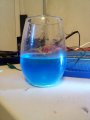
I ran it through 3 layer coffee filters and its relatively dark blue. with no visible precipitate.
Reasonably clear

Does this look like copper sulfate or carbonate? its sorta ambiguous. Theres some sodium bicarbonate also dissolved in with it remaining most likely.
This blue liquid is capable of plating something in copper. through electrolysis
 

Attachments

Last edited:

Thread Starter

realflow300

Joined Jul 28, 2023
137
Should I post a picture of my copper plated screwdriver tip. and scissors? There must be SOME copper sulfate in there for this to be working at all right?
Does that also mean there may of been a tiny amount of sulfuric acid generated? (Even although it may be neutralized by the baking soda?)
 
Last edited:

djsfantasi

Joined Apr 11, 2010
9,237
Yes it works. it creates a light to deep blue liquid solution. and it requires a copper electrode to grenerate the blue copper solution

That’s where the copper comes from. Now the mystery is where the sulphur came from. Or the blue solution is not copper sulphate.

Adding molasses is a source of sulphur…
 
Top