What wattage shoould resistors be?R1 220 R2 750 and 0.5FV schottky will give you 5V.
I see Crutschow has already said this.The tolerance of the regulator reference voltage will also give some variation in the output voltage from the ideal, even with exact resistors. If you want exactly 5V then you can use a pot (connected as a rheostat) for one of the resistors, but note that 5V circuits are typically designed to operate properly with +/- 5% tolerance on their supply voltage.
Since this is a learning exercise try calculating for yourself.what wattage should trimpot be, I can get cement trimmers for 0.75W
The supplier I can easily get parts from is Yebo Electronics (www.fort777.co.za) local. The suppplier that have more parts is www.mantech.co.za, but it's in another suburb, so difficult to get to with my VERY limited transport options...I see Crutschow has already said this.
Since this is a learning exercise try calculating for yourself.
What is the voltage and/ or current through the trim pot?
Either will lead you to the power dissipated. add 25% for safety.
I have two MJ2955 transistors listed.
These are TO3 metal can 150 watt devices
The MJ2955A has better guaranteed gain (20 to 70 at 4 amps) than the MJ2955 (5 at 10 amps)
The MJE2955s are what we call plastic transistors and have lower power ratings.
You need to be a bit more careful about these since there are three versions with different pinouts.
The MJE2955 has a TO127 case and a guaranteed gain of 20 -70 at 4 amps and a power max of 90 watts. Pinout is E-C-B
The MJE2955T has a TO220 case and a guaranteed gain of 20 min at 4 amps and a power max of 75 watts. Pinout is B-C-E
The MJE2955K has a TO220 case and a guaranteed gain of 5 at 10 amps and a power max of 90 watts. Pinout is B-C-E
There are similar variations in the 3055 range
So check with your supplier if you get these.
You can use 1W.Pot can be 0.5W LINEAR. 1N5822 diode is close enough.
I=V/R V=5v R =220, I=0.0227272727273 P=V*I = 5*0.022=0.113636363636I see Crutschow has already said this.
Since this is a learning exercise try calculating for yourself.
What is the voltage and/ or current through the trim pot?
Either will lead you to the power dissipated. add 25% for safety.
I have two MJ2955 transistors listed.
These are TO3 metal can 150 watt devices
The MJ2955A has better guaranteed gain (20 to 70 at 4 amps) than the MJ2955 (5 at 10 amps)
The MJE2955s are what we call plastic transistors and have lower power ratings.
You need to be a bit more careful about these since there are three versions with different pinouts.
The MJE2955 has a TO127 case and a guaranteed gain of 20 -70 at 4 amps and a power max of 90 watts. Pinout is E-C-B
The MJE2955T has a TO220 case and a guaranteed gain of 20 min at 4 amps and a power max of 75 watts. Pinout is B-C-E
The MJE2955K has a TO220 case and a guaranteed gain of 5 at 10 amps and a power max of 90 watts. Pinout is B-C-E
There are similar variations in the 3055 range
So check with your supplier if you get these.
yes, but how does that work? the DC block rating is 40V, and I believe that packaging is like a resistor.We are not rectifying anything if your input in the power supply is pure DC.We are going to use the diode at the output to drop the voltage from 5.5V to 5V so you can use it for microcontrollers.
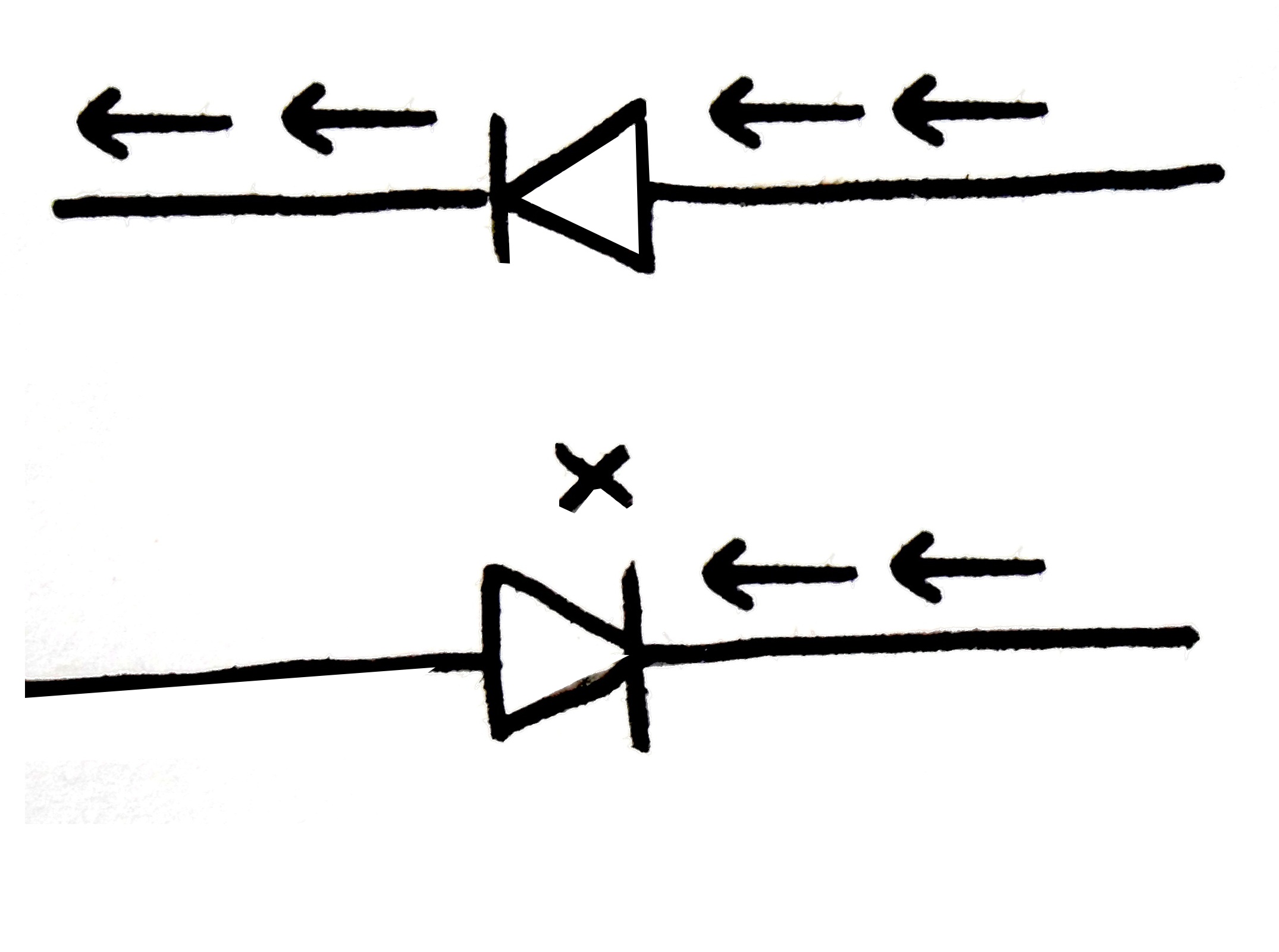
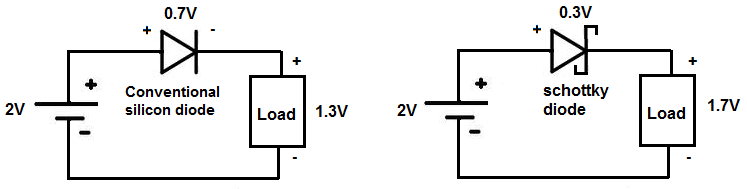
This is what we're looking for? :Diode blocks current only on one side. In case of Schottky's diode it has Forward voltage of 0,5V which means it going to turn on and let the current pass when you put more than 0.5V on it.So if you have 5,5V and you place diode in circuit its going to drop the the voltage by 0,5V since it needs it to turn on and pass the current.If you pass current from cathode towards anode its going to get blocked.
![]()
![]()
are these correct?Ok, let me try again:
220+750=970
Voltage will drop over both, so its I= V/R=5/970=0.00515463917526 P=V*I=5*0.00515463917526=0.0257731958763
is that right?
| Thread starter | Similar threads | Forum | Replies | Date |
|---|---|---|---|---|
| B | LEDs, voltage and wattage | General Electronics Chat | 18 | |
| D | Snubber component's wattage and voltage | Power Electronics | 6 | |
| A | Calculating complex wattage, voltage and amperage. | Homework Help | 8 | |
|
|
Low Voltage Low Wattage Incandescent bulb needed. | General Electronics Chat | 19 | |
|
|
Voltage, Wattage | General Electronics Chat | 32 |