Calculating complex wattage, voltage and amperage.

Thread Starter

Anex

Joined Dec 4, 2017
16
Good day everyone! So im new to this, so hopefully i dont screw up some of your rules!
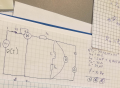
So today i've got given this circuit as a homework, and its pretty weird looking. I can't seem to get the correct answer, so i thought i'd ask you for help.
The values you have to find are the ones that are shown on wattmeter (W), voltmeter, (V1) and ampere meter (A1).
If you could also show me the steps to solving this, it would greatly be appreciated. Thank you for your help!
hometask.png
 

WBahn

Joined Mar 31, 2012
32,710
We won't do your homework for you, which is what showing you the steps to solve it amounts to.

What you need to do is show YOUR best attempt to work your homework. Just do the best you can. That gives us something to work from to try to identify where you are going wrong and to help get you back on track.

It looks like your schematic has two resistors labeled r2 but your list has an r1 and and r2. Please clarify.
 

Thread Starter

Anex

Joined Dec 4, 2017
16
We won't do your homework for you, which is what showing you the steps to solve it amounts to.

What you need to do is show YOUR best attempt to work your homework. Just do the best you can. That gives us something to work from to try to identify where you are going wrong and to help get you back on track.

It looks like your schematic has two resistors labeled r2 but your list has an r1 and and r2. Please clarify.
Fair enough! Yea, there is a mistake, the first resistance is R1 and the one next to the inductor is R2.

DaIW6Ud.jpg
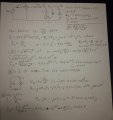
This is how i tried to solve it. I think i remember having to seperate the two loops by their complex resistances and then calculating the values of voltage and amperage, although im not entirely sure if what i did is correct. Also, im not 100% sure i calculated the wattage correctly too! Im trying my best here to understand, any help at all would be appreciated!
 

WBahn

Joined Mar 31, 2012
32,710
I'm confused by your schematic. You show no connection between the left part (that has the inductor) and everything to the right of it.
 

Thread Starter

Anex

Joined Dec 4, 2017
16
So i went back to ask for a proper schematic, and this seems to be it, sorry for the inconvenience.
So far i have 2 questions.
  1. Do i have to convert from micro farads to farads or can i use just microfarads for my complex resistance calculation?
  2. How do i write down the voltage in a complex form, given that the power supply is giving of a sinusoidal voltage (e(t)=300sin(wt+135°))
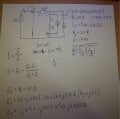
This is what i have so far!
hometask2.jpg
 

WBahn

Joined Mar 31, 2012
32,710
Go back and review the relationship between phasor representation and sinusoidal representation. In general, you must pick a zero-angle reference time -- i.e., a value of t at which sinusoidal signal would have zero phase angle. In this case that is already done for you since you are given the full time-domain description of one of the signals.

So review how the amplitude and phase of a sinusoidal signal is represented with a phasor.

You can keep μF if you want -- just be sure to track it properly. In particular, 1/μ = 1 M (1 mega).
 

Thread Starter

Anex

Joined Dec 4, 2017
16
Go back and review the relationship between phasor representation and sinusoidal representation. In general, you must pick a zero-angle reference time -- i.e., a value of t at which sinusoidal signal would have zero phase angle. In this case that is already done for you since you are given the full time-domain description of one of the signals.

So review how the amplitude and phase of a sinusoidal signal is represented with a phasor.

You can keep μF if you want -- just be sure to track it properly. In particular, 1/μ = 1 M (1 mega).
Alright, good stuff ! So if im understanding this correctly, if i have a rotating vector, with a phase angle of 0 at the given time t. So does that mean the phasors are written down like this ?

e(t) = 300sin(wt+135) = 300cos(wt+45) => U = 300*e^(j45) = 300*(cos(45)+j*sin(45))
 

WBahn

Joined Mar 31, 2012
32,710
There are a couple of ways of doing it -- you only have to be consistent within a given problem. The big thing is to make sure that all of your time domain equations are represented as either sine or cosine. Whichever you chose, you can use the angles in that representation as your phase angles, do your work, and then convert the results back to the time domain just being sure to use the same function to represent them.

But you have the right idea (though you should use units properly).

e(t) = 300V·sin(wt+135°) = 300V·cos(wt+45°) => U = 300V*e^(j45°) = 300V*(cos(45°)+j*sin(45°))

You could just as reasonable say

e(t)= 300V·sin(wt+135°) => U = 300V*e^(j135°) = 300V*(cos(135°)+j*sin(135°))

In the first case, you transform you angle back into a cosine function and in the second you transform it back into a sine function.
 

Thread Starter

Anex

Joined Dec 4, 2017
16
There are a couple of ways of doing it -- you only have to be consistent within a given problem. The big thing is to make sure that all of your time domain equations are represented as either sine or cosine. Whichever you chose, you can use the angles in that representation as your phase angles, do your work, and then convert the results back to the time domain just being sure to use the same function to represent them.

But you have the right idea (though you should use units properly).

e(t) = 300V·sin(wt+135°) = 300V·cos(wt+45°) => U = 300V*e^(j45°) = 300V*(cos(45°)+j*sin(45°))

You could just as reasonable say

e(t)= 300V·sin(wt+135°) => U = 300V*e^(j135°) = 300V*(cos(135°)+j*sin(135°))

In the first case, you transform you angle back into a cosine function and in the second you transform it back into a sine function.
Awesome ! Thanks for your help. If i get into any more problems with this, ill post them here later.
 
Top