Washing Machine Conversion

Thread Starter

Back Beat Pat

Joined Oct 24, 2019
26
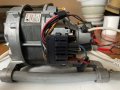
Converting an old washing machine to a sanding disc machine. I have adjusted the wiring to the universal type motor with a jumper as per the attached image and checked that I have continuity between connections 4 & 5 and 3 & 8. I then attached a 3 pin 13amp plug. When I plugged it in it tripped a fuse in the house board but the motor did spin freely momentarily. What might be causing it to trip. Maybe this is the incorrect place for such a question but thanks in advance for any direction.
 

Attachments

Thread Starter

Back Beat Pat

Joined Oct 24, 2019
26
Converting an old washing machine to a sanding disc machine. I have adjusted the wiring to the universal type motor with a jumper as per the attached image and checked that I have continuity between connections 4 & 5 and 3 & 8. I then attached a 3 pin 13amp plug. When I plugged it in it tripped a fuse in the house board but the motor did spin freely momentarily. What might be causing it to trip. Maybe this is the incorrect place for such a question but thanks in advance for any direction.
Its described as universal motor. Label on side of motor says - SELNI, U2.45.02.P30-1, Class F, 220/240V, 50/60Hz, 1400RPM, 350w, 2.5amp, Made in France. It came out of a Finlux washing machine of which the machine label states spins at 1200/min and P= 2100W.
 

schmitt trigger

Joined Jul 12, 2010
2,053
Whenever you are experimenting with any sort of AC powerline device, in which case this motor qualifies as such, is to use the incandescent lamp method to test it.
It has to be an incandescent lamp, LEDs or CFLs don't work for this current limiting purpose.

Wire the incandescent lamp in series with the device, then plug it to the AC receptacle. If there is a short or other anomaly, the lamp will turn on brightly but no harm is done. If the device is properly properly connected, the lamp will now glow dimly and the motor will rotate slowly, but you are now confident that your wiring is correct.

I know that incandescent lamps are no longer available, and that is the reason I kept several old ones when I re-lamped my whole house.
 

MaxHeadRoom

Joined Jul 18, 2013
30,590
@Back Beat Pat , There appears to be some kind of RPM control of some kind on the motor, ty[ical for a washing machine with a Universal motor.
If you just want maximum RPM, simply connect to the mains with ensuring that both fields are in series with the armature.
i.e. Two power connections only.
 

Thread Starter

Back Beat Pat

Joined Oct 24, 2019
26
Whenever you are experimenting with any sort of AC powerline device, in which case this motor qualifies as such, is to use the incandescent lamp method to test it.
It has to be an incandescent lamp, LEDs or CFLs don't work for this current limiting purpose.

Wire the incandescent lamp in series with the device, then plug it to the AC receptacle. If there is a short or other anomaly, the lamp will turn on brightly but no harm is done. If the device is properly properly connected, the lamp will now glow dimly and the motor will rotate slowly, but you are now confident that your wiring is correct.

I know that incandescent lamps are no longer available, and that is the reason I kept several old ones when I re-lamped my whole house.
Thanks to all for the assistance. Your comment triggered me to attack the problem with a 12volt battery and that helped me find an issue which was with one of the brushes. Not surprising considering the machine is many years old and has been sitting unused for almost 10 years.
 

MisterBill2

Joined Jan 23, 2018
27,284
The fact is that it may not be a SIMPLE universal motor. AND in post #7 MAX makes a good point. IF you are able to access the circuit schematic of the wash machine that will provide the answer.
The fact is that since most washers run the motors at different speeds and many use reversing as well, that it is more complex. If it was a front-load washer, probably quite a bit more complex.
 

MaxHeadRoom

Joined Jul 18, 2013
30,590
Universal (series field) motors operate in a runaway condition, there was a point they were used in washing machines and often used the special controller IC TDA1085 for rpm control.
 

MisterBill2

Joined Jan 23, 2018
27,284
Once again, if you have access to the machine circuit that will be valuable. If the machine is an early front-load washer, it undoubtedly had controls for both reversing and running at different speeds. The means of setting different speeds will be useful to understand, since disk sander machines will find having both low and high speeds quite valuable.
 
Top