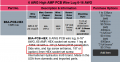
It was on an Analog Devices application note and looked like a really useful high current terminal.
i was sure must be in the Keystone catalogue, and then it wasn’t.
They want $164 shipping for 10 terminals. For a package in the post weighing 100g or so? I didn't ask them to fly to Britain and deliver it personally!That's three times as much as the shipping on a big box of pcbs from China.
Is there any wonder people don't like to import goods from the USA?
So I took their nice picture and gave it to Google lens, which found me some equivalent terminals on AliExpress, of which I bought 100 for £24 including carriage. I'll report back if they are any good (or not).
They want $164 shipping for 10 terminals. For a package in the post weighing 100g or so? I didn't ask them to fly to Britain and deliver it personally!That's three times as much as the shipping on a big box of pcbs from China.
Is there any wonder people don't like to import goods from the USA?
So I took their nice picture and gave it to Google lens, which found me some equivalent terminals on AliExpress, of which I bought 100 for £24 including carriage. I'll report back if they are any good (or not).
From the other point of view—shipping to Europe its a complicated and costly operation from the US. Brexit notwithstanding, the UK is effectively Europe since as a market it is not significant to small US stockists who have a domestic market large enough to survive on. If they choose to open their trade to the EU, they have to deal with a lot of regulation and high cost shipping.
On the other hand, inside the EU, a seller has a domestic market and China depends very largely on export and the fact that they have many services targeting shipments to the UK and Europe with greatly reduced cost via containerized bulk shipping.
So, "is is any wonder people don't want to export to the UK (and EU)?"
Of course there are many companies that do—but they are generally not small operations and have a presence in Europe and established shipping capabilities.
I'm surprised that there is no UK/EU supplier of that type of high-current PCB mounted cage/compression direct wire connector. It seems, from perusing several online catalogs, on this side of the pond we definitely appear to prefer a wire termination, either a FASTON 6.3mm blade
or a ring terminal
Really? The supplier already deals with FedEx. All FedEx needs is the weight and dimensions of the parcel, a copy of the invoice and the Intrastat commodity code. FedEx then collects the import duty and VAT for the British government.
It's 5000 miles, just the same as China, and FedEx charges about the same for both, and it's nowhere near $164.
I'm surprised that there is no UK/EU supplier of that type of high-current PCB mounted cage/compression direct wire connector. It seems, from perusing several online catalogs, on this side of the pond we definitely appear to prefer a wire termination, either a FASTON 6.3mm blade View attachment 350976
or a ring terminal View attachment 350974View attachment 350975
Agreed. I was very surprised not to find them in Mouser or Digikey alongside the offerings from Keystone.
The 6.3mm FASTON pcb terminals (and there is a 9.5mm version) aren't good with heavy cables as they can easily break their solder joints if there is any movement, and I'm never quite sure what the current ratings are (or if I believe them); and the REDCUBE stuff is expensive.
This is what I found on AliExpress:
It's 18mm square, so the high current connections to the pcb are spread out, and it has a proper nut, not just threads tapped in the sheet metal from which it was folded. Supposedly rated at 180A, but I don't need that much.
Really? The supplier already deals with FedEx. All FedEx needs is the weight and dimensions of the parcel, a copy of the invoice and the Intrastat commodity code. FedEx then collects the import duty and VAT for the British government.
It's 5000 miles, just the same as China, and FedEx charges about the same for both, and it's nowhere near $164.
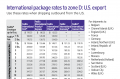
Below is an extract from the Fedex rate tables for US export shipping. Remember that there is overhead for international shipping which is more when you ship less. This includes Human Resources (knowledge of best practices), exception handling, and other things that are not the same as domestic shipping. As I said, if export is not your business the cost of establishing the infrastructure to do it may not appear to be a good cost-benefit option.
This is why many US firms don't offer international shipping, since the domestic market is sufficient. Of course, many US businesses do export since that is a potentially lucrative option, and why US→UK exports was $79.9B in 2024. But a small-to-medium sized retail business that occasionally ships internationally may find little utility in doing any more than the most basic since if someone in another country needs their product badly enough to pay whatever pops up when simply trying to ship the same way they do domestically there is no reason to do more.
But, even if it is possible to get better rates, and even if they could do more business if they established the process, it is very much unlike China where depending on the international market is the equivalent to a US company focusing on the domestic.
Below is an extract from the Fedex rate tables for US export shipping. Remember that there is overhead for international shipping which is more when you ship less. This includes Human Resources (knowledge of best practices), exception handling, and other things that are not the same as domestic shipping. As I said, if export is not your business the cost of establishing the infrastructure to do it may not appear to be a good cost-benefit option.
This is why many US firms don't offer international shipping, since the domestic market is sufficient. Of course, many US businesses do export since that is a potentially lucrative option, and why US→UK exports was $79.9B in 2024. But a small-to-medium sized retail business that occasionally ships internationally may find little utility in doing any more than the most basic since if someone in another country needs their product badly enough to pay whatever pops up when simply trying to ship the same way they do domestically there is no reason to do more.
But, even if it is possible to get better rates, and even if they could do more business if they established the process, it is very much unlike China where depending on the international market is the equivalent to a US company focusing on the domestic.
That's rather different from FedEx's prices over here! (Unless it's gone up a lot since I had them collect a package from China in May)
[Edit] or maybe I'm forgetting how much the dollar has weakened against the pound over the last month.
I'm pretty sure that you can find better pricing if you are a regular user of international routes—but those are the defaults. They do make a big deal about "saving money with an account" and have complicated administrative tools that you have to provision.
It very well may be asymmetrical concerning price and complexity, that I don't know...

 Facebook
 Google
 GitHub
 Linkedin