Voltage vs Current Which Occurs first?

Wolframore

Joined Jan 21, 2019
2,619
let’s try the good old water analogy:

Water will not flow without a difference in potential. Same with electrical current. Whether this differential is due to magnetic, heat, light or voltage, you need the difference in potential to make current flow.

I recall the conversation about MOSFETs and transistors are voltage or current controller devices. We should stay with the convention. Mosfets will trigger from a difference in potential even when this is provided through a dielectric. The BJT, however must have a constant source of current to stay switched on.

this circuit will not work for a BJT
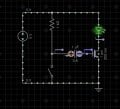
F1BD0DE9-B344-4799-A7DA-6CCB8592F812.jpeg
 

Thread Starter

MrAl

Joined Jun 17, 2014
13,707
let’s try the good old water analogy:

Water will not flow without a difference in potential. Same with electrical current. Whether this differential is due to magnetic, heat, light or voltage, you need the difference in potential to make current flow.

I recall the conversation about MOSFETs and transistors are voltage or current controller devices. We should stay with the convention. Mosfets will trigger from a difference in potential even when this is provided through a dielectric. The BJT, however must have a constant source of current to stay switched on.

this circuit will not work for a BJT
View attachment 261363
I am not sure we should be using a water analogy because water is different than electron activity. It may be possible but the force and mass analogy is much simpler and much clearer to understand. Water could have properties that electron flows do not possess so it might be hard to pin down the exact mechanism for what causes the water to flow. If it is a physical conditional change (dam breaking) that could be a lot different but the micro view may turn out the same too, one of force and mass.

But a MOSFET can draw a huge current even before it turns 'on'. That's why they make special IC gate driver chips that can handle 1 amp or more. In critical applications even the gate current is considered part of the problem in solving for the total dissipation. The gate looks mostly capacitive so we can emulate it with a capacitor in order to understand this phenomenon a bit better. Thus we end up with a capacitor to study and that would be the same for an inductor or resistor, the current and voltage are related in the same way at teh very instant of application.

Maybe the simpler way to look at this is that current and voltage both originate from the same particle.
 

LvW

Joined Jun 13, 2013
2,029
Mosfets will trigger from a difference in potential ....
The BJT, however must have a constant source of current to stay switched on.
I think this statement is a bit fuzzy and does not answer the real question.

In case of MOSFETS you are using the term "trigger" - so the question arises: Which quantity "triggers" the BJT?

No doubt about the fact that there will be a base current - and, yes, it "must" exist because there is a driving voltage Vbe and a junction betwen B and E which allows such a current.
But does the voltage Vbe causes the emitter to release electrons or is it the current into the base?
Even in case of switching applications, it is the voltage between B and C which opens the B-C junction - which is the definition for saturation.
What is your opinion?
 
Last edited:

drjohsmith

Joined Dec 13, 2021
1,602
I think this statement is a bit fuzzy and does not answer the real question.

In case of MOSFETS you are using the term "trigger" - so the question arises: Which quantity "triggers" the BJT?

No doubt about the fact that there will be a base current - and, yes, it "must" exist because there is a driving voltage Vbe and a junction betwen B and E which allows such a current.
But does the voltage Vbe causes the emitter to release electrons or is it the current into the base?
What is your opinion?
Can you make a voltage to "trigger" the JFET with out an electron flow no matter how small ?
 

Wolframore

Joined Jan 21, 2019
2,619
Let's look at the sequence of events:
insulated gate devices:
1. Voltage differential is applied at the gate
2. Gate charges (current)
3. The switching device turns on
4. The switching device stays on until this voltage differential is removed and gate is discharged.

BJT:
1. Voltage is applied at the base
2. Current flows from base to emitter
3. Device is turned on causing Current from Collector to Emitter
4. Device will stay on as longs as the base emitter current is maintained

F=ma analogy: are you saying at force and acceleration is intrinsically intertwined and drawing this analogy to voltage and current? Can you have voltage without current?
 

ElectricSpidey

Joined Dec 2, 2017
3,335
All this emphasis on voltage and current when in reality wattage/work is the critical factor.

You must have current flow in the BE junction to develop the voltage.

And you must do work to charge the gate of a MOSFET.
 

Wolframore

Joined Jan 21, 2019
2,619
Here's another question:

F=ma

Can you have force without the acceleration? Think gravity on an object at rest. Or imagine a magnet being placed under a table of a flat iron disk laying flat.
 

LvW

Joined Jun 13, 2013
2,029
You must have current flow in the BE junction to develop the voltage.
So voltage is developed as a result of a current?
Which force do you think will accelerate the electrons forming the current?
It can be shown and proofed that this is simply wrong - it is the wrong sequence.
 

ElectricSpidey

Joined Dec 2, 2017
3,335
Well, I took a formal course in electronics from a very reputable source (Bell & Howell) and they disagree with you.

Electronics involve a great deal of conversion from one energy form to another.

The battery provides the energy to create current, but the voltage in the battery does not flow thru the wires to the resistor. At the resistor a voltage is "developed" by the current.

So the sequence is indeed voltage...current...voltage. (not going into how the voltage got into the battery)
 

MrSalts

Joined Apr 2, 2020
2,767
Lenz's law only states that a conductor (as a circuit) pushed through magnetic lines of flux causes a flow of current. The voltage that develops as the current moves is merely a function of resistance in the conductive loop. Any rotating generstor works on a similar mechanism.

Conversely, an electrochemical "cell" (chemical battery) has a potential that is limited by the reduction/oxidation chemistry in the two half-cells and exists long before any current flows (when one completes the circuit by connecting anode and cathode.

Is the answer to this question dependent on the source of the electrical power? Maybe, maybe not.

In the end, it is all semantics and depends on how the asker wants to limit the scope of the question and the pre-existing motives for even asking the question.
 

visionofast

Joined Oct 17, 2018
106
Well as far as a know, the electron is the particle in question. Recently though it has been split into two particles one for negative charge and one for spin. Whether or not that holds over time we have yet to see but it has been thought to have been true for many years and just sort of recently has been observed.
It could be just under extreme conditions however so it may not always apply.

In the theory of charge as an electron as the quantum though the charge has both electric and magnetic properties and doesnt loose them. It makes sense then that when a charge movies it is going to alter the perceived voltage across two points unless the charges move in perfect unison and symmetry.

Yes quantum mechanics is changing literally everything even cause and effect. If the effect can come before the cause, there's no longer any meaning to cause and effect.
A world of independent basic objects or particles with various kind of entanglements or interactions,
this is what quantum is in my realization.
time,mass,space,... are even some kind of entanglements between basic quantas.
even electromagnetic waves as energy threads show particle like behaviour in higher freqs .
Newton also discovered gravity via a simple apple.so, an apple could be a symbol of quanta or particle for gravitional energy.
This is what they bring up to say farewell to all of known classic theories and rest my mind in peace :/
 

LvW

Joined Jun 13, 2013
2,029
The battery provides the energy to create current, but the voltage in the battery does not flow thru the wires to the resistor. At the resistor a voltage is "developed" by the current.

So the sequence is indeed voltage...current...voltage. (not going into how the voltage got into the battery)
OK - I only have one question to you:
When the voltage across the resistor is "developed by the current" (which means that the current is the cause for the voltage across the resistor) - which force within the conductive material (resistor) does act upon the electrons which form the current?
Please, can you give me this information?
 

MrSalts

Joined Apr 2, 2020
2,767
Are you really satisfied with such a meaningless answer.
That is not enough....
Why don't you ask for the evidence I mentioned?
Because this whole conversation is too meaningless and the asker's frame of reference and definitions are not defined so any answer you give in under a set of assumptions that you want to believe are the "right" definitions the asker should be using.
 

Thread Starter

MrAl

Joined Jun 17, 2014
13,707
Because this whole conversation is too meaningless and the asker's frame of reference and definitions are not defined so any answer you give in under a set of assumptions that you want to believe are the "right" definitions the asker should be using.
That's not really true. I pointed out many times what this was about.
It's about when we see a voltage with some reasonable circuit we see the current start as soon as any voltage appears but the important point is that the current does not come AFTER the voltage appears it is at the same time with no delay.

Now that i've thought about it, the electron has both voltage and charge and at least for now there is no way to separate the two.
The force and mass example is easier to understand though as follows...
1. You can NOT apply a force to a vacuum. Therefore there is NO FORCE until whatever we going to use to apply the force with touches a mass at rest (using a rest mass for this example).
2. An equation of motion tells us that a force moves a mass right away with no delay. So as soon as the thing we use to apply the force touches the mass, the mass begins to move. There is no delay at the point of contact, but there is also no force up until contact. But at the instant of contact the mass will start to respond.
3. Because a pure mass has only inertia, it begins to move with the tiniest amount of force, and that tiny force if we calculated it would tend to zero at the point of contact.
4. We describe this kind of reasoning in electronics by using a plus sign after a time value to show that it is an initial value. So if we say we apply the force at t=0, we say the mass moves at t=0+, but that "+" doesnt really exist it is just a tool to be able to apply a sort of timeline to the problem so it makes more sense overall.

One thing that i am also finding out though. We are all guilty of apophenia in every day life because we are constantly applying properties to things that dont actually have those properties. We see an experience things in a statistical way without realizing it, and that means we dont know what is really happening around us except for a huge number of conjectures that we made up in order to survive. I like to us the "hole in the ground" example for this kind of thing, because it suggests that we make things up as we go just to make things easier to deal with. But amazingly, quantum mechanics suggests that we are always doing this and doing it with virtually everything we encounter. Is a Table and Chair really what it looks like? It's really a huge huge number of particles that are stuck together but we see it as a 'noun' that we made up so we dont have to keep thinking about trillions and trillions of particles, we can just say "Chair" and everybody, from experience, knows what we are talking about and that allows us to use this in many ways.

So this voltage and current thing is not really much different. We made up a way to understand it, but wehn we look deeper we find it is a little different than what we think about when we are using it. I have thought about "applying a voltage to get a current flow" a million times over my lifetime so far, but that's a far removed viewpoint from the micro mass and micro time view i am trying to bring to light in this thread.

Also, it helps to believe other people when they say something. If you take it as truth, you can always go about and prove for yourself by reading up on material that deals with this sort of thing. You should never just believe anyone, but you should believe in a temporal way so that you can perhaps learn something new. You can always research it yourself if you dont believe it wholeheartedly.
 

ElectricSpidey

Joined Dec 2, 2017
3,335
OK - I only have one question to you:
When the voltage across the resistor is "developed by the current" (which means that the current is the cause for the voltage across the resistor) - which force within the conductive material (resistor) does act upon the electrons which form the current?
Please, can you give me this information?
Of course, the obvious answer is voltage moves the electrons, but it is charge that flows in a circuit, not voltage.

So, at some point that charge must again become voltage.
 
Top