voltage threshhold trigger

Thread Starter

Yabba Rays

Joined Oct 5, 2016
37
Hello out there!

I'm looking for a simple analogue circuit that allows current to flow only when the voltage reaches a pre-set level.

I have one solar panel that I'm using to power a 200mW QRSS 10140 kHz beacon which uses an ATtiny13 to key the transmitter circuit - all of which runs off 5V DC. The solar panel rises from zero to nearly 20 volts in full sun, and I have a 7805 regulator stabilising the ATtiny13 and the small transmitter circuit. However, as the voltage slowly rises before the 5V stabiliser kicks in, the ATtiny13 sometimes gets into a weird keying mode and stays there even when properly driven from the stabilised 5V rail. The entire QRSS circuit only draws about 100mA.

So I'm looking for a simple circuit that doesn't allow any voltage to the 7805 until it reaches say 7V by which time a stable 5V is applied to the circuit. A series Zener? Any better ideas? Thanks. Janet
 

ericgibbs

Joined Jan 29, 2010
21,395
hi YR,
If I understand your description correctly, the Solar panel is the only source of power for the project?
If so, the Sun > solar panel output could change slowly over time, due to clouds etc...

And under certain lighting conditions and the On/Off loading of the 5V, the supply could become unstable.

E
 

Irving

Joined Jan 30, 2016
5,002
hi YR,
If I understand your description correctly, the Solar panel is the only source of power for the project?
If so, the Sun > solar panel output could change slowly over time, due to clouds etc...

And under certain lighting conditions and the On/Off loading of the 5V, the supply could become unstable.

E
At least with this addition in place the 5v will either be there or not there, the cutoff is quite sharp and well above the 7805 drop out point. A simple Lipo or LPF battery charged from the solar panel would seem to be a useful upgrade and easy to implement.
 

crutschow

Joined Mar 14, 2008
38,325
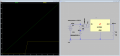
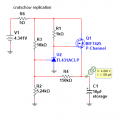
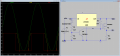
Below is the LTspice sim of a circuit similar to Irving's, but using a TL431 inexpensive shunt reference (functionally a programmable Zener):
It gives a more accurate and much sharper turn-on, as you stated a slow turn-on was a problem:

It turns on when the Ref volage from the R3/R2 divider reaches 2.5V (here 7V).
The circuit has about 1/2V of hysteresis from positive feedback through R4 to provide a snap-action response, and prevent oscillation at the trip point.
The P-MOSFET can be just about any that's rated at 30V or greater and for at least three times the maximum load current.

1749748724106.png
 
Last edited:

Irving

Joined Jan 30, 2016
5,002
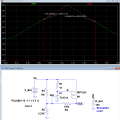
It gives a more accurate and much sharper turn-on, as you stated a slow turn-on was a problem:
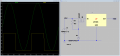
The apparently slow turn on in my LTSpice simulation was simply because I was plotting the DC operating point at 1v input intervals. If I do it at 0.1v intervals the switch over is near instant. witching to a time domain (below) the switchover is <8mS or about 32mV

1749754393627.png
 

Thread Starter

Yabba Rays

Joined Oct 5, 2016
37
Below is the LTspice sim of a circuit similar to Irving's, but using a TL431 inexpensive shunt reference (functionally a programmable Zener):
It gives a more accurate and much sharper turn-on, as you stated a slow turn-on was a problem:

It turns on when the Ref volage from the R3/R2 divider reaches 2.5V (here 7V).
The circuit has about 1/2V of hysteresis from positive feedback through R4 to provide a snap-action response, and prevent oscillation at the trip point.
The P-MOSFET can be just about any that's rated at 30V or greater and for at least three times the maximum load current.

View attachment 350924
Thank you. Another excellent suggestion!
 

Irving

Joined Jan 30, 2016
5,002
32mV could be long, depending upon how fast the actual voltage rises, which may still cause a problem with a corresponding slow rise of the 7805 output voltage.
That's 32mV around the 7.5v point, the 7805 won't react that fast and it's well away from the 7805's drop out point; from it's perspective it's no different to a physical on/off switch. If there's an issue with the ATtiny startup after that then the reset RC time constant is too short.
 

crutschow

Joined Mar 14, 2008
38,325
That's 32mV around the 7.5v point
Yes.
My sim shows about 65mV.
And we don't know how fast the voltage will increase for that amount in the actual system.
What is your assumption for that?
the 7805 won't react that fast and it's well away from the 7805's drop out point
I'm not concerned about the 7805's operate time, it's the rise-time of the cut-off voltage's MOSFET.

A circuit with snap-action hysteresis will eliminate that as a possible problem.
 

Irving

Joined Jan 30, 2016
5,002
My sim shows about 65mV.
And we don't know how fast the voltage will increase for that amount in the actual system.
What is your assumption for that?
The line regulation spec for a TI LM7805 is 50mV for a 7 -> 20v swing with a step response time < 1mS and a min 60dB rejection of input ripple, so I suspect there isn't really any issue here. More concerning is the standard spec for the 7805 min input for regulation is 7.5v so we should really be aiming for nearer 8v min input, eg 8.2v zener.
 

sparky 1

Joined Nov 3, 2018
1,218
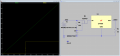
3.7V battery charger cutoff.png

Without the graph. An 18650 battery, specs 4.2V 1A, added a 5Ω after seeing inrush using 10F, it was slow. I switched to 10uF afterwards.
Adjusted the source to get 4.2 output, the current shown above just before cutoff, Did'nt have an IRF7205 model.
 
Last edited:

ericgibbs

Joined Jan 29, 2010
21,395
hi,
I would say using a 'pulsed' voltage source to check the performance of the posted circuits is not going to provide any meaningful results, when one considers the solar panel will be creating a slowly changing increasing/decreasing voltage levels when exposed to sunlight.

As stated above the circuit will require a high degree of hysteresis, in order to prevent rapid On/Off of the +5Vout.

@Yabba Rays would you please explain the purpose of the project as a whole, we may be able to suggest better solutions.

E
 

Irving

Joined Jan 30, 2016
5,002
@Yabba Rays would you please explain the purpose of the project as a whole, we may be able to suggest better solutions.
I thought Janet's explanation in post #1 was quite clear

Anyway, here's another option.... rather than switch the supply on/off just stop & start the ATtiny when the supply exceeds the 7805 drop out requirement.

1749815837571.png
 

ericgibbs

Joined Jan 29, 2010
21,395
I thought Janet's explanation in post #1 was quite clear
Hi Irving,
The TS original post was about the technical changes that need to be made to overcome the 'On/Off ' chattering of the 5v/ATiny, NOT ' the purpose of the project as a whole', which I requested.

Please read what I actually posted, before attempting pointless criticism.

Good to see your circuit has evolved to allow for a slowly changing Solar Vout.

E
 

Irving

Joined Jan 30, 2016
5,002
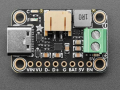
Another option: Adafruit BQ25185 module + 18650 cell. Charges from 7 - 20v solar input and generates battery-backed regulated 5v output. A 2200mAh 18650 cell would give at least 20h of 'dark' operation, and the 5v out does not use the battery if sufficient solar is available. Bargain at <$10 including a 2200mAh cell

1749816730802.png
 

Irving

Joined Jan 30, 2016
5,002
Hi Irving,
The TS original post was about the technical changes that need to be made to overcome the 'On/Off ' chattering of the 5v/ATiny, NOT ' the purpose of the project as a whole', which I requested.

Please read what I actually posted, before attempting pointless criticism.

Good to see your circuit has evolved to allow for a slowly changing Solar Vout.

E
Hi Eric, sorry, but to me " I have one solar panel that I'm using to power a 200mW QRSS 10140 kHz beacon which uses an ATtiny13 to key the transmitter circuit " was sufficient to give me the purpose of the project, but I accept that QRSS beacon may need more explanation: https://www.amateur-radio-wiki.net/qrss/
 
Top