Voltage regulator circuit to drop 15.3v output to recommended 14.4v

Thread Starter

MorrieB

Joined Nov 20, 2024
1
I have an unregulated 12v battery charger that is outputting over 15.3V. I have seen that the recommended maximum charging voltage should be around 14.4V for a 12V lead acid battery. What regulator and associated components would achieve this for me?
 

Ian0

Joined Aug 7, 2020
13,097
Are you measuring it with a battery connected?
Is it a battery charger that claims to be regulated? If so, the regulation circuit is awry and probably has some form of adjustment that you could adjust.
If it is just a basic battery charger, then it was never meant to be regulated, so it should be disconnected before the battery is fully charged.
You could add regulation to a basic charger, but you might run into a few problems.
It may not have a smoothing capacitor.
It may not output sufficient voltage to allow for the voltage drop of the regulator.
 

MrChips

Joined Oct 2, 2009
34,627
Diodes will not solve the problem.

The charger will work as is. When the battery is connected and being charged, the battery itself will determine the charging voltage. As the battery reaches full charge, the current will drop. If diodes were used, the voltage across the diodes will also fall.

The problem is, you want the charger to switch to a lower voltage for topping charge. At the very least, you should discontinue charging otherwise the battery will overheat and out-gas.
 

boostbuck

Joined Oct 5, 2017
1,032
You don't state the charging amps from the charger, but if it's just a small one then a shunt regulator will be better than a series one for such a low headroom 15.3V
 

crutschow

Joined Mar 14, 2008
38,316
Diodes will not solve the problem.
I disagree.
At any significant value of charging current a standard silicon junction diode (not Schottky) should drop enough voltage (about 0.5V @ 1mA giving 1V with two in series) to keep the battery voltage below 14.4V.
 
Last edited:

sparky 1

Joined Nov 3, 2018
1,218
We use diodes all over the place unfortunately not everyone has been understanding how to go from reference to charging current.
The understanding about what happens when it's fully charged and all the smart charging technology is making people wonder.
Since lead acid batteries are expensive it is natural to be more concerned about charger specs.

The previous post below shows a step up / step down module and the price is low. How to lower the voltage, TS did not post a schematic.
Typical low cost charger set up.
Without the battery connected you can set to 13.4 -14.4 Vdc then, with the battery and ammeter connected adjustment made to set the current.
Not easy to see them, there are two multiturn potentiometers are on the right.
(4) IC or circuit voltage regulator design to maintain voltage at 14 volt | All About Circuits

Indication by results. Possibly slow or trickle charging less heat, better cycle, battery is designed to tolerate faster charge or more current.
Interstate battery explains outcome of your charging effort with this chart and we know with the car alternator running it is normally 13.8 -14Vdc
We need to disconnect the battery charger, the average battery voltage shown. A one year old battery might be less than 12.88 that is still ok.
After a full charge 1V less than 12.88 is not good however 12.4 might still work for a while.

State of ChargeVoltage
100%12.88
75%12.64
50%12.39
25%12.09
0%11.80
 
Last edited:

crutschow

Joined Mar 14, 2008
38,316
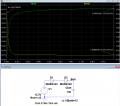
Here's the LTspice sim of a simple unregulated charger with a unregulated output voltage of 15.3V open circuit, and an internal resistance of 0.35Ω to limit the charge current, with two series diodes to limit the maximum charging current.
The sim shows a maximum battery voltage of 14.26V at the end of charge where the battery trickle current is 2.6mA.


1732151713610.png
 

Ian0

Joined Aug 7, 2020
13,097
Could it be possible that the original circuit is outputting 15.3V simply because your mains voltage was rather high at the time?
 

sparky 1

Joined Nov 3, 2018
1,218
The Float stage of a battery charger maintains battery in a standby mode by supplying low current, it prevents a lead acid battery from self-discharge it will extend the life of a battery and improve the ability to maintain a full charge. Details like 2.6 mA are seldom covered. like starting a car once in a while during the winter. Crutschow's idea could be made easily with a switch and a couple murs320 diodes makes sense after all.
 
Last edited:

schmitt trigger

Joined Jul 12, 2010
2,027
Another stink bomb question left by a single post member which will never see again.
Stirring all the grey beards here into a feeding frenzy.
Therefore, let me join the melee.

The well designed battery charger that I have (commercial unit), has a charging profile which consists of a constant current mode, which with an open circuit will provide a large voltage. But connected to an actual battery, the voltage will settle to a lower level and slowly rise depending the SOC.
Once the battery reaches a certain threshold voltage, it is considered charged and the charger will now drop to a lower “float” voltage to trickle the battery.

But we don’t know and never will exactly what the TS had.
 
Top