Voltage out from diodes

Thread Starter

crackhead227

Joined Feb 11, 2019
22
I got two circuits. One from a textbook example and one that I made and simulated in "PartSim".
I don't think they are supposed to be the same. I'm suposed to give an answer to the question: "Are the voltage out from the diods different? And if they are, why is that."

In my case they seem to be different.

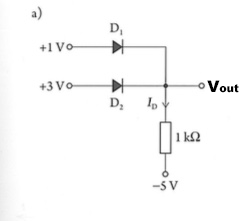
The voltage out from the diods in the textbook example is: Vout = 3V

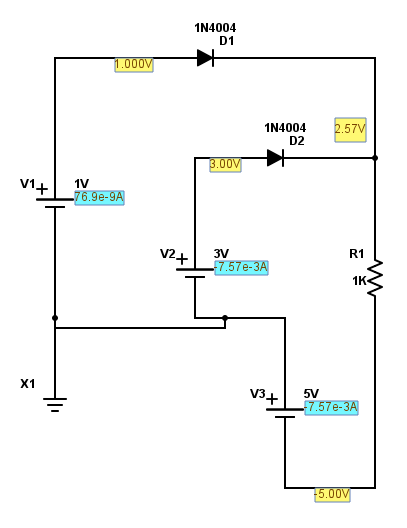
The voltage out from the diods in the circuit that I made in "Partsim" seems to be = 2.57V

So what's the explanation for the difference in voltage out from the diods in these two cases? :)


Circuit from textbook: (Vout = 3V)

Circuit made and simulated in "Partsim": (Vout = 2.57V)
 
Last edited:

Thread Starter

crackhead227

Joined Feb 11, 2019
22
hi 227,
Does the text book say that they are ideal diodes.?
E
The textbook neither confirm nor deny if they are ideal diodes.
But maybe that's the explanation? I mean textbook examples are usually ideal. Where as the simulation in PartSim maybe is supposed to more reflect reality?

I will go with that if no one else got a better explanation. :)
Thanks!
 

WBahn

Joined Mar 31, 2012
32,823
The textbook answer is clearly using an ideal diode that has 0 V drop across it when forward conducting.

The simulator is using a more realistic diode model that has about 0.43 V dropped when conducting about 7.6 mA.

If you play with the value of the resistor you will be able to plot out the voltage drop for various currents and will likely find that it is largely exponential.
 

WBahn

Joined Mar 31, 2012
32,823
What is the name of your textbook?
It's not uncommon for a textbook to introduce the concept of a diode as an ideal diode and have a few problems like this to get the basic notion across and then move onto the exponential model and then back it down to the piece-wise linear model that is used for nearly everything after that point. That's usually all covered in the first half of a lesson.
 

WBahn

Joined Mar 31, 2012
32,823
The textbook answer is clearly using an ideal diode that has 0 V drop across it when forward conducting.

The simulator is using a more realistic diode model that has about 0.43 V dropped when conducting about 7.6 mA.

If you play with the value of the resistor you will be able to plot out the voltage drop for various currents and will likely find that it is largely logarithmic (since the current is nominally an exponential function of the voltage).
EDIT: It was pointed out that the order of the variables in my plot was inconsistent with my description. That's been fixed.
 

JoeJester

Joined Apr 26, 2005
4,390
Bill,

I have no problem with the intro being based on ideals. The only way you or I would know that is to see the book. Any hypothesis on the author's application is just a guess and it could be a damn good guess. Another possibility is the author used a "fault induced diagram" and just rewrote the question, after all, who would notice that.

We don't know the name of the book or the chapter title of where the "problem" originated.

diode-fault.jpg
 
Top