Facebook
 Google
 GitHub
 Linkedin
So here is the scenario:
I am building a dedicated amplifier (with built-in crossover, 3 way design) for some special speakers I recently built.
For the mid/highs, I really love the sound of the TDA8932 chip amps. Incredible sound for the $$.
But these chip amps have a couple issues:
1) They are very sensitive to the supply voltage. Most run them from linear supplies since they easily "pass through" various bits of noise, etc from switching supplies.
2) They really start to run hotter-than-I-like once the voltage creeps over 20-21 volts or so.
This entire amp is powered by a single-rail 24 volts supply. And it is a switching supply at that. This raises BOTH problems mentioned above: the chip runs pretty warm AND you get some high-frequency interference that can be heard.
To solve this issue, I created a cascade of high-current silicone diodes (4 in a row) to drop the 24 volts down to around 21.2 or so. Just after each diode, I have a 440uF capacitor between the output of that diode and ground. This solves both issues: it drops the voltage down just enough that the chip runs FAR cooler (yes, them couple volts makes all the difference!) AND it serves as a really good noise filter. All the switching noise I had is now gone.
These amp boards are only around 35 watts max - and at the voltage (and 8 ohm load) I am running... they will never be able to supply more than 18-20 watts total. This is only for mid/tweet.
I have read that diodes used in such a fashion are typically not the best choice - but can not think of a better solution.
A DC-DC buck converter makes the noise problem WORSE.
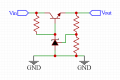
A LDO regulator would need to have a minimum voltage difference of around 3-5 volts. Say I set the output voltage to go from 24->19 (playing it safe).. 20 watts divided by 19 volts is around 1 amp. So the LDO would have around 1 amp passing through it with a voltage drop of 5... That would be 5 watts of heat, that would be a bit too much - no? Or is that reasonable with a LM317 or such?
The diode setup seems to work pretty good. The input voltage should never change (its a regulated switching supply!). The diodes I am using are some run-of-the-mill 6 amp silicone diodes. They seem pretty stable. A similar 1 amp (max) at .7 volts is less than 1 watt [per diode] and seems reasonable for a large diode [rated at 6 amps] to handle it seems.
Another thing to consider is what I am powering: 20 watt hifi amp boards. This is max output. I am not using these in a PA setting, typical household use - small-to-mid-sized-rooms. Typical music power will be much less most the time. These amps are behind a 24db active xover - they never see anything over 180hz. So all the real demanding high-current action is off their plate.
Should I consider something else?
Any sugestions would be welcome. Thanks!
I am building a dedicated amplifier (with built-in crossover, 3 way design) for some special speakers I recently built.
For the mid/highs, I really love the sound of the TDA8932 chip amps. Incredible sound for the $$.
But these chip amps have a couple issues:
1) They are very sensitive to the supply voltage. Most run them from linear supplies since they easily "pass through" various bits of noise, etc from switching supplies.
2) They really start to run hotter-than-I-like once the voltage creeps over 20-21 volts or so.
This entire amp is powered by a single-rail 24 volts supply. And it is a switching supply at that. This raises BOTH problems mentioned above: the chip runs pretty warm AND you get some high-frequency interference that can be heard.
To solve this issue, I created a cascade of high-current silicone diodes (4 in a row) to drop the 24 volts down to around 21.2 or so. Just after each diode, I have a 440uF capacitor between the output of that diode and ground. This solves both issues: it drops the voltage down just enough that the chip runs FAR cooler (yes, them couple volts makes all the difference!) AND it serves as a really good noise filter. All the switching noise I had is now gone.
These amp boards are only around 35 watts max - and at the voltage (and 8 ohm load) I am running... they will never be able to supply more than 18-20 watts total. This is only for mid/tweet.
I have read that diodes used in such a fashion are typically not the best choice - but can not think of a better solution.
A DC-DC buck converter makes the noise problem WORSE.
A LDO regulator would need to have a minimum voltage difference of around 3-5 volts. Say I set the output voltage to go from 24->19 (playing it safe).. 20 watts divided by 19 volts is around 1 amp. So the LDO would have around 1 amp passing through it with a voltage drop of 5... That would be 5 watts of heat, that would be a bit too much - no? Or is that reasonable with a LM317 or such?
The diode setup seems to work pretty good. The input voltage should never change (its a regulated switching supply!). The diodes I am using are some run-of-the-mill 6 amp silicone diodes. They seem pretty stable. A similar 1 amp (max) at .7 volts is less than 1 watt [per diode] and seems reasonable for a large diode [rated at 6 amps] to handle it seems.
Another thing to consider is what I am powering: 20 watt hifi amp boards. This is max output. I am not using these in a PA setting, typical household use - small-to-mid-sized-rooms. Typical music power will be much less most the time. These amps are behind a 24db active xover - they never see anything over 180hz. So all the real demanding high-current action is off their plate.
Should I consider something else?
Any sugestions would be welcome. Thanks!