Hi! I have a circuit that is supposed to supply 10mA maximum. I don't want it to supply more, even if it needs to.
How can I do that without dropping any voltage?
I have a circuit that is supposed to supply 10mA maximum. I don't want it to supply more, even if it needs to.
How can I do that without dropping any voltage?
Not possible.
Let’s take an example.
Suppose the desired voltage is 10V.
If the current is limited to 10mA then the load has to be 1kΩ.
If the load drops below 1kΩ Ohm’s still rules.
I = V / R
The current has to go up or the voltage has to go down.
Not possible.
Let’s take an example.
Suppose the desired voltage is 10V.
If the current is limited to 10mA then the load has to be 1kΩ.
If the load drops below 1kΩ Ohm’s still rules.
I = V / R
The current has to go up or the voltage has to go down.
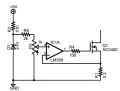
You could do something like this:
Change the supply to 12V, make R5 larger to limit the adjustment range of the pot. Make R1 some value (less than 50 ohms) that will drop less than a volt, but drop enough voltage for you to be able to set the current.
You can't use any opamp. LM358 is a very old design, but it was designed to allow the input voltage range to include ground and for the output to get very close to ground. You could use just about any opamp with rail-to-rail inputs, but that'd cost you around $1 and LM358 are cheap general purpose opamps.
At 10mA, MOSFET on resistance isn't too important, but lower is better. AO3400 is a logic level MOSFET (not important in this case) with an on resistance of about 0.04 ohms. It can handle 5A, also not important in this case.
If it wasn't obvious, you connect your load between power and the drain of the MOSFET.
You could do something like this: View attachment 326134
Change the supply to 12V, make R5 larger to limit the adjustment range of the pot. Make R1 some value (less than 50 ohms) that will drop less than a volt, but drop enough voltage for you to be able to set the current.
You can't use any opamp. LM358 is a very old design, but it was designed to allow the input voltage range to include ground and for the output to get very close to ground. You could use just about any opamp with rail-to-rail inputs, but that'd cost you around $1 and LM358 are cheap general purpose opamps.
At 10mA, MOSFET on resistance isn't too important, but lower is better. AO3400 is a logic level MOSFET (not important in this case) with an on resistance of about 0.04 ohms. It can handle 5A, also not important in this case.
If it wasn't obvious, you connect your load between power and the drain of the MOSFET.
If it's not obvious, you use R1 and R3 to set the current.
If you used 20 ohms for R1, you use Ohm's Law to calculate the voltage drop needed for 10mA. V = IR = 10mA*20 ohms = 0.2V, so you'd set the pot for 0.2V. With the R5 value in the schematic, the adjustment range is 0-0.8V. Making R5 larger would give you finer control with R3.
R1 should be a precision resistor, at least 1%, depending on the current accuracy you need.
You're welcome. If you post that circuit anywhere, be sure to give proper attribution.
If it's not obvious, you use R1 and R3 to set the current.
If you used 20 ohms for R1, you use Ohm's Law to calculate the voltage drop needed for 10mA. V = IR = 10mA*20 ohms = 0.2V, so you'd set the pot for 0.2V. With the R5 value in the schematic, the adjustment range is 0-0.8V. Making R5 larger would give you finer control with R3.
R1 should be a precision resistor, at least 1%, depending on the current accuracy you need.
You don't need to use a logic level MOSFET with that circuit. With a higher threshold voltage, you shouldn't have any problems using a 12V power supply because many MOSFETs have a 2-4V threshold voltage. That would require the opamp to apply a maximum of about 4V to the gate. The output of LM358 can only go as high as 2V below the supply voltage (10V in your case, so it should work with most MOSFETs - e.g. 2N7000 which is a low cost through hole part with a threshold voltage of 0.8-3V).
You could also substitute a BJT such as 2N3904. That makes the value of R4 a little more critical, but 100 ohms will still work. The base current shouldn't be large enough to be significant, but be aware that the current in the current sense resistor will be higher than the load (collector) current (because IE = IB + IC). In a worst case situation, there'd be about a 10% error.
EDIT: the resistor isn't actually required when using a BJT. It's there for MOSFETs to dampen potential oscillations from a capacitive load.
Hi! I have a circuit that is supposed to supply 10mA maximum. I don't want it to supply more, even if it needs to.
How can I do that without dropping any voltage?
The LM358 and some uncommon mosfet, The arrangement needs thermal compensation, mostly mosfet heat sinking ability.
LDO concideration is favorable with some mosfets. Typical LDO regulator voltage drops are 200mV or 300mV
Question of which common mosfet. Which garden variety mosfet that will do that is really available ?
The LM10 op amp came with a 200mV reference. Some have tryed TIP32.
Because circuit draws less than 10mA and the cost of an LM334 is still $0.39 vs cost of 1Watt 1% resistor limiter might be good enough.
Easier to just expect some voltage drop, also LM334 thermal compensation was addressed using diode.
The surplus market of past gave a limited availability of part types, now percentage imported are fake and noisy parts.

 Facebook
 Google
 GitHub
 Linkedin



 That's what I needed.