Voltage gradient...

Thread Starter

Externet

Joined Nov 29, 2005
2,627
Hello all.
Say the local mains from the electrical utility company is 230.00 Volts split phase AC right now at my house. I turn on my solar inverter and its display shows injecting 4500W back into the utility grid right now.
What is the voltage when this occurs ? Or, at what voltage those 4500W are injected ? Does it happen at 231.00V, or 235 V; or 230.01V ?
What determines at what voltage that amount of power flows back into the grid ; or, how much the grid voltage rises when I inject 4500W ? I have difficulty visualizing how it happens.

In an automobile, the 12.60VDC at rest becomes up to 14.00VDC while charging as there is a voltage regulator. There is no fine voltage regulation in the AC mains as its voltage depends on the neighborhood consumption. How does it work ?
 

nsaspook

Joined Aug 27, 2009
16,257
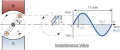
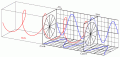
Most home grid inverters are designed as a current source feeding the utility grid as a infinite current sink at a stable voltage and frequency. The control point is energy calculations using grid voltage to your sync'd in phase (using small phase shifts to adjust power) adjusted current. The AC grid electrical energy is modeled as a rotational EM field in 3D space that we again model in circuit theory (as a projection) as time varying voltages, currents and phases because it's much easier to make measurements and calculations that way.

1689376274926.png j4gSn.gif

The key is to think about energy and, as an analogy, how the linked pedals on a bike for two (tandem) work as 2 riders vary the amount of effort to move forward.
1689375815183.png
 
Last edited:

Thread Starter

Externet

Joined Nov 29, 2005
2,627
Thanks.
For my inverter to push current into the grid; has to do it at a higher voltage than the grid has, otherwise, it would not happen... I think. How little or how large is that voltage increment ? What is its mathematical relationship with the power generated injected to the grid ?

The inverter display shows now 242V grid voltage nearing sunset with tiny 180W being produced and all consumed by the refrigerator alone and zero injected to the grid. It is a very hot 90F max. day. Air conditioner is off now, and no significant consumption is going on.
Tomorrow I will edit this adding the figures at high generation noon. Forgot to write down the grid voltage earlier today when it was injecting 4500W

I suspect that for a cooler tomorrow, the grid voltage will not track today's figures as the neighborhood will be consuming less power. Today's energy generated was 31KWh.
 

nsaspook

Joined Aug 27, 2009
16,257
Thanks.
For my inverter to push current into the grid; has to do it at a higher voltage than the grid has, otherwise, it would not happen... I think. How little or how large is that voltage increment ? What is its mathematical relationship with the power generated injected to the grid ?

The inverter display shows now 242V grid voltage nearing sunset with tiny 180W being produced and all consumed by the refrigerator alone and zero injected to the grid. It is a very hot 90F max. day. Air conditioner is off now, and no significant consumption is going on.
Tomorrow I will edit this adding the figures at high generation noon. Forgot to write down the grid voltage earlier today when it was injecting 4500W

I suspect that for a cooler tomorrow, the grid voltage will not track today's figures as the neighborhood will be consuming less power. Today's energy generated was 31KWh.
Did you read what I posted?

Stop thinking about grid-tie inverter voltage sources. Off Grid Inverters are "voltage sources" as they are the 'prime mover', grid-tie inverters are current sources.
The power delivered by a current source = current coming out of it x voltage across its terminals. There can only be one voltage at a given spot on a given conductor (like where the grid-tie AC is connected to the utility AC). Internally to the inverter there is likely to be some slight/small/tiny voltage difference/ gradient between that connection point and the actual circuit due to resistance and maybe a small power line isolation inductance.

Your grid-tie inverter is a synchronous generator (the electronic equivalent) connected to the grid 'prime mover' generator.

When we have micro-grid grid-forming inverters (unlikely at a house) without a prime-mover (utility scale generation) things are more complicated with voltages.
https://www.mdpi.com/1996-1073/13/10/2589

Abstract
In this paper, different control approaches for grid-forming inverters are discussed and compared with the grid-forming properties of synchronous machines. Grid-forming inverters are able to operate AC grids with or without rotating machines. In the past, they have been successfully deployed in inverter dominated island grids or in uninterruptable power supply (UPS) systems. It is expected that with increasing shares of inverter-based electrical power generation, grid-forming inverters will also become relevant for interconnected power systems. In contrast to conventional current-controlled inverters, grid-forming inverters do not immediately follow the grid voltage. They form voltage phasors that have an inertial behavior. In consequence, they can inherently deliver momentary reserve and increase power grid resilience.
...
Current-controlled inverter, CCI, or grid-following inverter, in contrast to GFI, denotes an inverter having a control approach that controls the current injection, e.g., based on terminal voltage measurement, in order to meet a given power set point. Due to the power set point determination, the inverter can operate as a grid-feeding inverter, which injects power independent of voltage or frequency deviations at the terminal.
 
Last edited:

Papabravo

Joined Feb 24, 2006
22,058
Is it worth pointing out that the gradient of a scalar-valued differentiable function f of several variables is a vector field. This might imply that there is such a function of several variables. What might that function be? I am not familiar with one.
 

nsaspook

Joined Aug 27, 2009
16,257
The OP seems to looking for a reason the terminal voltage varies by thinking the inverter directly controls the utility voltage.

1689390429654.png1689390774830.png
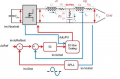
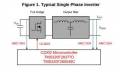
First, the grid voltage, VO, is sensed in the variable invVoInst. A software PLL algorithm is then run to
compute the angle and phase of the grid, invSine. This invSine value is then multiplied with the reference
current command invIoRef, which generates the instantaneous current command reference invIoRefInst.
This reference is then compared with the sensed output current, invIoInst, and the error fed into the
current compensator, Gi, as shown in Equation 1. The goal of the current compensator is to zero the error
between the reference and the measured value. A typical proportional integral (PI) controller can zero the
error for the DC value; however, for a sinusoidal reference, the controller cannot reduce the error to zero.
Thus, proportional resonant (PR) controllers are used as part of the current compensator Gi
to zero the error at the AC frequency.
https://www.ti.com/lit/ug/tidub21d/tidub21d.pdf

Internally the grid-tie inverter generated voltage is higher but at the utility connection point it's the same because the utility voltage regulation should be much stiffer than what a single home inverter coupling voltage can alter. The variance he sees is normal loading factors seen on a multi-port utility power network of sources and loads.
Feed voltage changes can be a issue when there is a large amount of PV energy moving to the grid at low loading but that's an infrastructure problem, not a requirement of power flow.
https://www1.eere.energy.gov/solar/pdfs/hpsp_grid_workshop_2012_steffel_pepco.pdf
 
Last edited:

crutschow

Joined Mar 14, 2008
38,331
The inverter voltage would be higher than the open-circuit grid voltage by the inverter current times the grid impedance, which is very small.
Edit: That impedance will likely be mostly due to the resistance of the wiring between the inverter and your utility transformer.
Beyond that, any extra impedance is likely negligible.
 
Last edited:

nsaspook

Joined Aug 27, 2009
16,257
Your typical impedance for a sub-division feeder would be a small fraction of a ohm. The stiffer your grid, the smaller this resistance number will be but you could still inject power at the terminals of the turbines at Bonneville dam with a proper current source grid-tie inverter. If the resistance were zero, the voltage would be the same and the inverter would work just as well.
1689391984753.png
1689392156312.png
The need for a slightly higher voltage difference is folklore.
 
Last edited:

Ian0

Joined Aug 7, 2020
13,097
The British power companies actually publish a figure for the grid impedance which is 0.24+0.25jΩ.
Living in a rural location, I was surprised when I measured ours and found it to be almost exactly that figure. The resistive part consists almost entirely of 175m of 25mm^2 cable (actually, it's coax). The supply transformer has a step-down ratio of 48:1 so the impedance the other side (11kV phase-to-phase) is transformed down by 2200:1 so its contribution is negligible (as @crutschow said, above).
A typical inverter output stage is an H-bridge creating a PWM signal at low impedance which drives the output through an inductor, so, if you just think of its operation for a 1ms segment of the mains waveform, the circuit is identical to a battery charger driven by a buck regulator.
 

Thread Starter

Externet

Joined Nov 29, 2005
2,627
Thanks, gentlemen, am a s l o w learner that will take some time to absorb and comprehend all your explanations and links. So far on a superficial view of links; and by the insistence on the tandem bicycle analogy, I see the tension of the chain/crank torque for the front pedaler or rear pedaler being higher for the most current pusher pedaler.
If voltage is related to the tension of the chain; that was my (right or wrong) perception. (In order to push current, more tension is needed by my grid-tied inverter)

the circuit is identical to a battery charger driven by a buck regulator.
Yes,
In an automobile, the 12.60VDC at rest becomes up to 14.00VDC while charging

The OP seems to looking for a reason the terminal voltage varies by thinking the inverter directly controls the utility voltage.
Not thinking it 'controls' but thinking it has to overcome the voltage in order to 'inject' power. If my grid tied inverter was adjusted to output ~225V instead; I do not think would be capable of injecting anything into the higher 240 volt grid.

The eere link talks with emphasis about voltage, as I perceived. Still much more to examine from your responses and guidance. Will be back another day also with figures as it is near noon but very overcast now and raining.
o_O
 

Thread Starter

Externet

Joined Nov 29, 2005
2,627
Figures collected :
Injecting 2505W, grid voltage showed 246V.
Injecting 2052W, grid voltage showed 244V.
Yesterday at 180W, voltage was 242V.
Injecting 4665 W now, 1PM, grid shows 245 V. Not a hot day.
 
Last edited:

AnalogKid

Joined Aug 1, 2013
12,055
Not thinking it 'controls' but thinking it has to overcome the voltage in order to 'inject' power. If my grid tied inverter was adjusted to output ~225V instead; I do not think would be capable of injecting anything into the higher 240 volt grid.
Correct. For current to happen (electrons to flow), there must be a potential (voltage) difference. That part of your initial thinking was correct. Even if it is a small amount, to push current onto the grid the inverter output voltage must be greater than the grid voltage. The incorrect part was thinking that the control electronics regulate the current based on voltages, when in fact the output voltage is modulated to produce the desired output current. Your inverter output voltage does whatever it takes to make the programmed current move. This is a working definition of what a current source is.

ak
 

nsaspook

Joined Aug 27, 2009
16,257
What is the voltage gradient in a superconducting loop coil where current keeps circulating forever? Once an external force has accelerated the charge into a conductor with zero resistance, it continues 'forever'. The ohms law voltage gradient current requirement is dissipative (em field energy moving into the conductor), not universal.
https://en.wikipedia.org/wiki/London_equations


There can be a current without emf (zero resistance)

Feynman:

In a ''perfect conductor'' there is no resistance whatever to the current. So if currents are generated in it,they can keep going forever .In fact,the slightest emf would generate an arbitrarily large current -which really means that there can be no emf at all.
 
Last edited:

BobTPH

Joined Jun 5, 2013
11,466
After about 5 minutes of reading I understand how this works. The inverter is coupled to the grid through an inductor. When the inverter side is at a higher voltage than the grid, the current going out to the grid increases with no change to the grid voltage. Closed loop PWM is used to regulate the current flowing onto the grid.

Think of it as a buck converter that is current controlled and follows the sinusoidal shape of the grid voltage.
 
Last edited:

Ian0

Joined Aug 7, 2020
13,097
After about 5 minutes of reading I understand how this works. The inverter is coupled to the grid through an inductor. When the inverter side is at a higher voltage than the grid, the current going out to the grid increases with no change to the grid voltage. Closed loop PWM is used to regulate the current flowing onto the grid.

Think of it as a buck converter that is current controlled and follows the sinusoidal shape of the grid voltage.
If it is isolated from its batteries or solar panels, then the “inductor” is the leakage inductance of a line-frequency power transformer, which is wound on a two section bobbin for an EI transformer or sectionally wound for a toroid.
If the solar panels are mains-live then it uses an H bridge and a real inductor.
 
Top