Voltage divider Problems

Thread Starter

tlewick1

Joined Dec 3, 2016
26
I have a circuit that needs 5V and 3V. The 3V is for a relay and an AVR microcontroller. When using 2 AA batteries for powering the relay and microcontroller, everything works fine. When I try to power them using a transformer, a 5V voltage regulator and a voltage divider using 150 & 100 ohlm resistors-- I measure 3V with a multimeter-- but when I try to run the circuit, nothing works and the voltage drops to 1V. I thought that maybe the resistors are causing a voltage drop under load and that if I got an adjustable voltage regulator, that would fix the problem, but looking at adjustable regulators, it seems like they essentially work the same way. Any thoughts?
 

Brevor

Joined Apr 9, 2011
297
Try measuring the resistance of the relay coil and calculate a voltage divider using the coils resistance and just one other resistor so you end up with 3 Volts across the coil.
 

crutschow

Joined Mar 14, 2008
38,503
The divider resistance is likely causing the drop you see, due to the current from the load.
This causes the voltage to vary with load current as given by Ohm's law.
It would appear that you have a load current of about 33mA going through the equivalent divider resistance of 60Ω, giving you the observed 2V drop.

A linear voltage regulator does rather act like a resistor in series to drop the voltage but internal feedback varies the effective resistance so that the output voltage is constant with a change in load current.

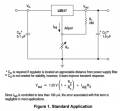
Suggest you use a regulator, such as the common LM317 to reduce the 5V to 3V.
Below is the basic circuit for that:

For a nominal 3.0V you can use fixed 1% resistors of 237 for R1 and 332Ω for R2.
Physically connect R1 as close to the LM317 output as practical for best voltage regulation.
upload_2016-12-29_19-18-41.png
 

WBahn

Joined Mar 31, 2012
32,823
I thought that maybe the resistors are causing a voltage drop under load and that if I got an adjustable voltage regulator, that would fix the problem, but looking at adjustable regulators, it seems like they essentially work the same way. Any thoughts?
At first blush it might seem that way since there is a voltage divider in both cases, but in the first case the load current must pass through one of the resistors, and hence there is a load-dependent voltage drop. In the case of the adjustable regulator, the voltage divider is in parallel with the load and only a small (and load-independent) reference current flows through it. These are actually fundamentally different situations.
 

Alec_t

Joined Sep 17, 2013
15,117
I think it would be better if you could power the relay from 5V and use a regulator to get 3V for the microcontroller. This would give you a wider choice of relays and simplify decoupling the relay from the microcontroller to prevent relay current/voltage surges/spikes from affecting the microcontroller operation.
 
Top