A little (9 components instead of 7), but accurate. It doesn’t need an output filter, and a phase fired dimmer would.
I would not recommend this circuit if it were driving a transformer
Please explain how a 100 watt load on a 120 volt system will produce " generate several amps of average DC current, ". I see a bit of confusion at that point.
Please explain how a 100 watt load on a 120 volt system will produce " generate several amps of average DC current, ". I see a bit of confusion at that point.
A common (although obviously not widely known) trick is to put a reasonably sized capacitor in series with the kettle (aka heating resistor)
If "somebody" would use LTSpice to find out how many microfarads would be required to create a drop of eg. 20 V ?
Voltage rating of the capacitor: 200 V would be fine. (You can get away with less if you're using a self-healing type (metallized paper or metallized foil) and are not shy occasionally hearing sparkovers
It requires about 160uF, which could perhaps be provided by a motor run (not start) type capacitor (but they likely aren't cheap).
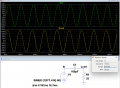
LTspice sim below showing a voltage at the load of 99.7Vrms:
@crutschow
Thanks for the math. So an EPCOS-TDK B32361A2157J050 (CAP FILM 150UF 5% 250VAC RADIAL) might work. It's a real bargain (ca. 30 € for single pieces @ digikey) as you get a lot of capacitor for your money: 63,5 (dia) x 123 mm, 500 g Heavy, bulky - maybe not very fancy.
Alternative:
An inductor in series. If my math holds, this would require 40 mH with a current rating of >4 A (more would be better in terms of resistive losses). These are even bulkier and heavier (basically look like a transformer with a single winding) - an example (32 mH) would be: https://www.digikey.com/en/products/detail/triad-magnetics/C-49U/4915195
To avoid voltage spikes during switchoff, I'd add an RC and/or a transzorb diode parallel to the choke.
An autotransformer will be about the same size and weight as the choke, but even more expensive.
Example: https://www.hammfg.com/electronics/transformers/line/168
This one at least wouldn't raise concerns about voltage spikes during switchoff.
@crutschow
Thanks for the math. So an EPCOS-TDK B32361A2157J050 (CAP FILM 150UF 5% 250VAC RADIAL) might work. It's a real bargain (ca. 30 € for single pieces @ digikey) as you get a lot of capacitor for your money: 63,5 (dia) x 123 mm, 500 g Heavy, bulky - maybe not very fancy.
Ah - I begin to understand your idea.
While I'd expect such a transformer to be somewhat smaller (it's only 100 W), your idea relies on the secondary voltage being perfectly in phase with the primary - either 0° or 180°. Might require some phase shifting (best done on the primary side where the current is lower).
Did you ever try this trick?
Ah - I begin to understand your idea.
While I'd expect such a transformer to be somewhat smaller (it's only 100 W), your idea relies on the secondary voltage being perfectly in phase with the primary - either 0° or 180°. Might require some phase shifting (best done on the primary side where the current is lower).
Did you ever try this trick?
Ah - I begin to understand your idea.
While I'd expect such a transformer to be somewhat smaller (it's only 100 W), your idea relies on the secondary voltage being perfectly in phase with the primary - either 0° or 180°. Might require some phase shifting (best done on the primary side where the current is lower).
Did you ever try this trick?

 Facebook
 Google
 GitHub
 Linkedin

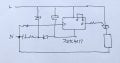 A little (9 components instead of 7), but accurate. It doesn’t need an output filter, and a phase fired dimmer would.