Voltage Booster

AnalogKid

Joined Aug 1, 2013
12,142
Well, that changes things. Tang Yew.

The schematic is hard do read, but that little bit of info is directional. Now I'm wondering if the original schematic is for a stepped-sine-wave type inverter rather than a high-frequency switcher. If so, then wouldn't a plain old 50-60 Hz power transformer hooked up "backwards" work. I've done that at a 10 W scale with an old Radio-Shack part.

OTOH - the schematic in post #1 is mostly a lift of the circuits in the UCC3808 datasheet. That implies a high-frequency switcher with a fixed output voltage.

The datasheet circuit is for 200 kHz. Based on that, this schematic is for around 360 kHz. And, the output is strange. Even though the secondary-side feedback circuit is standard for a DC-output supply, the output has very little filter capacitance and a strange extra pair of diodes. Hmmm ...

TS: What is it you are trying to design? What is the input? What are the output voltage (DC, RMS, etc.), max. load current, and intended load?

ak
 
Last edited:

Papabravo

Joined Feb 24, 2006
22,083
Well, that changes things. Tang Yew.

The schematic is hard do read, but that little bit of info is directional. Now I'm wondering if the original schematic is for a stepped-sine-wave type inverter rather than a high-frequency switcher. If so, then wouldn't a plain old 50-60 Hz power transformer hooked up "backwards" work. I've done that at a 10 W scale with an old Radio-Shack part.

OTOH - the schematic in post #1 is mostly a direct lift of the circuits in the UCC3808 datasheet. That implies a high-frequency switcher with a fixed output voltage. Hmmm ...

Really need a better schematic.

ak
What this suggests to me is a kind of magical thinking where circuit "A" which works for purpose "B" should(?)/could(?) also work for purpose "C" if only we were smart enough to work out the details. Never mind that "B" and "C" may be totally unrelated.
 

Ian0

Joined Aug 7, 2020
13,132
A 50Hz 50W transformer is only 65mm cube, so if "modified" sinewave will do, it's a SG3525 and a couple of TO220 MOSFETs.
 

Thread Starter

aliamin94ma

Joined Oct 25, 2020
17
Well, that changes things. Tang Yew.

The schematic is hard do read, but that little bit of info is directional. Now I'm wondering if the original schematic is for a stepped-sine-wave type inverter rather than a high-frequency switcher. If so, then wouldn't a plain old 50-60 Hz power transformer hooked up "backwards" work. I've done that at a 10 W scale with an old Radio-Shack part.

OTOH - the schematic in post #1 is mostly a lift of the circuits in the UCC3808 datasheet. That implies a high-frequency switcher with a fixed output voltage.

The datasheet circuit is for 200 kHz. Based on that, this schematic is for around 360 kHz. And, the output is strange. Even though the secondary-side feedback circuit is standard for a DC-output supply, the output has very little filter capacitance and a strange extra pair of diodes. Hmmm ...

TS: What is it you are trying to design? What is the input? What are the output voltage (DC, RMS, etc.), max. load current, and intended load?

ak
Well, that changes things. Tang Yew.

The schematic is hard do read, but that little bit of info is directional. Now I'm wondering if the original schematic is for a stepped-sine-wave type inverter rather than a high-frequency switcher. If so, then wouldn't a plain old 50-60 Hz power transformer hooked up "backwards" work. I've done that at a 10 W scale with an old Radio-Shack part.

OTOH - the schematic in post #1 is mostly a lift of the circuits in the UCC3808 datasheet. That implies a high-frequency switcher with a fixed output voltage.

The datasheet circuit is for 200 kHz. Based on that, this schematic is for around 360 kHz. And, the output is strange. Even though the secondary-side feedback circuit is standard for a DC-output supply, the output has very little filter capacitance and a strange extra pair of diodes. Hmmm ...

TS: What is it you are trying to design? What is the input? What are the output voltage (DC, RMS, etc.), max. load current, and intended load?

ak
i designed a circuit with ic ne555 to make 12v pulse (20khz) and i connected it to Iron Metal Core transformer and achieve 220v ac 50w , but there is 2 problem :
1)Iron metal core transformer is big for our purpose ( ferrite core which are using in inverters are smaller)
2)my require frequency is 50-60 Hz (now we have around 20khz)
now how can i solve size of transformer ? and reduce output frequency ?
 
Last edited:

Audioguru again

Joined Oct 21, 2019
6,826
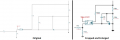
It is silly for the original schematic to have its parts spread so far apart making it as large as my city, causing the text to be tiny.
I cropped and enlarged a piece of it but the enlarging needed to be extreme and then the text is too blurry to be seen.
 

Attachments

AnalogKid

Joined Aug 1, 2013
12,142
So the desired output parameters are 220 Vac, 50 Hz, 230 mA.

1. What is load or device connected to the output?

2. Is a square wave output acceptable, or do you require a sine wave? Note that a sine wave output is a more complex design.

ak
 

Papabravo

Joined Feb 24, 2006
22,083
I've encountered numerous people over the years that passed off complete BS for actual work. More'n likely it was plagiarized from some source with a format that could not be adapted or modified.
 

Ian0

Joined Aug 7, 2020
13,132
i designed a circuit with ic ne555 to make 12v pulse (20khz) and i connected it to Iron Metal Core transformer and achieve 220v ac 50w , but there is 2 problem :
1)Iron metal core transformer is big for our purpose ( ferrite core which are using in inverters are smaller)
2)my require frequency is 50-60 Hz (now we have around 20khz)
now how can i solve size of transformer ? and reduce output frequency ?
A 50VA 50Hz toroid is 82mm diameter x 34mm high - the ER28 core you mentioned earlier is 32mm cube.
You can use the ER28 to step up to 340V DC at 50kHz or so, then you can use an H-bridge to turn the 340V DC into a sinewave, The sinewave will need filtering. The filter choke and capacitor will take up space.
Or you can use the toroid and a SG3525 as I mentioned earlier
Both version will take up about the same amount of space.
 

LesJones

Joined Jan 8, 2017
4,511
You need to use a totally different approach to achieve what you are trying to achieve within the size constraints.
Use the method used in modern 12 volt Dc to 240 volt inverters. This is a two step process. First step up the 12 volts to about 300 volts DC using a small transformer running at a high frequency. (Several hundreds of Khz.) Then use an H bridge to turn the 300 or so volts into a square wave. You can extend this idea using PWM to produce an output that is close to a sine wave. (The PWM switching is done at a much higher frequency than the output frequency and the duty cycle varied during each cycle of the output frequency.)
I think it will be cheaper to buy a ready made unit than to build one yourself.

Les.
 

Thread Starter

aliamin94ma

Joined Oct 25, 2020
17
So the desired output parameters are 220 Vac, 50 Hz, 230 mA.

1. What is load or device connected to the output?

2. Is a square wave output acceptable, or do you require a sine wave? Note that a sine wave output is a more complex design.

ak
Device is printer. sin wave is acceptable
 

Thread Starter

aliamin94ma

Joined Oct 25, 2020
17
th
A 50VA 50Hz toroid is 82mm diameter x 34mm high - the ER28 core you mentioned earlier is 32mm cube.
You can use the ER28 to step up to 340V DC at 50kHz or so, then you can use an H-bridge to turn the 340V DC into a sinewave, The sinewave will need filtering. The filter choke and capacitor will take up space.
Or you can use the toroid and a SG3525 as I mentioned earlier
Both version will take up about the same amount of space.
thank you, it was very useful
 

Thread Starter

aliamin94ma

Joined Oct 25, 2020
17
You need to use a totally different approach to achieve what you are trying to achieve within the size constraints.
Use the method used in modern 12 volt Dc to 240 volt inverters. This is a two step process. First step up the 12 volts to about 300 volts DC using a small transformer running at a high frequency. (Several hundreds of Khz.) Then use an H bridge to turn the 300 or so volts into a square wave. You can extend this idea using PWM to produce an output that is close to a sine wave. (The PWM switching is done at a much higher frequency than the output frequency and the duty cycle varied during each cycle of the output frequency.)
I think it will be cheaper to buy a ready made unit than to build one yourself.

Les.
thank you, it was very useful
 
Top