Wet your fingers... a little contact-lens saline solution will do the trick.... another technique would be to prick your fingers with the MM's probes... though that would be a little painful.
Isn't it wonderful how human nature can be nice! I just got help from lots of people that I doesn't even know, and that doesn't expect nothing in return!
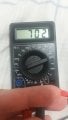
Your meter is set to measure a low resistance with its 200 ohms range. That is the maximum resistance on that range. But your skin is much higher. Holding my probes like you do I measure 31 million ohms when my hand is dry. Your meter can measure resistance no higher than 2 million (2000k) ohms.
Your meter is set to measure a low resistance with its 200 ohms range. That is the maximum resistance on that range. But your skin is much higher. Holding my probes like you do I measure 31 million ohms when my hand is dry. Your meter can measure resistance no higher than 2 million (2000k) ohms.
Thanks a lot! If I ever get my hands on a multimeter that has more sensibility, I will try to measure with my hands dry! =)
By the way... That's also one of the things that is measured in the polygraph test, isn't it? Along with breath ratio, pressure... ? I'm asking because I've found some sites that also claims that, somehow (I'm more of a skeptical about it) polygraph measurement in plants showed some funny results, like a galvanometer did "detected" when someone "desired" to harm a plant that were connected to a polygraph, I guess it's called a galvanometer...
Just like in this mythbuster episode:
Later in this episode they made other measurements and concluded that the needle moved due to lots of interference that happened in the room, like cellphones and stuff!
Please, in the show, what they are measuring is the same thing I'm measuring in the multimeter? I mean, when the needle spiked, if it was a digital multimeter, it would increase its value suddenly?
About languages - at least some 4 I have fluent or near that, more 6 I understand and can speak with many mistakes, and some other dozen I can read with help of translation engine or dictionary. So, I don`t know what means to be able for only one language. My opinion is that every man is so much worth as much languages he speaks (and mathematics ought be one of such languages ).
Just learn it! My greatest confession is that I hadn`t learned Spanish, as it opens at least a 25% of the World territory, English opens the 50-60%, russian at least 20%, and Chineese some 30% (mea culpa, together count more than 100% ).
If want to contact me privately, use the (Moderator's note: plesse do not post email addresses in public places. You can exchange email addresses in private messages on this site )
RE:""That's also one of the things that is measured in the polygraph test, isn't it?""
YES. But about polygraph experience, my father was one of first who was inquisited here with this thingy at early 70~ies. Then russian kgb was jabbing him into rat filled cell, and half slept pushed into highlight ray, forced electrodes and said - NOW we shall let all out of You and nothing You will be able to hide of us. Father said - may You show how it works? They said - okay, what to ask you? Father answered, ask me do I drink coffee or tea first at the morning. So they did and was incapable to detect what are lie. Because he drind AS coffe, AS tea, depending case to case.
I am finding this "skin resistance" measurement hard to believe using only two contact points.
Skin is a layer of material, similar in topology to a thin piece of metal but not as conductive. To measure the resistance of a piece of metal like that you need to define where you are measuring from with the two points, But better yet, you need to use a multi contact probe and measure the "resistance per square". That is the only meaningful measurement unless you have established measurement data from certain exact locations of the body.
As to the guy who said one of the only Russian words he knows is "vodka", didnt you mean "wodka"
I guess the people that work with it has the right spots to measure, standard devices and tables to compare findings... but again, I really dont understand it, I'm just curious! =)
I guess the people that work with it has the right spots to measure, standard devices and tables to compare findings... but again, I really dont understand it, I'm just curious! =)
Not all things are as they are said to be, but on the other hand not all things that are said to be untrue are really untrue either, so we sometimes have to see proof, proof of concept at least.
I'd have to see a set of readings and what they correlate to in order to believe that this is possible, and that goes double with just the two point measurement "method".
Keep in mind we are all able to do the two point measurements if we have a meter. Seeing how much they can vary with parameters that are very hard to control makes me skeptical right off from the start. I am always willing to listen to supporting arguments though.
The term I used was "4 terminal measurement of skin impedance". OK, why did I use that term? Familiar with the term "sheet resistance" which uses 4 probes. They eliminate the contact resistance of the probes. One method uses 4 probes in line with a specific spacing. Current flows on the outer contacts and and voltage is measured on the inner ones with a meter with an input impedance much greater than what your measuring. See: http://four-point-probes.com/four-point-probe-manual/
Another technique required 4 probes, two being voltage and two being current as before, but arbitrarily placed, usually at the edge of a thin fim.
Two reading or better yet, two sweeps, are taken and then the probes rotated. A function is then applied to get sheet resistance, See https://en.wikipedia.org/wiki/Van_der_Pauw_method
In both cases, you need thickness to get the actual resistance.
The term I used was "4 terminal measurement of skin impedance". OK, why did I use that term? Familiar with the term "sheet resistance" which uses 4 probes. They eliminate the contact resistance of the probes. One method uses 4 probes in line with a specific spacing. Current flows on the outer contacts and and voltage is measured on the inner ones with a meter with an input impedance much greater than what your measuring. See: http://four-point-probes.com/four-point-probe-manual/
Another technique required 4 probes, two being voltage and two being current as before, but arbitrarily placed, usually at the edge of a thin fim.
Two reading or better yet, two sweeps, are taken and then the probes rotated. A function is then applied to get sheet resistance, See https://en.wikipedia.org/wiki/Van_der_Pauw_method
In both cases, you need thickness to get the actual resistance.

 Facebook
 Google
 GitHub
 Linkedin





 ).
).