Using tunnel diodes to achieve infinite gain on a BJT amplifier

Thread Starter

Samantha Groves

Joined Nov 25, 2023
151
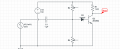
Suppose we have this circuit:

1743355718761.png

The ac equivalent small-signal model of a BJT is a resistance re' between the base and the emitter with a ac current source in series.We know that a tunnel diode can have negative AC resistance if biased properly by a DC source(in my circuit potentiometers R2 and R4),so we could end up with 0 AC resistance between base and emitter(since the negative AC resistance of the tunnel diode will "eat" re').But if we had 0 AC resistance between base emitter we could have infinite AC voltage gain!Is this possible?Thanks.
 

nsaspook

Joined Aug 27, 2009
16,250
Suppose we have this circuit:

View attachment 345671

The ac equivalent small-signal model of a BJT is a resistance re' between the base and the emitter with a ac current source in series.We know that a tunnel diode can have negative AC resistance if biased properly by a DC source(in my circuit potentiometers R2 and R4),so we could end up with 0 AC resistance between base and emitter(since the negative AC resistance of the tunnel diode will "eat" re').But if we had 0 AC resistance between base emitter we could have infinite AC voltage gain!Is this possible?Thanks.
No, you can't have infinite gain as that would create a microscopic black hole from the infinite energy density of the BJT amplifier warping spacetime. :eek:

Where are you getting these circuits from?
 

Ian0

Joined Aug 7, 2020
13,097
Suppose we have this circuit:

View attachment 345671

The ac equivalent small-signal model of a BJT is a resistance re' between the base and the emitter with a ac current source in series.We know that a tunnel diode can have negative AC resistance if biased properly by a DC source(in my circuit potentiometers R2 and R4),so we could end up with 0 AC resistance between base and emitter(since the negative AC resistance of the tunnel diode will "eat" re').But if we had 0 AC resistance between base emitter we could have infinite AC voltage gain!Is this possible?Thanks.
Infinite gain would mean that the transistor would be switched fully with no base current. So just use a piece of wire instead of the transistor - same effect.

BUT.. . . a bipolar transistor is a voltage controlled device, and you are talking about "current gain" i.e. hfe.
So your device could be controlled by a voltage without any current flowing from the base to the emitter - it has become a MOSFET.
 

Thread Starter

Samantha Groves

Joined Nov 25, 2023
151
Infinite gain would mean that the transistor would be switched fully with no base current. So just use a piece of wire instead of the transistor - same effect.

BUT.. . . a bipolar transistor is a voltage controlled device, and you are talking about "current gain" i.e. hfe.
So your device could be controlled by a voltage without any current flowing from the base to the emitter - it has become a MOSFET.
The (AC)voltage gain of a common emitter amplifier is -(R1||Rl)/input resistance of BJT.If input resistance of the BJT becomes 0 then gain becomes infinite.
 

Thread Starter

Samantha Groves

Joined Nov 25, 2023
151
Also I noticed that if we set the DC operating point of the diode so the AC negative resistance has bigger magnitude than the AC BE resistance you can have a common emitter amplifier with 0 phase difference between input and output.
 
It makes no sense to me.
When the input signal rises and reaches tunel diode peak the diode current (and base current also) starts to drop.
So the Ic of transistor is now decreasing.

So the tunel diode connected this way will decrease the gain.

For increasing the gain a diac characteristic is more suitable instead of tunel diode.

However diac is higher voltage device 30-40V and also would cause hysteresis since it need to be reversed to be closed.
 

ZCochran98

Joined Jul 24, 2018
351
Always remember...negative differential resistance is still positive ohmic resistance in these devices. You can only achieve simulated negative ohmic resistance with active devices (for instance: a ground-terminated "negative resistor" which is a resistor in parallel to an x2 amplifier), and then are limited, once again, to the restrictions of thermodynamics...and your power supply.
 

boostbuck

Joined Oct 5, 2017
1,033
Stepping back from your circuit and asking "Is infinite gain possible" should tell you that it isn't and your thinking is in error and you need to re-evaluate your presumptions.
 

nsaspook

Joined Aug 27, 2009
16,250
Always remember...negative differential resistance is still positive ohmic resistance in these devices. You can only achieve simulated negative ohmic resistance with active devices (for instance: a ground-terminated "negative resistor" which is a resistor in parallel to an x2 amplifier), and then are limited, once again, to the restrictions of thermodynamics...and your power supply.
You are such a downer man.
 
Top