Facebook
 Google
 GitHub
 Linkedin

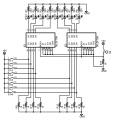
I am designing some digital circuits for a homeschool course in logic. One of these uses 2 74LS173 ICs to implement an 8-bit D flip flop register. The circuit is shown below:
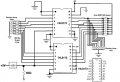 .
.
When I breadboarded the circuit, the second of the two 74LS173 chips was fried. Upon reflection, I hypothesize that hardwiring the two input enable pins (1 and 2) and the two output enable pins (9 and 10) on both chips to ground, thereby enabling both inputs and outputs on both chips and then connecting the two clock pins (7) together with the output of a momentary switch (and a 1K pull down resistor) is the problem.
If so, then one solution would be to use a DPDT momentary switch with separate connections to +5V and separate pull downs on each throw, connecting one throw to the upper chip and the other to the lower chip. The problem with that approach is it doesn't scale well. For example a 16-bit register would require a 4-pole/4-throw switch, something that isn't common. If I have analyzed the problem correctly, are there any other possible solutions that don't require the use of other ICs.
If I haven't analyzed the problem correctly, would someone suggest what the problem might be?
.When I breadboarded the circuit, the second of the two 74LS173 chips was fried. Upon reflection, I hypothesize that hardwiring the two input enable pins (1 and 2) and the two output enable pins (9 and 10) on both chips to ground, thereby enabling both inputs and outputs on both chips and then connecting the two clock pins (7) together with the output of a momentary switch (and a 1K pull down resistor) is the problem.
If so, then one solution would be to use a DPDT momentary switch with separate connections to +5V and separate pull downs on each throw, connecting one throw to the upper chip and the other to the lower chip. The problem with that approach is it doesn't scale well. For example a 16-bit register would require a 4-pole/4-throw switch, something that isn't common. If I have analyzed the problem correctly, are there any other possible solutions that don't require the use of other ICs.
If I haven't analyzed the problem correctly, would someone suggest what the problem might be?