Using Crosley 56TU as guitar amplifier

Thread Starter

Jsprite7660

Joined Jan 9, 2024
40
I've been turning radios into guitar amplifiers for a bit now with a simple 2 wire add on at the volume control potentiometer. I want to take it a step further now to get some more character out of the signal. On this Crosley 56TU, the center tap of the pot goes right to the grid of one of the output tubes and the signal is pretty bland.

I thought it'd be great to place the output of the guitar where the antenna feeds into the pre amp stages of this radio, but when putting the signal to the grid of the first tube I don't get any signal. I feel like this has to do with the variable capacitor and the oscillators that the radio uses to demodulate the signal from the carrier wave. Almost like I'm turning the guitar pickups into an antenna vs. them feeding a signal into the first tube as intended.

Am I on the right track by completely disconnecting the variable capacitor and oscillator coil from the circuit and then continue with feeding the guitar signal to the grid of the 14Q7 tube?

Here is a link to the radios schematic;
https://www.tubesandmore.com/sites/default/files/schematics/crosley_corp_56tu_pg17-1.png
 

MrChips

Joined Oct 2, 2009
34,828
No. You are on the wrong track. 14Q7 tube is an RF amplifier, oscillator, and mixer stage. In order for the signal to get past the 1st and 2nd IF transformers, the signal has to be AM RF at 455kHz.
 

Thread Starter

Jsprite7660

Joined Jan 9, 2024
40
Ok, so I would need to build an AM transmitter and connect the output directly to where the antenna was. Correct?

Can't the carrier wave be any Hz on the AM band? Like if I used a transmitter at 540kHz for example? And then just use the tuner to dial it in on the receiver?

Thanks
 

MrChips

Joined Oct 2, 2009
34,828
That would be like creating a "Rube Goldberg machine". What you need is a 1-transistor preamp for the guitar and then feed that to the volume control.
 

Thread Starter

Jsprite7660

Joined Jan 9, 2024
40
Ok thanks. I still want to send an AM signal of the guitar through that first tube tho. The whole fun for me is the challenge and experimentation.

I was just curious if, going into that first tube, the AM carrier wave signal had to be 455kHz or not.

From what I read tho, that first tube shifts the initial carrier wave(whatever radio station the antenna picks up) to the 455kHz IF, which is recognized by the 1st IF transformer.

Am I right?

Appreciate the feedback.
 

MrChips

Joined Oct 2, 2009
34,828
Here is how a superheterodyne radio receiver works (superhet for short).

The AM RF signal has a carrier frequency A Hz.
The local oscillator is tuned to a frequency B Hz.
The RF mixer results in two RF signals at the sum frequency (A+B) Hz and the difference frequency (A-B) or (B-A) Hz.
The IF amplifier is tuned to one of the two RF signals (455kHz in this example).

Let us take an example. Let us suppose that the incoming AM RF signal has a 1000kHz carrier.
A local oscillator tuned to 1455kHz would produce both 2455kHz (sum) and 455kHz (difference). The IF transformer selects only the 455kHz

(Also, a local oscillator tuned to 545kHz would produce both 1545kHz (sum) and 455kHz (difference). This is an option for the radio designer. In some cases it better for the local oscillator to be below the carrier frequency. Other times it is preferable to be above.)

In short, if you want to experiment with radio, you can build or buy a simple AM radio transmitter circuit.
 

LadySpark

Joined Feb 7, 2024
194
Ok thanks. I still want to send an AM signal of the guitar through that first tube tho. The whole fun for me is the challenge and experimentation.

I was just curious if, going into that first tube, the AM carrier wave signal had to be 455kHz or not.

From what I read tho, that first tube shifts the initial carrier wave(whatever radio station the antenna picks up) to the 455kHz IF, which is recognized by the 1st IF transformer.

Am I right?

Appreciate the feedback.
The front end is made for the AM Band.
But if you want to know my feelings about it. this isn't a safe circuit to use for a guitar amp. because the AC line ground instead of transformer isolated. So there is a 50/50 chance you get electrocuted depending the direction the non polarized plug is plugged in.
 

Audioguru again

Joined Oct 21, 2019
6,826
Most of us could hear frequencies as high as 20kHz before we became 25 years old.
AM radios produce no audio frequencies higher than about 3kHz and probably the same with their amplifier.
Then the guitar sounds will be muffled and sound bad like an old wired telephone.
 

LadySpark

Joined Feb 7, 2024
194
Most of us could hear frequencies as high as 20kHz before we became 25 years old.
AM radios produce no audio frequencies higher than about 3kHz and probably the same with their amplifier.
Then the guitar sounds will be muffled and sound bad like an old wired telephone.
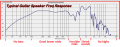
Guitar amps normally don't have that much bandwith beyond 5K and most of the speakers start their high roll off at around 3K. That is why some high fidelity modifications are not as pronounced like they are on high bandwidth high fidelity amps. But the one capacitor from plate to cathode on the output tube should be removed for full bandwidth operation.
If they really wanted to use the whole thing, the easiest way is to remove the primary of the osc coil out of circuit and the tuning cap, go in the 1 tube's grid with a 68K resistor and go across the IF transformers from plate to the grid of the next tube with a .1 uf @250V cap.

But I wouldn't try to do this with the type of power supply this has to begin with.
 

LadySpark

Joined Feb 7, 2024
194
I like the sounds of an acoustic guitar played live or played on a hifi so it sounds live.
I dislike the severe distortion and muffled highs produced by most electric guitar sound systems.
to each there own tastes in music, but its not really a safe circuit to land its ground on every metal piece on a guitar.
 
Top