Using a horn speaker as a microphone

MisterBill2

Joined Jan 23, 2018
27,600
Unless the pre-amplifier is designed to have an 8 ohm input impedance it will require a matching transformer. And I very much doubt that an arduino input is a sensitive low impedance input.
 

LowQCab

Joined Nov 6, 2012
5,101
An Instrumentation-Amplifier will completely eliminate any need for Impedance-Matching,
and eliminate any external Electrical-Noise-Pick-up in the Wiring at the same time.
( an INA may also be referred to as a "Balanced-Line-Receiver" )

Exactly the same as for any standard, generic, Low-Impedance-Microphone.
You can even use cheap "Lamp-Cord", ( Zip-Cord ), ( Speaker-Wire ), to wire it, with zero-problems.
Twisting the pair is always an extra-bonus,
but not required when used outside, and for very moderate distances, as employed in this application.
No Frequencies above ~2KHz are needed, so they may be filtered-out.
.
.
.
 

sghioto

Joined Dec 31, 2017
8,634
Unless the pre-amplifier is designed to have an 8 ohm input impedance it will require a matching transformer
Not true.
A transformer can be used and has the added benefit of additional gain but is not necessarily needed.
The input impedance of the preamp should normally be at least 10 times the source impedance for maximum voltage transfer.
 

MisterBill2

Joined Jan 23, 2018
27,600
Given the power handling capability of even a low-power speaker, the voice coil is able to deliver more current than a standard dynamic microphone. Thus the suggestion of a transformer to increase the voltage a bit. Certainly a well balanced input of an I.A. will reduce the noise effect of picked up noise. BUT it needs to be an IA with adequate frequency response. AND, for the greatest benefit, neither side of the mic tied to common. Keep the input balanced.
 

LowQCab

Joined Nov 6, 2012
5,101
Any Amplification above ~2kHz, or below ~200Hz, is actually undesirable in this application.

In any case, a cheap Folded-PA-Horn with a Phenolic-Diaphragm, ( the most common material used ),
can not physically reproduce Frequencies much above ~5kHz, even if it's very life depended on it.
So high-Frequency-Response is a moot-point in this project.

"Instrumentation-Amplifier" is a "multiple Op-Amp Circuit-arrangement", not a set of typical-Specifications.
Almost any Op-Amp can be used in an "Instrumentation-Amplifier" configuration.
Of course some "Purpose-Designed-Chips" are better suited to achieving certain Specifications when in use.
Some Specifications may be more desirable than others,
depending upon what type of performance is to be expected from the Circuit.

Used with little or no Gain, offset-Voltages don't amount to much.
Extensive interstage-Filtering zero's out the remnants of any odd Offset-Voltages.
.
.
.
 

Thread Starter

MrCodeUK

Joined Jul 8, 2024
7
You mentioned in post #1 that the LM386 circuit worked well, do you have a schematic of that circuit?
Curious what level of gain was used with that lapel microphone.
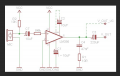
Sure, here's the schematic of what i'm using with the lapel. I added the 100k resistor to pin 3 as the microphone was too sensitive.

circuit.png
 

sghioto

Joined Dec 31, 2017
8,634
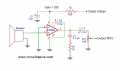
Without C2 the gain is only 20. Adding C2 will increase the gain to a max of 200. Other gain levels can be achieved by adding a resistor in series with C2.
With the horn speaker you can remove C7 and the 100K resistor.
1720901940482.png
 
Last edited:

Thread Starter

MrCodeUK

Joined Jul 8, 2024
7
Without C2 the gain is only 20. Adding C2 will increase the gain to a max of 200. Other gain levels can be achieved by adding a resistor in series with C2.
With the horn speaker you can remove C7 and the 100K resistor.
Thanks so much i'll give that a try!
 

MisterBill2

Joined Jan 23, 2018
27,600
That circuit in post#30 will probably deliver a fair amount of distortion because when the speaker output goes negative the amplifier will not be able to follow. so a series capacitor and two resistors to bias the non-inverting input a bit positive is in order. probably 100K to V+ and 10K to the common will be adequate.
 

sghioto

Joined Dec 31, 2017
8,634
That circuit in post#30 will probably deliver a fair amount of distortion because when the speaker output goes negative the amplifier will not be able to follow. so a series capacitor and two resistors to bias the non-inverting input a bit positive is in order. probably 100K to V+ and 10K to the common will be adequate.
Totally incorrect!
The circuit functions fine as shown, I have personally breadboarded it myself.
The output stage of the amp is auto biased at 1/2 supply voltage.
Any positive bias added to the + input will shut the output down like a mute switch.
A capacitor is only required on the input if the source has any DC offset as if using an electret microphone.
 
Last edited:

Thread Starter

MrCodeUK

Joined Jul 8, 2024
7
Totally incorrect!
The circuit functions fine as shown, I have personally breadboarded it myself.
The output stage of the amp is auto biased at 1/2 supply voltage.
Any positive bias added to the + input will shut the output down like a mute switch.
A capacitor is only required on the input if the source has any DC offset as if using an electret microphone.
This is actually perfect for my needs having just tested it. I can fine tune the trigger threshold in code so it performs really well. Thank you for taking the time to help, and to everyone else for commenting. It was quite humbling to read everyone's replies. There's some very clever people here for sure.

Thanks again all
 

MisterBill2

Joined Jan 23, 2018
27,600
This is actually perfect for my needs having just tested it. I can fine tune the trigger threshold in code so it performs really well. Thank you for taking the time to help, and to everyone else for commenting. It was quite humbling to read everyone's replies. There's some very clever people here for sure.

Thanks again all
OK, and it seems that any harmonic distortion caused by the input going below the negative supply voltage does not bother the digital system trigger function. That is entirely reasonable.
 
Top