Using a horn speaker as a microphone

Thread Starter

MrCodeUK

Joined Jul 8, 2024
7
Hello all
Previously I have made a remote control for clay target shooting which a lapel microphone plugs into, utilising an LM386 audio amplifier. It works really well, with the amplifiers output mapped to an analogue arduino pin. if the signal is above the threshold, then transmit to the receiver.

I would like to take this a step further now, and have some floor standing microphones. the professional companies use horn speakers as directional microphones such as the attached picture. Of course this would be a terrible microphone in general, but they're very effective for just detecting a sound to be used in the same manner as my example above.

The question as you have probably already worked out, is that I don't know how to do it. Optimistically I connected the horn to my LM386 circuit but to no avail. I assume because the signal is too weak. I did buy an oscilloscope incase that would prove handy, but i confess I have not learned how to use it.

Could anyone be so kind as to give me some pointers on how I could achieve this?

TLDR: I am looking to connect the audio signal from a horn speaker to an analogue input of an arduino so I can trigger an event if the noise is over a threshold.

Thank you in advance for any help you can give.
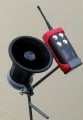
unnamed.jpg
 

LowQCab

Joined Nov 6, 2012
5,101
In any case, You will require severely limiting the Frequency-Response of the required Pre-Amplifier,
because the Ambient-Noise-Level is going to be a serious consideration.
Then You will need to insure that the Pre-Amp-Output is "Hard-Clipped",
this is to avoid pushing too much Voltage into your MC's Input and destroying it.
The Pre-Amp may need as much as ~200X Amplification,
which can easily be handled by any modern Dual-Op-Amp Package.

Accidents can be VERY expensive and painful.

I think a cheap PA-Speaker sitting on the ground is just asking for endless swear-words and frustrations.

Regardless of how the end result is accomplished,
having the Microphone as close as practical to your Mouth is going to be a massive bonus.

You don't need a Micro-Controller to accomplish any of this,
But, You DO NEED a Manual-Safety-Switch,
such as a Manual-Foot-Switch on the ground, to Arm the Clay-throwing-device.

Personally, I would wear a Wireless-Lapel-Mic, it will be much less problematic.

Without a Schematic-Diagram showing how the Throwing-Device is Electrically-Triggered,
there's not much else that can be offered.
.
.
.
 

MisterBill2

Joined Jan 23, 2018
27,172
I have rather successfully used a 25 watt rated horn speaker as a microphone in an air-based distance measuring system. I experimented with a hybrid scheme like a phone system with the transmitted signal cancelling out at the receive port. What ultimately worked was non-linear elements (diodes) where the transmit signal exceeded the diode turn-on voltage and reached the speaker coil to deliver an audio output. Then when not transmitting the sensitive amplifier was not saturated and could receive the weak return echo signal. It was rather crude and not efficient but it worked well 60 years ago. all tube electronics, by the way.
Really, a horn speaker makes a reasonable microphone, but with a peaked frequency response curve.
 

Lightium

Joined Jun 6, 2012
320
I'll bet the impedance for the horn is low, so a common-base amplifier would do before the lm386.
 
Last edited:

MisterBill2

Joined Jan 23, 2018
27,172
Many trumpet type (horn) speakers are indeed low impedance usually 8 ohms. When not used in arrays they will also serve very well as intercom quality microphones, usually having a much higher output voltage than more common microphone types. Horn speakers do have advantages, in that they are quite rugged and accept speech from a greater distance.
 

Audioguru again

Joined Oct 21, 2019
6,826
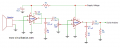
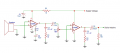
In post #9, the left LM386 has a high gain of 200 times (!) because of C2. The right LM386 has a gain of 20 times then the total maximum gain is 4000 which is WAY too much and will produce lots of hiss because an LM386 is not low noise.
 

sghioto

Joined Dec 31, 2017
8,633
I'll concede the gain is probably too high. The value of R1 determines the gain. In this version with R1 at 1K the total gain is a little over 1000.
1720568811056.png
 

MisterBill2

Joined Jan 23, 2018
27,172
I am wondering why select a small noisy audio power amplifier as a microphone amp?? The PA horn is a good enough mic that you can just use a step-up transformer for a bit of free voltage gain.
 

sghioto

Joined Dec 31, 2017
8,633
I am wondering why select a small noisy audio power amplifier as a microphone amp?? The PA horn is a good enough mic that you can just use a step-up transformer for a bit of free voltage gain.
I have used the LM386 as a preamp for an intercom system and it worked just fine. I suggested using two LM386s since the TS is already familiar with them.
 

LowQCab

Joined Nov 6, 2012
5,101
There is no "simple", down & dirty "hack" that is going to provide satisfactory and reliable performance.

This project must have all aspects "tuned" to do exactly one thing, and do it every time, without fail.

I realize that this project is a "what if I could do it myself" proposition, like many projects here.
Maybe it will take a pile of mistakes before frustration sets-in, or,
it's finally realized that this project is not all that simple.

Is it wanted bad enough to, "bite-the-bullet", and commit to doing it right the first time ?,
that is, so it will actually work, and be of some value as a reliable-tool ?

These Forums can sometimes, unfortunately, devolve in to simply
a place to go to shoot-the-breeze about Electronic-Stuff.

I'm willing to design a no-compromise-system that works every time,
but I'm not really all that interested in swapping "what-if" stories around the Coffee-Machine in the Break-Room.
Any observations of any mistakes, or possible improvements, are obviously always welcomed.

This doesn't mean that I have the only workable-solution, far from it,
but if a finished-workable-solution is desired, I'm willing to provide one.

This starts with a show of interest from the Thread-Starter,
and then formulating a list of wanted, and/or, not-wanted, specifications.

I'll be looking for a show of interest from the TS.
.
.
.
 
Last edited:

Thread Starter

MrCodeUK

Joined Jul 8, 2024
7
All,
Thank you for taking the time with your comments, it's appreciated and certainly gives me plenty to ponder and experiment with.

LowQCab, While I understand your viewpoints, they seem either biased due to your previous encounters with others, or presumptuous at best. Over the past few years I've invested a lot of time and money designing remote controls with so much success it's formed a successful small business. I currently have around 30 models. Unfortunately my strengths are greater in coding, than they are in electronics - though I do my best. Taking a weak signal and polishing it so that it is acceptable to be used on a GPIO is more than I've tackled thus far .. hence the reach out for a little guidance which others have gladly offered.

Kind Regards
Brad
 

MisterBill2

Joined Jan 23, 2018
27,172
OK, now we see what is needed, which are the definitions: Taking a "weak signal "and polishing it so that it is " acceptable to be used on a GPIO". How weak?? "acceptable to be used on a GPIO". Once those can be defined then a solution can be designed. At least that is the usual practice. Creating a design for defined requirements is usually possible.
 

Thread Starter

MrCodeUK

Joined Jul 8, 2024
7
OK, now we see what is needed, which are the definitions: Taking a "weak signal "and polishing it so that it is " acceptable to be used on a GPIO". How weak?? "acceptable to be used on a GPIO". Once those can be defined then a solution can be designed. At least that is the usual practice. Creating a design for defined requirements is usually possible.
That's the issue, I don't know how weak it is, I just know it's going to be a lot weaker than the electret lapel microphone I have been using. Currently it's not even registering a 1 on the mapped input, though I do see movement on the oscilloscope, but unfortunately the information doesn't mean too much to me if i'm being honest. others have suggested some pre-amplifiers above. i'll do a little prototyping with those first before taking anyone elses time to see if I can get at least in the right ball park. Once I'm there, I can look at cleaning it up.
 

LowQCab

Joined Nov 6, 2012
5,101
"" Taking a weak signal and polishing it so that it is acceptable to be used on a GPIO ""

That is the main item that I was offering.

Is this proposed to be a personal-project, or a commercially-marketed project ?

If You don't want to use a Wireless-Lapel-Mic, You are making things way more difficult.
You are not just dealing with a low Signal-Level,
You will now be dealing with a massively increased Background-Noise-Level.
The "Signal-to-Noise-Ratio", ( SNR ), is something that should be maximized at almost any cost.
Which is best accomplished by a Microphone as close as possible to the Shooters Mouth.

Then there is proper Filtering, You don't want any sounds that
are not related to, or associated with, the various sounds of the word "Pull".
Including Male and Female examples.
Everything else should be cut-out hard.

Your Ears, along with your Brain, naturally "process-out", or ignore, the background Noise.
You may not think these things amount to much until You see them on an Oscilloscope-Display,
which is exactly what the Circuit will be attempting to process.

These ends are not easily achieved with a Micro-Processor, ( it is "possible", just very complex ),
and are much more easily accomplished with Analog-Circuitry.

No Micro-Controller is need to accomplish this task.

Using a Folded-PA-Horn could be a blessing, or a curse,
depending upon the specific-Frequency-Response-characteristics of the Horn chosen.
.
.
.
 

sghioto

Joined Dec 31, 2017
8,633
others have suggested some pre-amplifiers above. i'll do a little prototyping with those first
You mentioned in post #1 that the LM386 circuit worked well, do you have a schematic of that circuit?
Curious what level of gain was used with that lapel microphone.
 

MisterBill2

Joined Jan 23, 2018
27,172
Of course the input of an ardino is not intended to work with a low impedance (8 ohms) microphone. So you will need an impedance matching transformer, which will also increase the voltage.
HOWEVER, I have consulted with an audio expert on the problem of those who will not raise their voices.
So the problem is undoubtedly that the sound level is not adequate, it may also be that the aiming is not correct. Some of those horn speakers are quite directional. And that one in the photo does not look close to those that I am familiar with. The aspect ratio is wrong, and it is too small.
 
Last edited:
Top