Using a 12V 1.2amp adapter for a 12V 1.5amp max load

Thread Starter

Harrygrower

Joined Jun 17, 2014
14
Hi all,

I have a netgear 4 socket router (WNF R3300) rated at 12V , 1.5 amp. I am only using a maximum of two ethernet cables, and generally only one, as the router is also wireless. The only power adapter I have is rated at 12V, 1.2 Amps. This does power the router and it seems to work OK. Can you advise if I can use this and what if any risks are involved especially regarding any damage to either the router or the adapter.

Many thanks
 

ScottWang

Joined Aug 23, 2012
7,500
Normally it won't damage the router or adapter, it just can't be works properly, if you can maybe you can measure the real draw current of router, since the current less than 1.2A and you can compare the draw current with 1.2A and then to decide how bad is it.
 

Thread Starter

Harrygrower

Joined Jun 17, 2014
14
Normally it won't damage the router or adapter, it just can't be works properly, if you can maybe you can measure the real draw current of router, since the current less than 1.2A and you can compare the draw current with 1.2A and then to decide how bad is it.
Thank you for this fast repsones. I am ( as you can see) not too up on this, so would this just be a case of putting a multimeter in series with the supply?

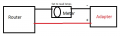
Router amp measurement_Harrygrower.png

Also does in make any difference if this is on the live or neutral side? I am attaching a very primitive layout, and would be grateful if you could confirm that is is OK

Thanks
 

dl324

Joined Mar 30, 2015
18,308
I have a netgear 4 socket router (WNF R3300) rated at 12V , 1.5 amp. I am only using a maximum of two ethernet cables, and generally only one, as the router is also wireless. The only power adapter I have is rated at 12V, 1.2 Amps. This does power the router and it seems to work OK.
It's not worth even bothering to consider this; the manufacturer knows more than you. Trust them and just get an appropriate power adapter.
 

ebp

Joined Feb 8, 2018
2,332
If you are only using two ports you are probably OK. There is a risk of damaging the power supply due to overcurrent. Most small supplies like that do not limit current or limit it very crudely and it is possible to cause damage if you overload them.

Most modern routers and switches manage power very well and reduce their power requirement when there are unused ports and even when the ports are used but can operate reliably with reduced signal power. If you were to use all ports at high speed on long lines and use the wireless at maximum power simultaneously, you probably would overload the power supply.
 

ScottWang

Joined Aug 23, 2012
7,500
Thank you for this fast repsones. I am ( as you can see) not too up on this, so would this just be a case of putting a multimeter in series with the supply?
Normally I will measure it on the positive line, the left side of meter will be the positive pin in your block diagram, if you can't measure the current directly then maybe you will need to use other connector or jack.

Also does in make any difference if this is on the live or neutral side? I am attaching a very primitive layout, and would be grateful if you could confirm that is is OK
On the ac side then the draw current will be including the adaptor itself.
 

Thread Starter

Harrygrower

Joined Jun 17, 2014
14
Thanks to all for these responses.

Dennis you are right in terms of getting the 'correct' adapter. There are however two reasons for wanting to use this one. Firstly, it is a Netgear adapter, but may be from another router. But secondly, it will give me an opportunity to try and get my head around the concept of Amps, and how they are depedent on the load, as opposed to Volts which is dermined by the supply (I think !)

Thanks ScottWang. I will change the position of the meter and see what readings I get. Hopefully this will be in the safe range and I can go ahead.
 

dl324

Joined Mar 30, 2015
18,308
I will change the position of the meter and see what readings I get. Hopefully this will be in the safe range and I can go ahead.
You're not going to get an accurate reading that way. The meter has resistance and will drop the voltage getting to the router. You'll get a more accurate reading by inserting a low resistance in series (e.g. 0.1 ohms) and measure the voltage drop across the resistor.
 

ebp

Joined Feb 8, 2018
2,332
If the voltage to the router drops, the current will go up. The router will have an internal switch mode regulator which has a negative resistance input characteristic.

The high current range (separate jack) on most DMMs has very low voltage burden.
 

MrChips

Joined Oct 2, 2009
34,758
Manufacturers will often be on the conservative side and provide a margin of error.
If your router runs without failure for a week then don't lose sleep over it.
 

Reloadron

Joined Jan 15, 2015
7,882
Your router typically draws about 200 mA. It used a 12 VDC wall wort with the center pin positive (+). The router will only draw from the source the power it needs so using a 12 VDC 1.5 Amp supply is just fine. While p[ower consumption at idle is minimal even using all four ports is not likely to draw over 250 mA. I have a Linksys wrt 54 which is a similar router sitting here and on boot it draws about 250 mA and normally running right about 240 mA.

Ron
 

GetDeviceInfo

Joined Jun 7, 2009
2,271
Two things you can do, measure the dc voltage, and feel the converter to see how warm it is. If you are overdrawing it, the output voltage will fall, and it will heat up.
 
Top